Status Reshare: The WhatsApp New Feature Accelerating Misinformation Among Nigerians


By Abdullateef Sebiotimo
On Saturday, May 23, 2026, panic gripped the southwestern region of Nigeria. What was seen in various WhatsApp group chats and statuses were screenshots and voice notes, warning residents to stay indoors before 9PM or risk falling victim to a “sacrificial wind” allegedly connected to the general election. In the voice note, people were urged to share as widely as possible to save their loved one. With so much urgency, the warnings travelled.

Screenshot of Viral False claim
Eyewitnesses reported that across various locations, traders shut their shops earlier than usual and commuters hurried home, causing panic. What started as an unverified message in a group chat, within hours, evolved into a cause of panic.
Responding to the situation the following day, in Oyo state, one of the southwestern states, the Police Command issued a statement assuring residents that there was no security threat warranting panic or curfew. The Ogun State Police Command would also follow suit as seen here. Unfortunately, the misinformation had already completed its journey and caused confusion and panic.
This incident was yet another example of how misinformation is now finding a new life and evolving on WhatsApp through the culture of instant resharing, especially with “Status Reshare”, a new feature on the messaging app.
When Falsehoods Become Viral Warnings
On May 22, 2026, Senator Natasha Akpoti-Uduaghan took to her social media accounts to share images allegedly depicting schoolchildren abducted from Ahoro Esinele community in Oriire district of Oyo State.
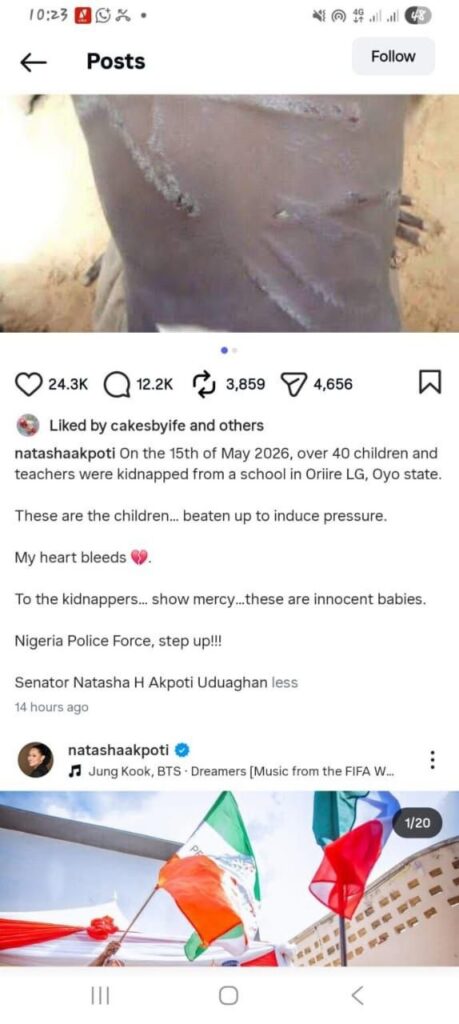
Screenshot of False claim from Senator Natasha
The images showed children with visible marks and injuries on their backs, suggesting that they have received severe physical torture. In her caption, the senator wrote:
“On the 15th of May, 2026, over 40 children and teachers were kidnapped from a school in Oriire LG, Oyo state. These are the children… beaten up to induce pressure. My heart bleeds. To the kidnappers… show mercy… these are innocent babies. Nigeria Police Force, step up!!!”
The post quickly gained traction, attracting thousands of interactions across Facebook and Instagram. But a reverse image search conducted by FactCheckAfrica revealed that the images predated the incident by several years.
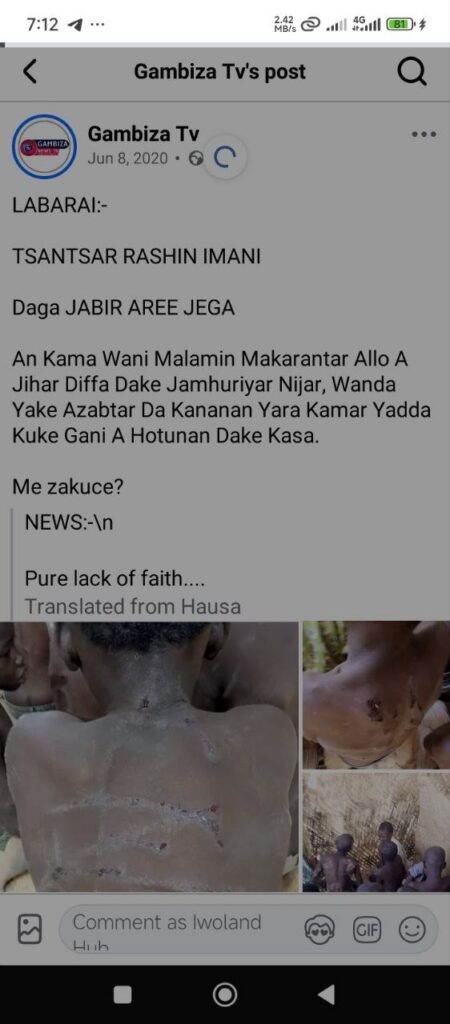
Screenshot of false claim on Children torture
The photographs had appeared online as far back as six years earlier when a Facebook page known as Gambiza TV shared them alongside a caption in Hausa-language, claiming that a teacher in Diffa State, Niger Republic, had tortured pupils. Although the original context itself could not be independently verified, the existence of the images online for over 2,000 days before Senator Natasha’s post confirmed that they were being reused out of context.
The senator would later acknowledge the mistake and replace the images on her post. However, days after her correction and acknowledgement, the correction struggled to travel as widely as the original claim as the pictures still continue to trend.
On WhatsApp, the fate of the images took another fate as users reposted the pictures on statuses with captions condemning the alleged treatment of the abducted children. Some explicitly encouraged others to amplify the posts further.
One caption read:
“To you all that always reshare my memes, I want you all to use that energy to repost this…”

The misinformation moved from an ordinary post to one that went viral and charged with emotions.
The Rise of WhatsApp Status Reshare Ecosystem
Earlier in 2025, WhatsApp began testing and expanding its “Status Reshare” feature. The feature allowed users to repost another person’s status directly to their own contacts.
Previously, for one to reshare a WhatsApp status, one would need to screenshot or save the post using external apps. This small layer of friction between seeing a status and resharing slowed virality. With the new feature, a single post can now find its way into multiple networks within minutes.
Considering the fact that WhatsApp statuses can only be viewed by people who have one’s contact, meaning there is a level of trust to some extent, the feature improves communication and social interaction, while in practice, however, a new pathway for misinformation to spread rapidly within trusted personal networks has been created.
Unlike public platforms such as Facebook or X where shares and engagements on a post can be tracked, WhatsApp operates largely within encrypted private spaces. Once a misleading screenshot, image, or voice note enters this ecosystem, tracing its movement becomes almost impossible.
With this absence of visible public timelines to track resharing patterns, no accessible moderation systems, and often no effective way for corrections to reach the same audience that consumed the original falsehood, false information travels faster with very low chance of making corrections to them.
The Natasha case was not isolated as in October 2025, a young woman on X accused an InDrive driver, James Oluwatosin, of conspiring with a gang to rob her. Attached to her post was a screenshot showing the driver’s profile, photograph, and vehicle details.
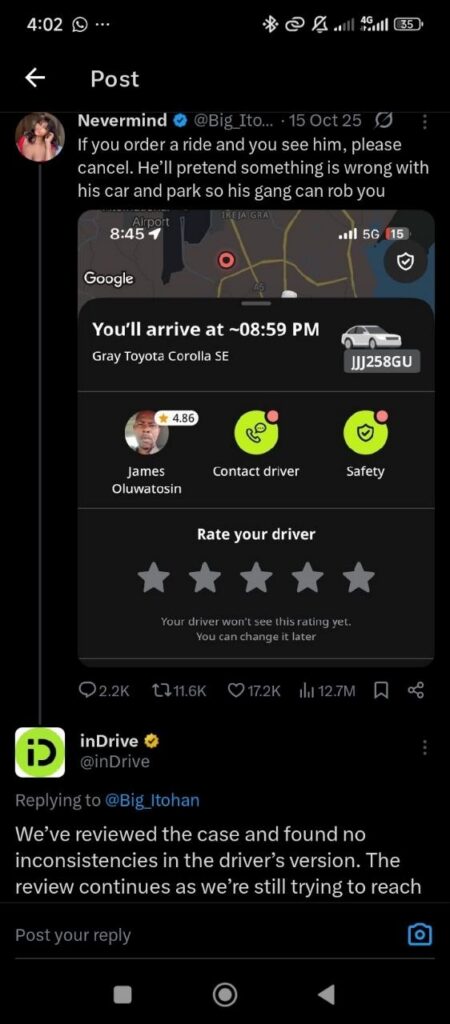
Screenshot of Viral claim on Uber Driver
As the post migrated from X to WhatsApp, users reshared it with captions warning others to avoid the driver. The screenshot spread rapidly across statuses and group chats, transforming from an allegation into what many perceived as an established fact.
But FactCheckAfrica found out that the following day, the driver had denied the accusation as seen here, He explained that his car had genuinely developed a fault under a bridge in Lagos where local touts demanded money. According to his account, the passenger herself negotiated with the touts before transferring ₦8,000 to resolve the situation.
Later, the InDrive team reportedly found no evidence supporting claims of collusion or attempted robbery. The Lagos State Police Command also confirmed that they are aware of the case and invited both parties for questioning.
Unfortunately, the clarification struggled to catch up with the screenshot already circulating across WhatsApp as many users only encountered the reshared warning and not the rebuttal.
These incidents on WhatsApp further cement one of misinformation’s most enduring characteristics of corrections not travelling as far as the false narratives.
Patterns of Fake Product Scares on WhatsApp
The same resharing pattern has been noticed not only in emotionally charged falsehoods but also in consumer-related misinformation.
In separate viral WhatsApp posts, users circulated side-by-side images of Hollandia yoghurt packaging, claiming one was “fake” while the other was “original.” Similar claims later emerged concerning Lonart antimalarial medication, where a white package was labelled counterfeit and a yellow package described as authentic.
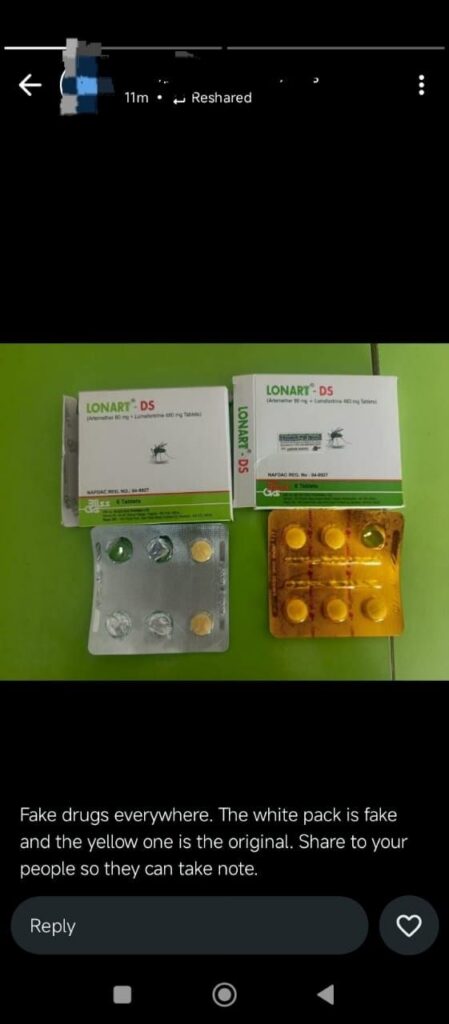
Screenshot of ‘fake’ drug claim
The claims spread rapidly across statuses and group chats, often accompanied by urgent warnings encouraging users to “share to save lives.”
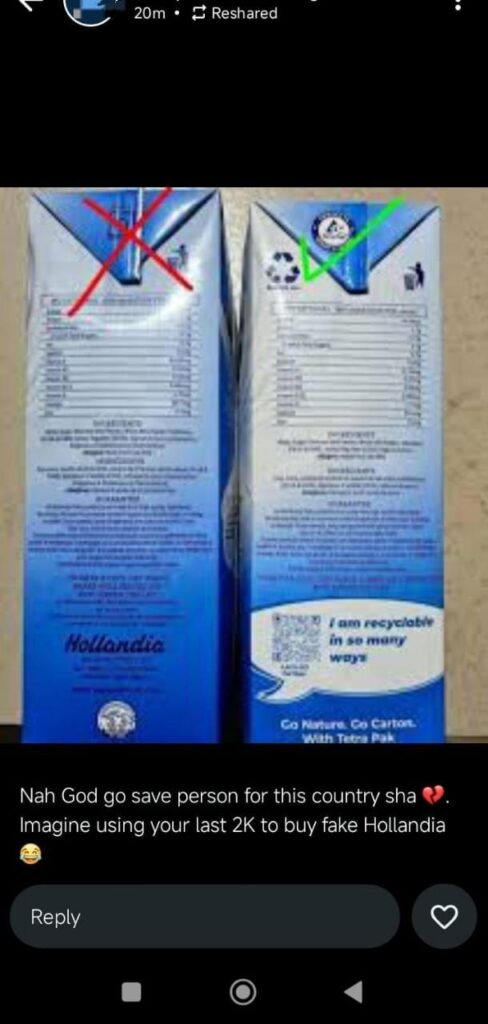
Screenshot of viral fake Hollandia claim
However, FactCheckAfrica later gathered that Chivita-Hollandia and Greenlife Pharmaceutical, manufacturers of the two products later clarified that the different packages were legitimate product variations as seen here and here.

By the time the clarifications emerged, the misleading claims had already shaped public perception. Many users who encountered the original warnings never saw the corrections. In closed digital environments like WhatsApp, misinformation often lingers long even when it has already been debunked.
Why People Share Without Verifying on WhatsApp
The spread of misinformation on WhatsApp is rarely driven solely by malice or the intention to do so. More often, it is fueled by fear, urgency, empathy, and the trust in the person that posted.
A warning received from a family member, classmate, religious leader, or close friend often carries emotional credibility before factual credibility is even considered. Users resharing posts about kidnappings, dangerous products, or security threats frequently believe they are protecting their friends or relatives viewing their status rather than spreading falsehoods.
But the architecture of instant resharing compresses the distance between seeing and spreading. Where sharing once required screenshots or manual reposting, the reshare feature now encourages impulsive amplification. The faster content moves, the less likely users are to pause for verification before resharing.
This becomes especially dangerous during periods of insecurity, political tension, or public anxiety when emotionally charged claims gain traction more easily.
The Correction Gap
One of the biggest challenges in combating misinformation on WhatsApp is what researchers often describe as the “correction gap”. Correction gap is the imbalance between the reach of false claims and the visibility of later corrections.
A sensational screenshot may be reshared hundreds of times within hours. But when the claim is debunked, only a fraction of the original audience encounters the updated information.
While people can delete their status and it will disappear, it will not go off the status of anyone who reshared. No source attribution on posts as usually seen on other social media like Facebook, Instagram or X also complicates the situation further.
Also in many cases, misinformation does not need to remain online permanently to continue influencing public perception. Once it is embedded in collective memory, the damage becomes difficult to reverse.
For individuals that are accused falsely online, the consequences can extend beyond embarrassment to reputational harm, economic losses, psychological distress and more.
The Responsibility of Platforms and Users
WhatsApp has previously introduced measures such as message forwarding limits and labels identifying heavily forwarded messages in an attempt to slow misinformation.
However, the rise of Status Reshare introduces new challenges. While the feature also labels heavily reshared statuses, critics still argue that the feature lowers the barrier between exposure and redistribution, allowing unverified content to gain legitimacy through repetition.
Digital literacy experts argue that users must begin to treat verification as a civic responsibility rather than an optional step. A pause before resharing to ask whether a claim has been independently verified, whether the accused has responded, or whether the images are authentic could prevent serious harm.
In an interview with FactCheckAfrica, Olarinde Sodeeq, a digital product designer explained that while the new feature offers users the opportunity to share status without having the content on their phone, thereby making resharing easier, it is important that the platform also bring forward features that can help prevent misinformation.
“WhatsApp can try leveraging on Artificial Intelligence to label some posts as doubtful and prompt people to verify before resharing or even flag posts as false, as available on X,” he said.
When Repetition Becomes Truth
Gone are those days when the misinformation problem in Nigeria confined only to fake websites, anonymous trolls, or coordinated propaganda campaigns. Falsehood spread is now on the rise through people acting out of fear, concern or empathy and aided by technology that aims to make information sharing easy. And in a digital ecosystem where misinformation travels faster than corrections to them, the question is no longer only what people can share but what they should share.