As conversations around fact-checking deepened on the second day of the Africa Facts Summit 2025 in Dakar, Senegal, the themes resonated closely with initiatives already underway across the continent. The day’s first sessions picked up precisely on this theme of embedding fact-checking into the DNA of journalism. Mouminy Camara of CESTI opened with a presentation on “The state of journalism education and why fact-checking should be an integral part of the curriculum,” laying bare how universities can be catalysts for building a culture of verification.
In Nigeria, FactCheckAfrica has taken a pioneering step by developing a comprehensive fact-checking and media and information literacy curriculum for higher institutions. With modules spanning critical information literacy, digital and data literacy, media literacy, moral and civic sensibility, and the use of AI and open-source intelligence (OSINT), the curriculum reflects the very concerns echoed on the Dakar stage: that without education, technology, and resilience, Africa’s information integrity will remain vulnerable to threats.
The session was followed by Professor Peter Kimani of Aga Khan University, who, in his lecture on “NGOnisation of Journalism: from promise to peril”, cautioned about the risks of external donor agendas skewing newsroom priorities. The next panel, “Disinformation in times of crisis”, featured Esdras Tsongo (Eleza Fact), Jibi Moses Korsuk Maring (Clarity Desk), Aliyu Dahiru (HumAngle, Nigeria), and Sadibou Marong (RSF), with Azil Momar Lo of Africa Check South Sudan as moderator. Together, they highlighted how fragile societies bear the heaviest burden when disinformation thrives during moments of instability, often deepening the very crises it purports to explain.

Geopolitics, Gendered Disinformation, Climate Change Narratives and Digital Harm
The next panel, “Disinformation and influence in Africa: Geopolitics, narratives and the role of fact-checking”, brought Kamtchang Paul Joel (ADISI-Cameroun), Harouna Drabo (Fasocheck), and Kouini Walid (Algeria Check) to the stage under the moderation of Samba Dialimpa Badji (OsloMet University). The session underscored two major dynamics: local/domestic disinformation and geopolitically driven narratives. Both, the panellists argued, are shaping Africa’s information ecosystem in ways that demand fact-checkers look beyond their borders while strengthening local responses.
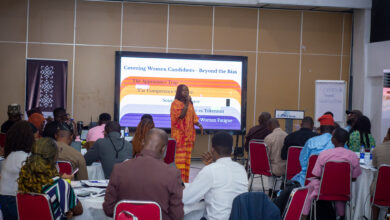
The discussion then shifted to “Gendered disinformation and digital harm: Fact-checking, empowerment and resilience in the Sahel and beyond.” Kangaye Sangare (Benbere) and Simbiat Bakare (DUBAWA), moderated by Kwaku Krobea Asante (Fact-check Ghana), revealed the gendered dimension of information attacks. They pointed to how AI-generated deepfakes are being used to undress women digitally, slut-shame them, and strip them of dignity. They also raised the issue of unchecked gendered misinformation on social media, citing viral cases where fabricated messages falsely framed women in compromising positions.
In the panel “Challenging climate change misinformation with African-led responses”, Amjed Khurwat, Lanre Olagunju (CheckClimate.Africa), and Doreen Wainainah (PesaCheck), moderated by Rabeb Aloui (BN Check), addressed three recurring issues: that climate change as a Western agenda, that extreme heat is divine punishment, and that failures in governance can be conveniently blamed on climate effects. The session called for presenting facts in plain language, empowering opinion leaders with accurate information, and investing in local repositories of climate data.
Closing the day’s formal program, Enock Nyariki of IFCN presented “The future of fact-checking standards: Inside the IFCN code,” before Noko Makgato, Executive Director of Africa Check, delivered closing reflections on the progress and challenges facing fact-checkers across Africa.
Celebrating Excellence: The African Fact-Checking Awards
The day ended on a celebratory note with the 2025 African Fact-Checking Awards gala dinner, honouring outstanding contributions to truth and accountability. AFP reporter Samad Uthman (Nigeria) took home the top prize for professional fact-checkers, while Hossam Elhendy (Factcheckar, Egypt) was named runner-up. In the working journalist category, Ariel Gbaguidi (La Nation, Benin) emerged the winner, followed by Cissé Fana (Ouestaf, Senegal). The student journalist award went to Badra Dabbabi (She Checks, Tunisia), with Iretomiwa Balogun (Roundcheck, Nigeria) as runner-up.
The summit reinforced a powerful truth: Africa’s battle against disinformation must be fought on multiple fronts, in classrooms, in communities, online, and in the stories journalists choose to tell.
Mustapha Lawal represented FactCheckAfrica at the just concluded Africa Facts Summit in Dakar, Senegal.