FACT-CHECK: Ebola, How Nigeria’s Disclosure of Patient Information Compares Between 2014 and 2026

Claim:
An X user, @n6oflife6, claimed that Nigerian authorities disclosed the identity of the Ebola patient, the hospital where he was treated and the medical team attending to him during the 2014 outbreak under former President Goodluck Jonathan. However, the user argued that, under President Bola Tinubu, authorities had failed to disclose the identity of the patient or the people she had contacted following the latest outbreak.
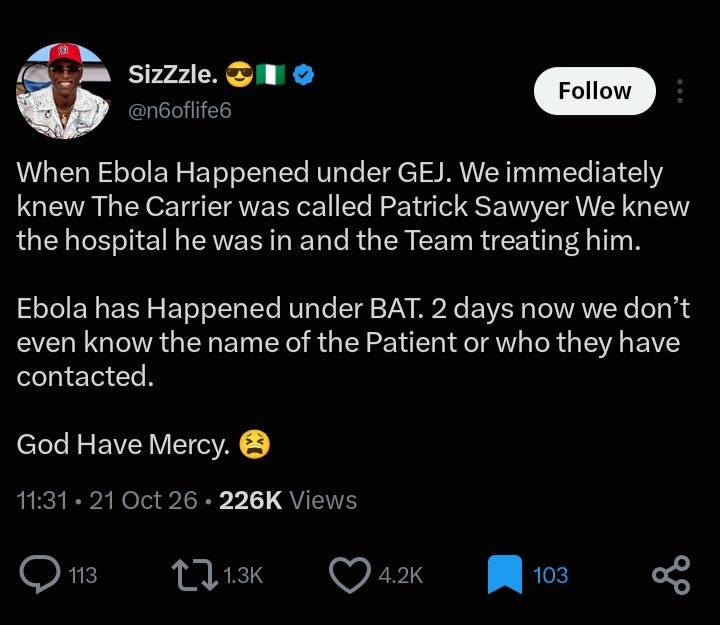
The post, published on October 21, 2026, had garnered approximately 1,200 reposts, 3,800 likes and 103 comments at the time of this fact-check.
Verdict: Misleading.
Full Text:
Nigeria confirmed an imported case of Ebola virus disease in the Federal Capital Territory (FCT), Abuja, on October 20, 2026. The infection was identified as the Bundibugyo strain, which has been associated with an outbreak in parts of Africa.
The announcement prompted public concern about the government’s preparedness, transparency and ability to contain the disease. Against this backdrop, the X user compared the handling of the current index case with Nigeria’s response to the 2014 Ebola outbreak, when Liberian-American diplomat Patrick Sawyer was identified as the index case.
The post questioned why the current patient’s identity and details about people who might have been exposed to the virus had not been publicly disclosed.
FactCheckAfrica examined what authorities had disclosed about the 2026 case and compared the available information with reports from the 2014 outbreak.
Verification:
FactCheckAfrica reviewed statements from the Federal Ministry of Health and Social Welfare and the World Health Organization (WHO), alongside reports from credible news organisations covering the 2026 case and Nigeria’s 2014 Ebola outbreak.
What have authorities disclosed about the 2026 Ebola case?
In a statement published on October 20, 2026, the WHO confirmed that Nigeria had recorded an imported case of Ebola Bundibugyo virus disease in Abuja.
According to the statement, the patient was a woman who had recently travelled from Uganda. Her symptoms began on October 7, and she sought medical attention at a private health facility in Abuja on October 11. Laboratory tests confirmed the infection on October 20.
WHO stated that the patient was in isolation and receiving medical care while investigations continued to establish the likely source of infection and reconstruct her travel and exposure history.
Although WHO did not name the hospital, a Reuters video report identified the facility as Nizamiye Hospital in Abuja.
WHO also reported that 44 contacts had been identified and were being monitored as part of efforts to prevent further transmission.
Similarly, a Premium Times report published on October 20, quoting a statement signed by the Coordinating Minister of Health and Social Welfare, Muhammad Pate, confirmed that the Federal Government had commenced contact tracing. It reported that the contacts included healthcare workers, patients, caregivers and travel contacts who might have been exposed to the virus.
The statement urged public and private healthcare facilities to remain vigilant, promptly identify and isolate suspected cases, observe strict infection-prevention measures and report suspected cases to public health authorities.
These disclosures established key details about the current case, including the patient’s sex, travel history, diagnosis, treatment arrangements and the number of contacts identified. However, the official statements reviewed did not disclose the patient’s name or publish the identities of those being monitored.
Was the patient’s identity publicly disclosed in 2014?
During Nigeria’s 2014 Ebola outbreak, Patrick Sawyer was publicly identified as the index case. Nigerian media reported that he was a Liberian-American diplomat who arrived in Lagos and was admitted to First Consultants Medical Centre in Obalende.
TheCable reported Sawyer’s death on July 25, 2014, identifying him by name and reporting that he had received treatment at the hospital.
On July 29, 2014, Channels Television reported that First Consultants Medical Centre had issued a statement explaining how it managed Sawyer’s case. The hospital said it had isolated him, initiated infection-control measures and contacted relevant state and federal authorities for assistance with diagnosis and treatment.
These reports establish that Sawyer’s identity and the hospital where he was treated became publicly known during the 2014 outbreak.
Have authorities disclosed information about the patient’s contacts?
The claim suggests that the identities of people who might have come into contact with the current patient remain unknown. While the official statements reviewed did not name individual contacts, they confirmed that 44 people had been identified and were being monitored. Reports also provided broad categories of contacts, including healthcare workers, patients, caregivers and travel contacts.
It is important to distinguish between identifying and monitoring contacts for public-health purposes and publicly disclosing their personal details. According to protocols established by the World Health Organization (WHO), contact tracing strictly involves locating potentially exposed individuals, assessing their risk level, and systematically monitoring them for symptoms. The organisation also recommends protecting contacts’ privacy and keeping their identities confidential as far as possible. Similarly, the Nigeria Centre for Disease Control (NCDC) has protocols for identifying and monitoring contacts during Ebola outbreaks.
Therefore, not publicly naming the individuals being monitored does not, in itself, mean contact tracing has not been conducted. Authorities can provide updates on contact tracing without disclosing individuals’ identities.
Hence, while the identities of the contacts had not been publicly disclosed in the official statements reviewed, the claim overlooks the information authorities had already released about the contact-tracing exercise.
Conclusion:
The claim is misleading. Patrick Sawyer’s identity and treatment hospital were publicly reported during the 2014 Ebola outbreak. In 2026, authorities had not publicly named the index case or disclosed the identities of individual contacts in the official statements reviewed. However, they had confirmed the case, provided details about the patient’s travel and treatment, and announced that 44 contacts were being monitored. The available evidence does not establish that authorities withheld all relevant information or that the two outbreaks were handled less transparently in every respect.