BY: Mustapha Lawal
Claim:
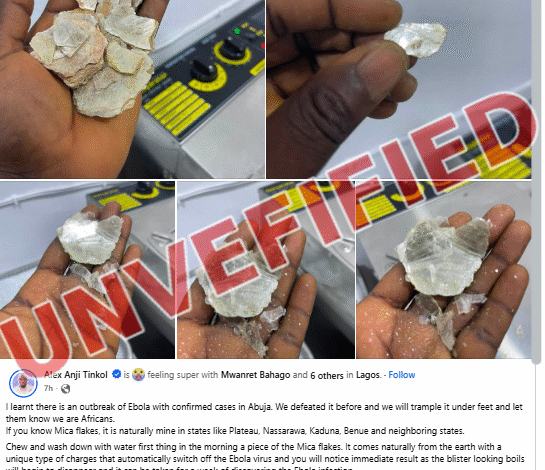
Chewing and swallowing mica flakes can neutralise Ebola, make blister-like skin lesions disappear and treat the infection within a week.
Verdict:
Unverified and potentially dangerous advice.
Full-Text
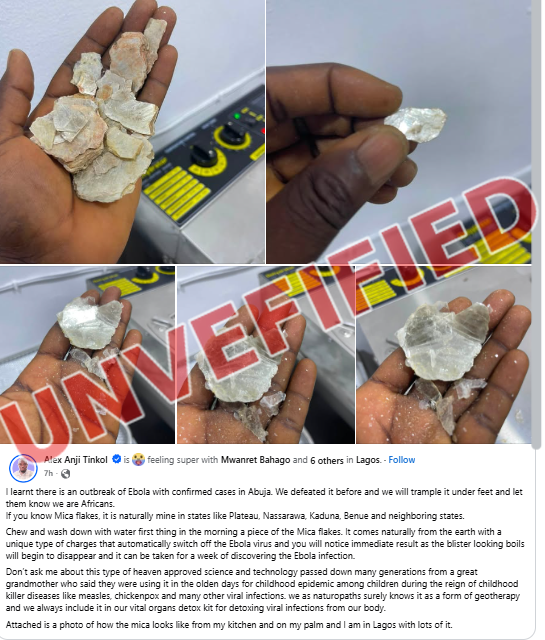
A Facebook post circulating amid Nigeria’s reported Ebola case claims that swallowing a piece of mica, a naturally occurring mineral, can “switch off” the Ebola virus and make blister-like skin lesions disappear.
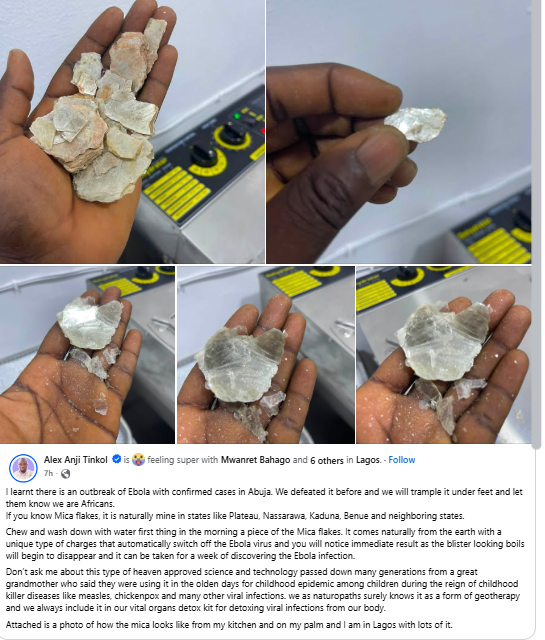
The post’s author “Alex Anji Tinkol” describes the practice as a traditional remedy passed down through generations and associates it with geotherapy, a term used for practices involving earth or mineral materials.
The claim is particularly concerning during an outbreak, when people who suspect they have been exposed to Ebola need prompt medical assessment rather than unverified home treatments.
Nigerians recall the 2014 salt-water incident
The Facebook post promoting mica flakes as an Ebola remedy prompted reactions from users who remember the misinformation that circulated during Nigeria’s 2014 Ebola outbreak. In the comments to the post, Josephine Effah-Chukwuma asked whether the claim was another “SALT matter,” referring to the incident in which people reportedly consumed excessive amounts of salt water after false claims circulated that it could prevent Ebola infection.
Jennifer Ngozi Aisuan replied that she remembered people gulping down large quantities of salt in the belief that it could cure Ebola.
In response to such comments, the post author Alex Anji Tinkol, described the earlier incident as painful and warned against repeating it. However, he reiterated his endorsement of the current mica claim, asserting that the mineral could switch off certain viruses. No scientific evidence was provided in the comment to support that assertion.
Other users expressed concern about the safety of swallowing mica flakes. Yintariere Okorodudu questioned whether consuming the glass-like material could cause kidney stones, while another commenter joked about whether people promoting the remedy should keep some for themselves.
The reactions show that the post has prompted both scepticism and support. Some users recalled the dangers associated with the earlier salt-water claim, while others appeared receptive to the assertion that a natural mineral could neutralise viruses.
One commenter, George Emmanuel, also questioned whether the reported Ebola case was genuine and speculated that the announcement might be intended to restrict movement ahead of Nigeria’s 2027 elections. The comment did not provide evidence for this allegation, which should be assessed separately from the claim about mica.
These comments are evidence of the reactions expressed by the users whose comments were supplied to FactCheckAfrica. They do not, on their own, establish how widespread belief in the mica remedy is or how many people have acted on the advice.
Nevertheless, the comparison with the 2014 incident highlights why unverified medical claims require a prompt, evidence-based response. During an outbreak, people may be frightened and eager to protect themselves. Claims that a readily available household substance or natural material can prevent a serious infection can spread quickly, even when there is no reliable evidence that the remedy works.
Health authorities and media organisations should therefore communicate clearly about what is known, correct dangerous claims and explain where the public can obtain reliable medical advice.
Verification:
No credible clinical evidence identified for this fact-check supports the claim that swallowing mica prevents or treats Ebola. The remedy is not included in recognised Ebola treatment guidance, and consuming an untested mineral may expose people to additional health risks.
What does the evidence say about Ebola treatment?
The World Health Organization (WHO) identifies Bundibugyo virus as one of the viruses that can cause Ebola disease.
In its guidance on Ebola disease, WHO says there are no approved specific therapeutics or licensed vaccines for Bundibugyo virus disease. Candidate treatments and vaccines are being investigated, while clinical care focuses on supportive treatment and managing symptoms and complications.
Early supportive care, including rehydration and appropriate medical management, can improve the chances of survival.
WHO’s guidance does not identify mica, geotherapy or swallowing mineral flakes as a treatment for Ebola.
This does not mean that every possible mineral compound has been tested against the virus. It means the specific remedy promoted in the Facebook post has not been established as safe or effective through credible clinical evidence.
Source: WHO Ebola disease fact sheet.
Can mica neutralise Ebola?
The Facebook post claims that mica contains a unique type of charge that automatically switches off the virus.
The post does not provide scientific evidence demonstrating this mechanism, identify a validated medical product, or cite a clinical study showing that swallowing mica reduces viral infection.
The presence of a naturally occurring mineral does not establish that it can neutralise a virus inside the human body. Such a claim would require evidence that the substance has the proposed antiviral effect, reaches the relevant part of the body at an effective concentration, and can be used safely.
No credible clinical evidence identified for this fact-check establishes those effects for the mica remedy described in the post. The claim that taking it for a week can treat Ebola is therefore unsupported.
Does traditional use prove that the remedy works?
The post appeals to traditional knowledge, saying the practice was passed down through generations and used for childhood illnesses.
Traditional knowledge can be important in understanding cultural practices and identifying questions for scientific research. But historical use alone cannot establish that a remedy cures a particular disease.
Researchers need to determine whether a remedy works, what dose is safe, what adverse effects it may cause, and whether its apparent effects can be distinguished from natural recovery or other treatments.
The National Academies of Sciences, Engineering, and Medicine has warned that unproven remedies promoted during Ebola outbreaks can put people at risk, particularly when they lead individuals to delay effective medical care.
Source: National Academies: Are There Proven Treatments for Ebola?.
Is swallowing mineral flakes safe?
The Facebook post describes mica as a naturally occurring mineral found in several Nigerian states. But identifying a substance as a natural mineral does not establish that it is safe for human consumption.
The composition and contamination levels of materials collected from the environment can vary. A person cannot determine whether a mineral contains harmful contaminants simply by looking at it.
Research published in Environmental Geochemistry and Health examined geophagic clay materials from Nigeria and reported potentially hazardous concentrations of several elements, including arsenic, cadmium, selenium and lead, in the samples studied.
Another study of geophagic clays consumed in southern Nigeria also identified concerns about lead and cadmium exposure.
These studies did not establish that the specific mica flakes described in the Facebook post contain those contaminants. They do, however, demonstrate why naturally occurring mineral materials should not automatically be considered safe to swallow.
Sources: Research on Nigerian geophagic clay and heavy-metal risks; Research on cadmium and lead in geophagic clay consumed in southern Nigeria.
Claim that Ebola causes blister-like boils?
The post says people will notice blister-like boils disappearing after taking mica. But it does not provide medical evidence establishing that these lesions are caused by Ebola or that the remedy makes them disappear.
Ebola can cause a range of symptoms, including fever, fatigue, muscle pain, headache, sore throat, vomiting, diarrhoea and, in some cases, skin rash or bleeding. These symptoms are not sufficient on their own to confirm an Ebola infection.
A person should not use the appearance of their skin—or the disappearance of a lesion after taking a substance, as proof that Ebola is present or has been cured. Diagnosis requires appropriate medical assessment and laboratory testing.
Source: WHO Ebola disease fact sheet.
What should people do instead?
Anyone who believes they may have had a relevant exposure to Ebola should follow public health advice and contact the appropriate health authority for guidance.
People who develop symptoms after a suspected exposure should seek medical advice promptly and explain the possible exposure before arriving at a healthcare facility, so appropriate precautions can be arranged.
They should not rely on mica flakes, salt-water baths or other unproven remedies as substitutes for medical assessment.
This does not mean people must abandon ordinary hygiene or cultural practices that do not pose a health risk. It means that claims about preventing or curing a serious infection must be supported by evidence, and practices involving ingestion of untested substances should not be assumed safe.
The Nigeria Centre for Disease Control and Prevention provides public health guidance on Ebola, including symptoms, transmission and the importance of early detection.
Source: Nigeria Centre for Disease Control and Prevention: Public health advisory on Ebola.
Conclusion:
The claim that swallowing mica flakes can neutralise Ebola or cure the infection within a week is unsupported by credible scientific evidence.
WHO guidance does not recognise mica as an Ebola treatment. Research on some mineral materials consumed in Nigeria has also identified potential contamination risks, although those findings cannot be directly attributed to the specific mica flakes described in the post without testing.
People should not swallow untested mineral materials or rely on unproven home remedies to prevent or treat Ebola. Anyone concerned about possible exposure should seek guidance from public health authorities and obtain appropriate medical care.
During an outbreak, sharing unverified treatment claims can put lives at risk. Health advice should be based on evidence, not on claims of natural origin, tradition or testimonials alone.