By Muheeb Mashood
In a move to tighten bilateral ties, the recent visit to the United Kingdom by the President of Nigeria, Bola Tinubu, births a shocking financial revelation between the two nations. On 19 March 2026, the British government agreed to lend a whopping sum of £746 to Nigeria. While many laud the deal as bold investment to develop Nigeria’s coastal economy, others raise concerns over the country’s dependency on external loans.
Beyond the loan, a closer examination of the deal reveals a cold gentleman agreement, delivering majority of the contractual benefits to UK companies.
Meanwhile, the UK outcome is not a new trend to Nigerians. Over decades ago, the country has earned a grim reputation of leading the pack among nations of the world that value external credits to support its financial needs. Data from International World Bank show that Nigeria’s debt rose to $18.7 billion as of December 31, 2025. This places Africa’s largest economy country among the third-largest borrowers in the IDA portfolio.
A few days after the UK loan agreement, the National Assembly approved another loan of $6 billion to support Nigeria’s revenue. Facilitated by the presidency, Tinubu notes that the financial assistance by lenders from the United Arab Emirate (UAE) is important to service budget implementation, critical infrastructure development, and refinancing of existing high-cost domestic and external debts.
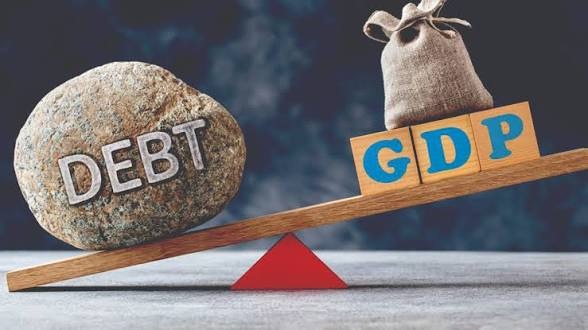
The above two debts alongside other existing loans have created economic sabotage in Nigeria, with repayment schemes translating beyond a burden. The Debt Management Office reveals that as of December 2025, Nigeria’s loan debts approximately hit N159.28 trillion. This means each Nigerian owes N724,000 as average citizens earn between N80,000 and N120,000 monthly.
The fiscal implications of the above statistics are even more daring. The Federal Government is reported to have spent N27.2 trillion on servicing public debt in the last two years. This figure surpasses capital spending by N3.9 trillion between 2024 and 2025.
The Nigerian Minister of Marine and Blue Economy, Adegboyega Oyetola, hails the UK investment deal as transformative. The loan targets to modernise the country’s leading trading ports, Apapa Quays and Tin Can Island. The ports, located in the heart of Nigeria’s megacity, are reputable for handling more than 70 percent of Nigeria’s goods trades.
The ports are also accountable for the highest source of revenue generation for Nigeria after crude oil. Despite the importance of the two spots, long-term decay has resulted in congestion, delays, and high transaction costs, including indiscriminate extortion along the ports’ corridors. These problems have slowed down businesses, contributing to rising prices. Hence, Nigerian authorities boast that modernized infrastructure, such as automated processes replacing paperwork-heavy procedures, and expanded capacity would phase out the longstanding bottlenecks.
On the other hand, the approved $6 million promises to boost infrastructural deficiency of the country, targeting modernized roads, railways, power grids, productive economic growth, including job creation and regional trade.
With effective frameworks; concessional terms, transparent monitoring, revenue-generating projects, analysts identify Foreign Direct Investment (FDI) and manufacturing opportunities as the direct results of the loan.
In a bid to develop transportation channels, coupled with sustainable energy distribution that are necessary for improved economic liberation, the consortium capital from the international sources is important to attract foreign investments through reliable infrastructure.
Justifications from the Nigerian government for relying heavily on loans have varied from inflation control to foreign exchange reserves, reduction of debt burden, boosting of investors confidence. Other reasons include funding of capital projects, conformity to international standards, tightening of diplomatic and collaborative ties.
Although the ideas behind the loan trajectory are presented as progressive, critics however identify flaws that are eyesore. When a government relies heavily on loans to run its services, dependency becomes unavoidable, exposing such countries to several disadvantages.
As part of the terms for the UK deal, British companies stand the chance to earn nothing less than £236 million. This forms part of arrangements that facilitated a contract for British Steel worth about £70 million to supply 120,000 tonnes of steel billets in order to support the ports’ upgrade. The agreement has raised displeasure from critics, who say it is disproportionately skewed in the UK’s favor.
However, according to managing partner at consultant SBM Intelligence, Ikemesit Effiong, the benefits will be “contingent on whether Nigeria actually have the operational sovereignty to ensure the ports serve our trade interests, and the operations are managed to account for our trade, export and import interests rather than just becoming yet another concessionary cash cow.”
The economic implication of the debt servicing towards Nigeria’s revenue is damning. In the Review of the Nigerian Economy in 2025 and Outlook for 2026, the Centre for the Promotion of Private Enterprise flagged the projected N15tn debt service bill for the 2026 financial year, saying that it would affect the growth anticipated for the year. The Chief Executive Officer of the organisation, Dr Muda Yusuf, said Nigeria’s rising debt-service bill is set to remain a major constraint on fiscal performance.
In 2024, the N12.63tn spent on debt servicing exceeds capital expenditure by about N1.04tn. Similarly, the gap widened further in 2025, as debt servicing of N14.57tn exceeded capital spending of N11.7tn by about N2.87tn. Within the two years, Nigeria’s debt servicing exceeds capital expenditure by about N3.91tn.
The above data indicates that about two-thirds of the country’s revenue was swallowed by service debt — as debt service-to-revenue ratio rose from about 60 per cent in 2024 to roughly 66 per cent by November 2025.
On Thursday, 23th April, President Tinubu tabled before the Senate an approval of another tranche of a $516.3 million loan from Deutsche Bank AG. Insurance for this new loan is to be covered by Islamic Corporation for the Insurance of Investment and Export Credit, the insurance arm of the Islamic Development Bank.
The loan targets to finance a 1,000-kilometre high-capacity carriageway linking Sokoto, Kebbi, Niger, Kwara, Oyo, Ogun, and Lagos states, stretching from Illela to Badagry. The proposed Sokoto–Badagry Superhighway is a flagship project under Tinubu’s Renewed Hope Agenda. President Tinubu boasts that the project would boost connectivity between Nigeria’s north-west and south-west, leading to a major economic corridor.
While there are numerous arguments in support of reliance on loans to furnish government policies, experts note that the human impact of debt should not be ignored.
Nigeria’s rising dependency on loans is a two-way traffic. In as much as it can transcend the country into economic liberation, mismanagement has the consequence of dragging the nation into a long-term debt burden.
The reality playing out in the country shows that service-to-revenue borrowing is funding survival instead of developmental progress it promises. Therefore, the Nigerian government must not derail from its objective of borrowing, empowering local industries through trade liberalization, while unlocking the private sector’s potential to drive growth.
Muheeb Mashood is a 2026 Free Trade Fellow at Ominira Initiative. He is also an intern at FactCheckAfrica