INVESTIGATION: Despite Increasing Surveillance on Civilians, Criminal Actors Weaponise Social Media to Promote Terrorism


BY:Muheeb Mashood
In Nigeria, crime is no longer committed in the shadows. The boldness of terrorist organisations is growing, just like their operations. Muheeb Mashood spent months investigating how dangerous gun-wielding individuals are now weaponizing social media to promote their atrocities. Several posts analysed by this reporter reveal the same pattern: terrorists continue to decorate themselves online.
In some of the clips, arrivals of bandits to peace-deal locations are marked by outright dominance, trooping the venues heavily armed, with local onlookers being turned into spectators. In some others, the terrorists celebrated gains over the state’s authority after running down military targets.
Other disturbing videos captured sceneries where the kidnappers subject their abducted victims to torture and inhumane treatment — as the bid for ransom payment intensified, so did the threats of killing the captives if their offer was not honoured, or not met in time.
Meanwhile, the governments of Nigeria have earned a grim reputation of heightening surveillance to crackdown social media users, especially the individuals flagged for unfair comments.
Nigeria reportedly spent over $470 million on AI surveillance technology, emerging as the biggest consumer of such systems in Africa. However, the essence of the expenditure has been questioned. Jackson Ojo, a certified gold member of the International Security Association, Switzerland, argued that criminal activities across the country remained largely unaffected.
On 24 March 2020, Emperor Gabriel Ogbonna, a lawyer and human rights activist, was arrested by the officers linked to the Department of State Services (DSS) in Abia State, after the latter stormed the former’s chamber. What was the activist’s only offence? He shared a post on Facebook, alleging Okezie Ikpeazu, the former Governor of Abia State, of visiting a shrine to swear an oath of loyalty and secrecy to his Godfathers.
Emperor was put before a Magistrate Court in the state’s capital, Umuahia, for an alleged offence of cyber terrorism against the provisions of the Cybercrime Act (2015). He was remanded in custody for five months before gaining freedom after being released on bail of N2 million.
Recently, the Nigerian military was caught in a controversy for allegedly arresting a social media influencer and activist, Justice Chidiebere, famously known as “Justice Crack”. The arrest followed an alleged social media post exposing poor treatment of personnel within the Nigerian military.
However, the Nigerian Army defended the action as a move to protect its integrity against incitement of discontent among soldiers. Appolonia Anele, the army spokesperson, disclosed that Justice is under custody, undergoing investigation and possible prosecution alongside military personnel involved in the controversial post.
The above two cases are few instances where authorities intensified campaigns of cracking down on individuals alleged of inciting distress through the usage of social media. Yet, the perpetrators of terrorism parade the internet with impunity.
Criminals operate freely and even share videos of attacks online without being traced, Jackson continued, pointing to the ineffectiveness of the surveillance infrastructures. “Are they able to use it to track the terrorists,” Jackson questioned. “The kidnappers will kidnap people, they will be negotiating on the phone, and we still cannot track them.”
“The terrorists are operating, they will kill people, they will do the video, they will send it through TikTok, but they are not trackable.”
When Terrorism Is No Longer Committed With Guns Alone
Across social media platforms, especially Facebook, terror groups continue to display their fighting strengths.
A disturbing clip shared by a Facebook page in March 2026, The West Africa Pilot News, captured a moment when terrorists suspected to be members of Boko Haram and ISWAP, performed a spiritual prayer in an open area, allegedly Borno State. The terrorists appeared heavily clothed in ammunition, carrying AK-47 rifles, launchers, and other sophisticated weapons.
The footage widely sparked tension, raising a serious concern about the operational strength of terror groups in Nigeria. A further question that emerged centred on whether the ongoing military campaign against terrorism is effective.
The post so far has generated nothing less than 1,700 likes, 1,500 comments, 1,200 reshares, and 430 bookmarks.
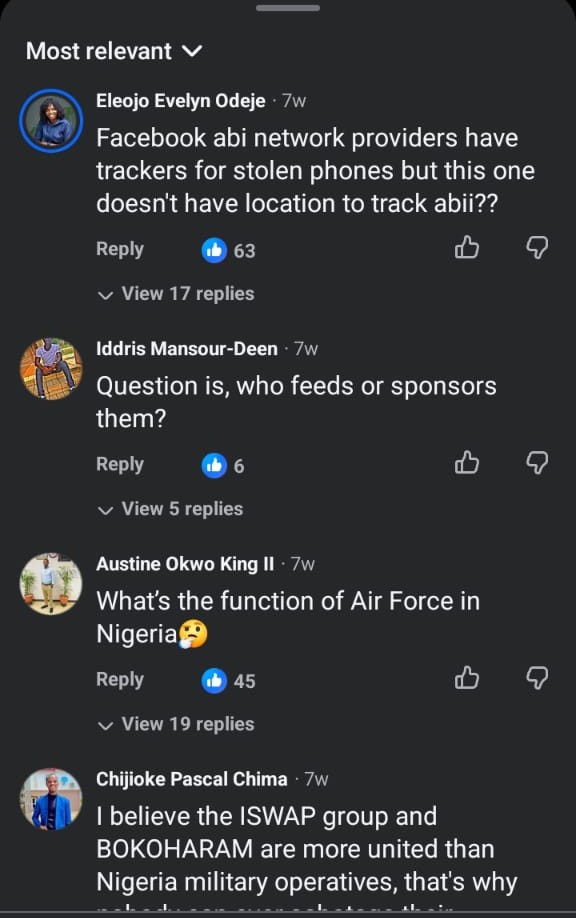
Eleojo Evelyn Odeje, one of the Facebook users said in the comment’s section: “Facebook abi network providers have trackers for stolen phones but this one doesn’t have location to track abii??” Austine Okwo II, another user said, “What’s the function of Air Force in Nigeria🤔”
Another video published by the same page showed celebrations of another set of terrorists, as they praised God upon a successful IED attack on motorists. The clip captured a burning vehicle linked to be an armour carrier belonging to the personnel of the Nigerian Army.
The post garnered at least 25 likes, three comments, five reshares, and two bookmarks. Many more disturbing contents have dominated online.
During an interview with this reporter, Daniel Ojukwu, a 2025 fellow at Dubawa Kwame Karikari Fellowship, the biggest network of journalists driving accountability and credible information across Africa, identified varieties of ways in which disturbing contents recorded by terrorists manage to dominate social media platforms.
The investigative journalist with FIJ disclosed that the Islamic States all over the world operate a website where they share their activities. Daniel pointed to ISWAP as one of the dominant terrorist organisations in Nigeria that regularly contribute to the platform. He noted that every internet user freely accesses the platform.
While admitting that it’s difficult to combat proliferation of terrorism on general spaces like Facebook, Tiktok, etc., he suggested that governments could have easily charged telecommunication networks to shut down those terrorists-run platforms.
Peace Deal Never Meant To Be One
Negotiations, whether by authorities or communities, is another engagement by terrorists that has tremendously gained traction on the internet. In November 2025, a video showing the arrival of a bandit network was widely shared online. The post captured counts of a civilian spectator lining up to watch a negotiation involving armed militants. The terrorists arrived at the scene on bikes, possessing different sophisticated weapons.
Shehu Umar who shared the clip through his Facebook account bemoaned: “With Videos like dis coming out of Katsina State in the name of Dialogue with Bandits, how do you convince people like Gen TY Danjuma that FG and State Governments are not working with Bandits? We don’t hate APC but their stupidity in the name of Dialogue is making Nigeria look like comedy.”
The post amassed at least 2,000 likes, 820 comments, 1,200 reshares, and 548 bookmarks.
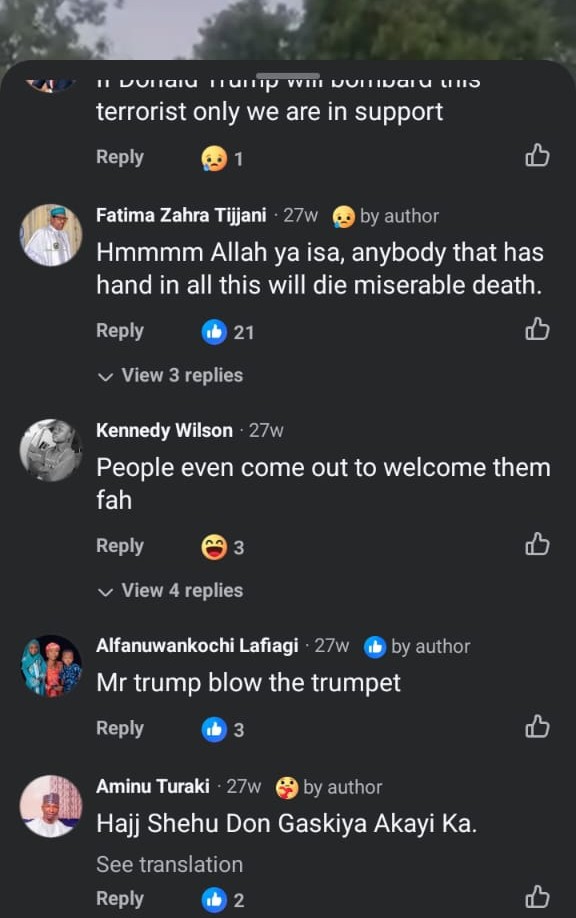
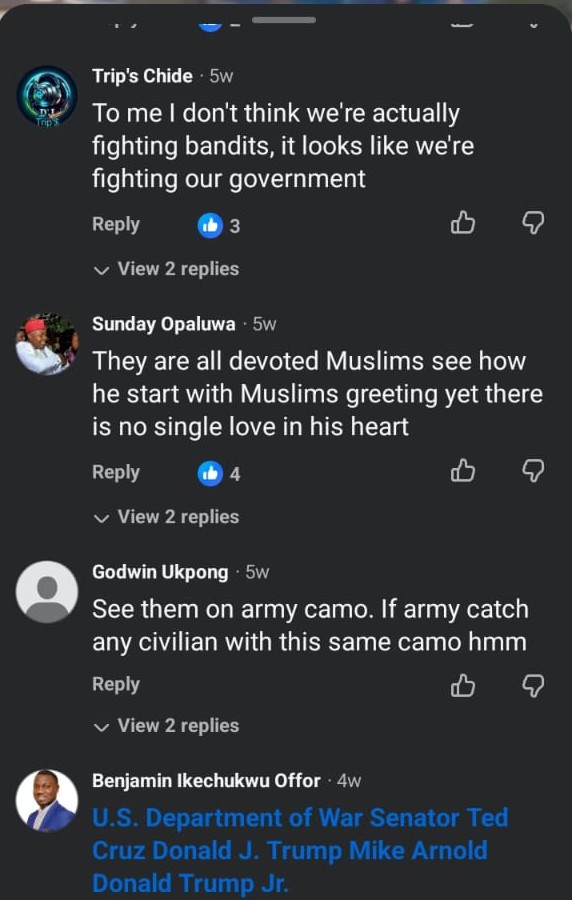
The major concern raised by users in the comment section is the direct implications of the gathering towards local onlookers. Muhammad Nura wrote, “My concern is that this approach of inviting bandits in the name of dialogue is indirectly encouraging and recruiting younger ones into banditry. It gives the wrong impression that these criminals are heroes who are above the law, which can only worsen the security situation instead of solving it.” Similarly, Kennedy Wilson remarked, “People even come out to welcome them fah.”
Aliyu Dahiru, a Northwest Editor who headed Radicalism and Extremism at HumAngle, a leading conflict-niche media platform in Africa, shared what attendance of the bandits’ peace-deals means to the local communities. He noted that whenever peace negotiations are organised, locals attend mainly as witnesses, not because they see the terrorists as unfamiliar people, but because they want assurance that the agreement means they will no longer be harmed.
“Terrorists are not hidden figures in some villages. They sometimes enter markets openly, and in many cases, people even know where their hideouts are,” Aliyu affirmed, drawing from his extensive research experiences in violence activities across Northern Nigeria.
“What prevents action against them is the fear of reprisals, particularly in areas where there is inadequate security presence. They can even enter villages and demand taxes from residents.”
Fueling Incitement, Creating Disunity
The growing online campaign initiated by armed terrorists is far-reaching. Apart from incitement of belligerence against the authority of the Nigerian governments, those terror groups are recording success in sowing discord and disunity among the citizens.
A video posted by Adigun Abraham Tope in April 2026, captured a group of gun-wielding bandits insulting President Bola Tinubu and the Governor of Zamfara State, Dauda Lawal. The terrorists refuted a claim allegedly linked to the Nigerian governments. One of them was quoted to have stated “the government said they’ve killed Bakin Sibundi and Iliya Mai Rasha. The government is lying that we are being killed by the vigilantees.” They further challenged the governments to open confrontation with them.
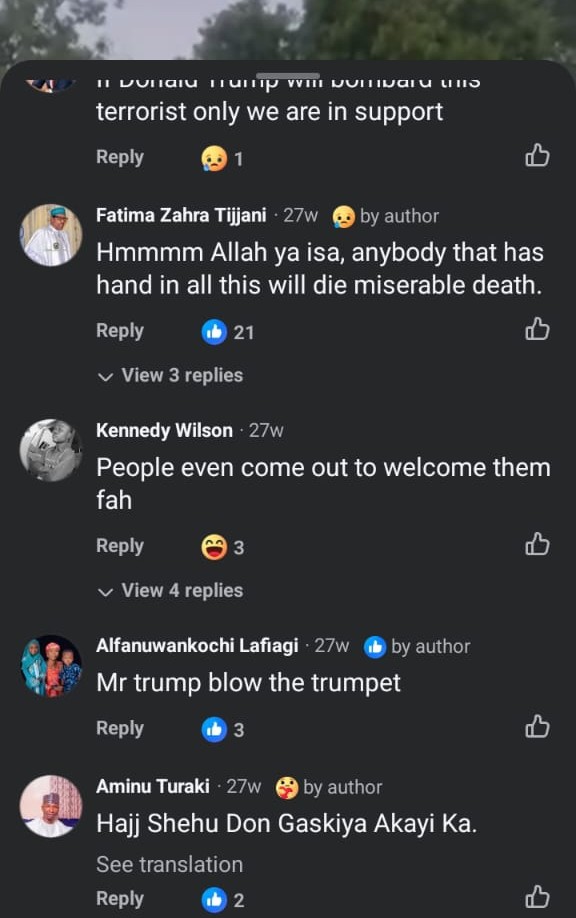
The concluding part of the video saw the speaker citing some verses of the Qur’an. This has generated so much divisive narratives in the comment section with some accusing Islam as the root cause of the ongoing security crisis in Nigeria, while others countered that opinion.
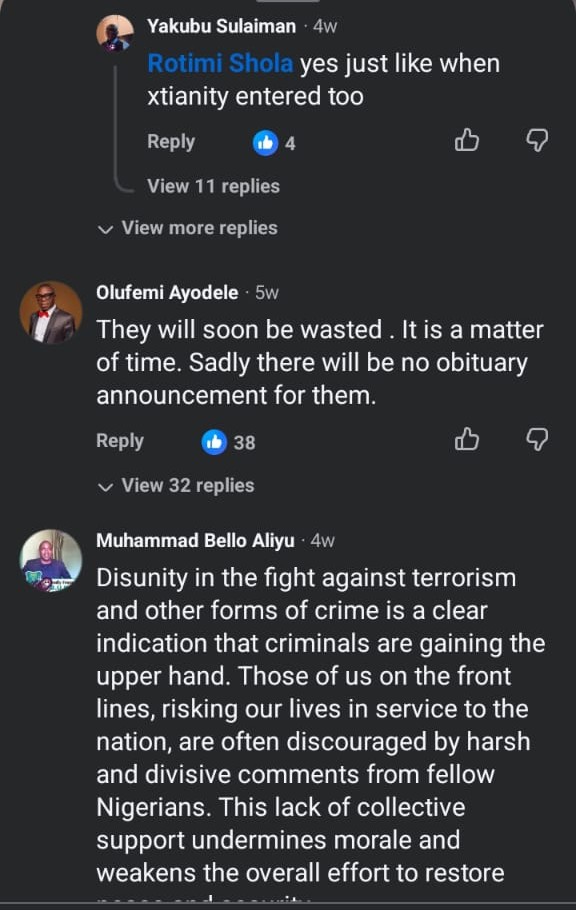
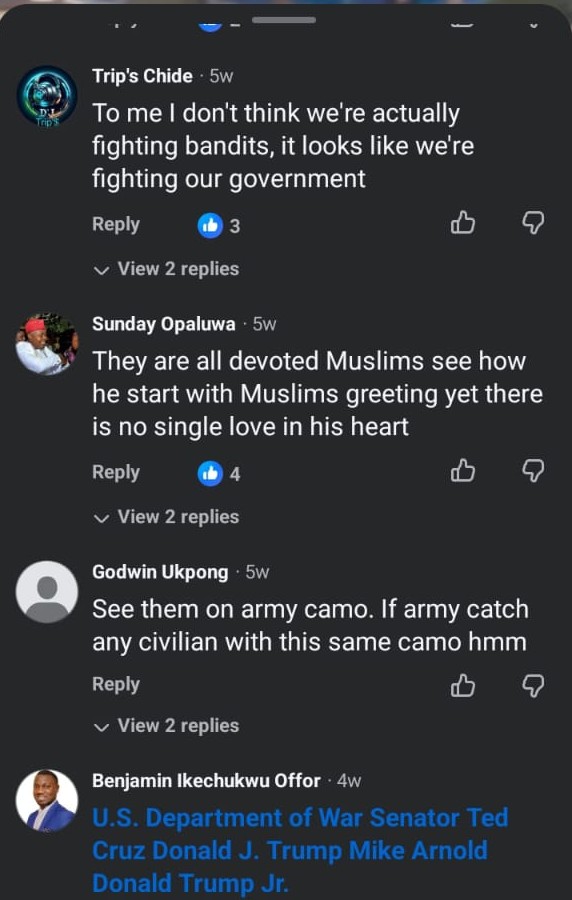
For example, Rotimi Shola commented, “When Isl@m entered Nigeria we didn’t know we were finished.” Sunday Opaluwa also said, “They are all devoted Muslims see how he start with Muslims greeting yet there is no single love in his heart.”
Contrastingly, Yakubu Sulaiman noted, “Rotimi Shola yes just like when xtianity entered too.” Similarly, Mujaheed Udubo added, “Rotimi Shola, which product are you from, the baby factory?”
Admitting to the implication of the video, Muhammad Bello Aliyu, another Facebook user, explained “Disunity in the fight against terrorism and other forms of crime is a clear indication that criminals are gaining the upper hand…”
Several clips as seen here and here have captured terrorists challenging governments’ authorities, while belittling Nigeria’s military strength.
Commenting on the implication of the internet’s divisive mission, FIJ’s Daniel warned of linking terrorism to some particular identities, groups, or religions. He cautioned against creation of a deeper crisis in the process of covering one gap.
“Imagine you are in a community and you learn that terrorists have attacked an area. Then in your community there is a minority Muslims population. There’s a tendency that people in that community rise up against the Muslims and hurt them simply because they learnt that Muslims elsewhere committed the crime.
“So, it’s very important that people get sensitised, get this understanding that things might appear in a certain way, but there are a lot more contexts that need to be considered. There are a lot more ideologies, there are a lot more conversations that we need to be having.”
Turning Internet To Ransom Payment Market
Another growing presence of terrorists online is how they engage the members of the public to raise ransom. Bandits now use cameras to threaten to kill their captives if ransom terms are not met, share the clips online, and are circulated by social media users.
One cold example is the case of Abba Musa, a 2023 member of the National Youth Service Corps (NYSC), who was abducted during a business transit from Zamfara to Sokoto in January 2026. Several clips already dominated online where Musa was subjected to cruel torture, as he begs his family and members of the public to raise his head payment. After the initial payment of N10 million ransom was met, Musa’s abductors failed to grant him freedom. While the businessman was presumed dead as his family held an Islamic funeral for him in absentia, a video suddenly surfaced online where the kidnappers set new terms: delivery of motorcycles, payment of another sum of money, among other things.
Analysts shared that such a case is a powerful method employed by terrorists to influence ongoing negotiations and secure ransom payment.
Speaking at a TV Show with News Central, D English Alhaji shared how he volunteered with some other individuals to facilitate a crowdfunding for the payment of Musa’s first payment, alongside other captives. He admitted that the money was raised through the aid of social media appellation. D English Alhaji himself was later shocked when a group of bandits called him via a WhatsApp video call, cautioning him for his ongoing campaign against the terrorists. D English Alhaji has been reputable on social media for advocating that terrorists should be eliminated immediately they are captured.
Musa’s case revealed how terrorists are deliberately using the internet as a ransom market. A report published by Foundation for Investigative Journalism (FIJ) Nigeria, uncovered how the former Corper’s torture video was shared online. The victim’s relatives disclosed that the bandits firstly shared the footage with them before they (the bandits) circulated it online afterwards.
HumAngle’s Aliyu underscored the impacts of online campaigns in promoting outlawed ransom payment. While he acknowledged that people circulated the clips capturing victims’ vulnerable states out of sympathy, it only strengthened the propaganda being pushed by the terrorists. “If the videos continue spreading widely, it will encourage terrorists to continue kidnapping and releasing propaganda videos.”
“As for public opinion, people will increasingly blame the government, even though, from a security strategy perspective, authorities would generally prefer that such videos are not widely circulated.”
Another instance similar to Musa was the case of Pastor Adegoke Jaiyesimi, who was abducted in March 2026. Several posts and videos featuring Adegoke Jaiyesimi circulated on social media, primarily used by his captors to demand a ransom of ₦100 million. Jaiyesimi was captured pleading to the public to support his ransom in order to regain his freedom. He also provided the phone number of his brother to contact him for further assistance.
The footage captured his abductors circling behind him, while holding rifles. Although the video captured the bandits covering their faces, one of them was caught without a cover. Yet, there’s no report of arrest in connection to the abduction.
Why Governments Should Step Up Their Game — Experts
Experts claimed that the primary responsibilities of the governments is the protection of lives and properties of citizens as backed by the Nigerian Constitution under Section 33, 43, and 44. Therefore, in order to eliminate terrorists’ campaigns on social media, the governments must obliterate terrorism itself.
Daniel noted that for terrorists to showcase their activities online in the first place, it showed that there is a lingering problem that is yet to be tackled. To eliminate the terror crisis, he said that authorities should firstly identify the terrorists’ suppliers, then block access to their resources.
“We have brilliant minds in our military, we have brilliant minds that we can tap in from abroad. There are different ways you can infiltrate these terror camps.”
“You can recruit. You can tap in from previous information, you can install CCTV footage at vital locations, you can do Aerial scans, there are several ways you can survey these people and get information.”
The solution doesn’t end there.
As terrorists live among innocent civilians and move through borders, effective collaboration with neighbouring countries is another way forward suggested to fight the problem. “You chase them from this country and they are entering the next county.”
“These people are going from country to country, they chased them from Nigeria and they are entering Niger. They are going to cause problems in the next country and come back to your borders again once they are done with the other locations,” Daniel concluded.
From his part, Aliyu envisaged the necessity for the governments to improve surveillance if they truly want to restore public confidence. He emphasised that if terrorists produce and circulate videos without being arrested, this developed an impression among the public that the government has failed. Therefore, if the government wants citizens to better appreciate its efforts, it must intensify intelligence gathering and strengthen operations aimed at tracking and apprehending terrorists.
All efforts to speak with the government proved unsuccessful. This reporter forwarded several communications, including reminders to the Defence Spokesperson, Appolonia Anele. However, no response was received as at the time of filing this report.
Muheeb Mashood is currently an intern with FactCheckAfrica