BY: Mustapha Lawal
Claim
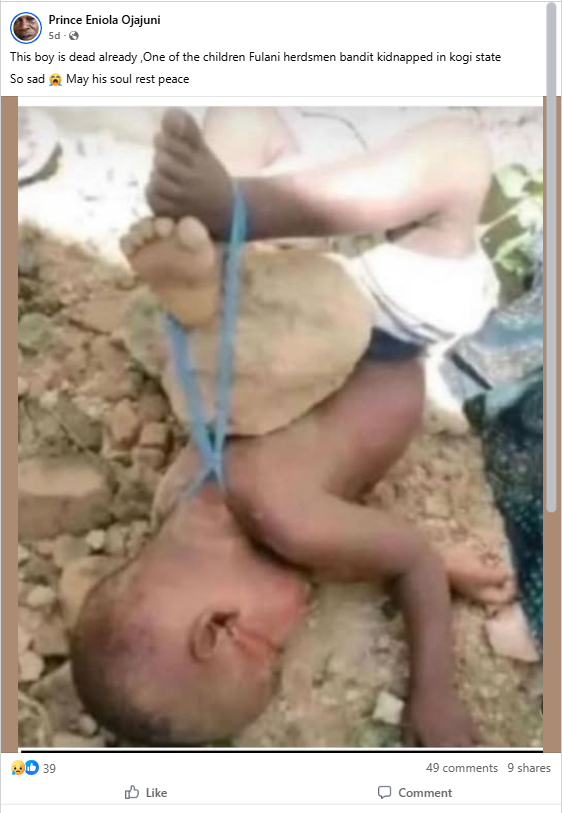
A Facebook user, Prince Eniola Ojajuni, shared an image of a young boy, claiming he had been killed after being kidnapped alongside other children by suspected bandits in Kogi State.
Verdict:
False. The image is unrelated to the Kogi school kidnapping incident. Findings show it had been circulating online days before the abduction occurred and has previously been used in several unrelated narratives.
Full Text:
A Facebook user, Prince Eniola Ojajuni, shared a photograph of a young boy with the claim that he was among children abducted by suspected Fulani herdsmen in Kogi State and had subsequently died.
FALSE CLAIM
Screenshot of the Claim
The post, shared on May 30, 2026, was accompanied by the caption: “This boy is dead already. One of the children that the Fulani herdsmen bandits kidnapped in Kogi state. So sad. May his soul rest in peace.”
The claim quickly attracted engagement, generating dozens of reactions, comments and shares. While some users expressed sympathy and outrage, others questioned the authenticity of the claim and accused the poster of spreading misinformation.
The image was subsequently reposted by other Facebook users and pages (here, here, here, here, and here), further amplifying the narrative that it depicted a victim of a recent school kidnapping in Kogi State and even narratives of paternity fraud..
The claim emerged against the backdrop of growing concern over school abductions in Nigeria and renewed public attention following the kidnapping of pupils from an Islamic school in Kogi State.
But does the image actually show one of the abducted children?
Verification
FactCheckAfrica reviewed reports of recent kidnapping incidents in Kogi State and found that the most recent school abduction occurred on April 26, 2026, when suspected bandits attacked Daarul Kitab, an unregistered Islamic school and orphanage located in Zariagi, Lokoja. According to official reports, 26 persons, including 24 pupils and two wives of the school proprietor, were abducted during the attack.
The Kogi State Government later disclosed that the school was operating illegally in a remote area without proper registration or security clearance. Security agencies subsequently launched rescue operations to recover the victims.
Authorities later confirmed that all abducted victims were successfully rescued. Seventeen pupils were recovered shortly after the attack through security interventions, while the remaining nine victims were rescued during a joint operation involving the Nigerian Army’s 12 Brigade and other security agencies in the Agbaja Forest axis.
To determine whether the viral image was connected to the incident, FactCheckAfrica conducted a reverse image search. The search revealed that the image had already appeared online on April 19, 2026, seven days before the Kogi school kidnapping took place.
Further checks showed that the same photograph had been shared repeatedly across multiple social media platforms in entirely unrelated contexts. In some cases, it was used to support false claims involving paternity disputes and family-related stories, demonstrating a pattern of image recycling and misinformation.
Because the image existed online before the kidnapping occurred, it cannot be a photograph of a victim from the incident. No credible news report, official statement, or security agency update identified the child in the image as one of those abducted in Kogi State.
Conclusion
The claim that the image shows a child killed after being kidnapped during the Kogi school abduction is false. FactCheckAfrica’s findings show that the photograph predates the kidnapping incident by several days and has been repeatedly recycled online in unrelated contexts. There is no evidence linking the child in the image to the Kogi school abduction.