By: Abayomi Abdulwaliyy Jolayemi
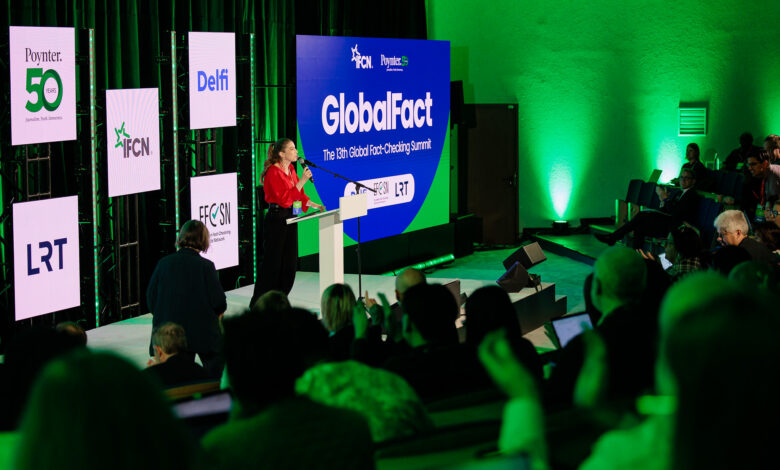
The conversations at GlobalFact 2026, the annual conference of the International Fact-Checking Network (IFCN), offered a sobering assessment of the state of fact-checking worldwide. Bringing together hundreds of journalists, researchers, technologists and verification professionals in Vilnius, Lithuania, the conference focused on three defining issues: the rapid evolution of artificial intelligence (AI), the growing financial vulnerability of independent fact-checking organisations, and mounting political pressure against evidence-based journalism.
The message emerging from the conference was clear. Fact-checking has become more essential than ever, but sustaining it has become increasingly difficult. As misinformation evolves in scale and sophistication, particularly through generative AI, verification organisations are being challenged to innovate without compromising the editorial principles that underpin public trust.
For African fact-checking organisations, including FactCheckAfrica, these developments are not distant global trends. They are realities that increasingly shape newsroom operations, verification workflows and audience engagement across the continent.
A Global Industry Under Pressure
The Duke Reporters’ Lab’s 2026 Fact-Checking Census paints a concerning picture of the sector’s trajectory. As of 1 June 2026, researchers identified 437 active fact-checking projects operating across 116 countries and in 70 languages. While the global network remains extensive, and still more than double its size a decade ago, the census found that 2025 marked the first year since the Lab began tracking the sector in 2014 that closures significantly outpaced new launches.
Just 10 new fact-checking projects were established during 2025, while more than 30 ceased publishing, resulting in a net decline. The downward trend has continued into 2026, with the total number of active projects falling from 441 at the end of 2025 to 437 by 1 June 2026, amid mounting financial pressures on fact-checking organisations.
Researchers attribute this decline to several intersecting factors, including shrinking philanthropic funding, newsroom downsizing and increasing financial uncertainty affecting independent journalism. Many organisations have also experienced staffing reductions and heightened operational costs, making long-term sustainability an increasingly urgent concern.
These concerns featured prominently throughout GlobalFact 2026. Delegates discussed how fact-checking organisations can continue serving the public interest while adapting to a digital environment where platform algorithms change frequently, referral traffic has become less predictable and competition for funding continues to intensify.
The Platform Challenge
Another significant discussion centred on the changing relationship between technology companies and fact-checkers.
Participants pointed to policy changes by major technology platforms as evidence that news organisations should avoid overreliance on external distribution channels. In particular, delegates referenced Meta’s decision to discontinue its third-party fact-checking programme in the United States, replacing it with a Community Notes model while many international partnerships continue to operate. The policy shift has nevertheless intensified debate about the long-term sustainability of platform-dependent funding models.
For many participants, the implication was straightforward: fact-checking organisations must continue strengthening direct relationships with audiences through newsletters, websites, memberships, training initiatives and community engagement rather than relying primarily on social media platforms for reach or revenue.
Artificial Intelligence: Friend and Foe
Artificial intelligence dominated discussions throughout GlobalFact 2026.
Across newsrooms, AI is already improving efficiency by assisting with transcription, translation, multilingual monitoring, document analysis and claim discovery. At the same time, generative AI is dramatically increasing the volume and sophistication of false information, enabling malicious actors to produce convincing synthetic images, cloned voices, fabricated documents and misleading narratives within minutes.
Recognising these developments, Poynter’s AI Hub emphasises that AI should enhance journalism not replace editorial judgement. Responsible use requires transparency, newsroom guidelines and continued human oversight to maintain public confidence.
For Africa, the challenge extends beyond highly sophisticated deepfakes.
Much of the misinformation circulating across the continent consists of AI-assisted text, manipulated audio recordings and misleading graphics distributed through encrypted messaging platforms such as WhatsApp and Telegram. Because this content frequently appears in indigenous languages, mixed-language formats or culturally specific contexts, automated detection systems often struggle to distinguish genuine information from fabricated claims.
This reality reinforces an important conclusion shared during GlobalFact: technological tools are valuable, but contextual human expertise remains indispensable.
Human Expertise Remains Essential
While multilingual AI systems continue improving, many still perform inconsistently across underrepresented languages and regional contexts.
For African fact-checkers, linguistic fluency and local knowledge remain among the profession’s strongest assets. Understanding cultural references, political dynamics, community relationships and language nuances often determines whether a misleading claim can be accurately verified.
Rather than replacing journalists, AI is increasingly viewed as an assistive technology that accelerates research while leaving editorial decisions firmly in human hands.
Political Pressure and Public Trust
Beyond technology, delegates highlighted a growing pattern of political attacks directed at fact-checking organisations worldwide.
Verification teams increasingly face accusations of bias, censorship or political interference after publishing investigations that challenge influential figures or widely circulated misinformation. Such criticism often seeks to undermine confidence in the verification process itself rather than engage with the evidence presented.
During the conference, IFCN Director Angie Drobnic Holan urged fact-checkers to respond not through rhetoric but through transparency, consistency and rigorous methodology. Publishing primary evidence, explaining verification processes and correcting mistakes openly remain among the strongest safeguards for maintaining public trust.
For FactCheckAfrica, these principles align closely with the organisation’s commitment to independent, evidence-based journalism.
What These Trends Mean for Africa
Africa’s information environment presents both opportunities and challenges.
Mobile-first internet access has accelerated access to information, while encrypted messaging platforms enable information to move rapidly within communities before reaching public platforms where it can be monitored more easily.
At the same time, audiences increasingly consume news through social media, video platforms and, more recently, AI chatbots rather than directly through news websites. According to the Reuters Institute’s Digital News Report 2026, social media and video platforms have overtaken traditional news websites globally as the most widely used pathway to online news, while use of AI chatbots for news is also growing.
These shifts require verification organisations to produce journalism that is not only accurate but also accessible, timely and adapted to changing audience behaviour.
Strategic Priorities for FactCheckAfrica
The discussions at GlobalFact 2026 point towards several priorities that can strengthen FactCheckAfrica’s work in the years ahead.
First, AI should continue to be integrated where it improves efficiency without compromising editorial independence. Used responsibly, AI can support multilingual monitoring, investigative research and content discovery while leaving final verification to experienced journalists.
Second, organisational sustainability should remain a strategic priority. Diversifying revenue through research partnerships, professional training, institutional collaborations and specialised misinformation monitoring can strengthen resilience while preserving editorial independence.
Third, transparency must remain central to every investigation. Clearly documenting sources, explaining verification methodologies and publishing corrections when necessary reinforce the credibility upon which public trust depends.
Finally, continued investment in newsroom capacity including training in open-source intelligence (OSINT), AI-assisted verification, digital investigations and emerging misinformation techniques will ensure that verification teams remain equipped for an increasingly complex information ecosystem.
Conclusion: Looking Ahead
GlobalFact 2026 demonstrated that fact-checking stands at an important crossroads. Artificial intelligence will continue reshaping how information is created, distributed and consumed. Platform policies will continue evolving. Funding pressures are unlikely to disappear soon.
Yet these challenges also reaffirm the enduring value of independent verification.
As UNESCO has argued in its recent reflections on journalism and the information ecosystem, the future of journalism depends not on competing with algorithms, but on delivering reliable, transparent and meaningful reporting that helps citizens understand an increasingly complex world.
For FactCheckAfrica, this means continuing to combine technological innovation with rigorous editorial standards, contextual expertise and unwavering commitment to evidence-based journalism. In an era where misinformation evolves by the day, the credibility of independent fact-checking remains one of democracy’s most valuable public goods.