FactCheckAfrica Empowers Ogun Youths, Journalists, and Civic Actors on Inclusive and Accessible Use of AI for Transparency and Accountability


BY: Mustapha Lawal
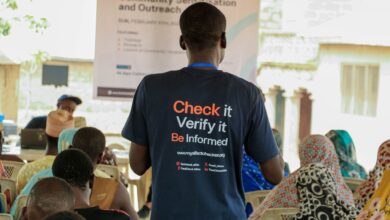
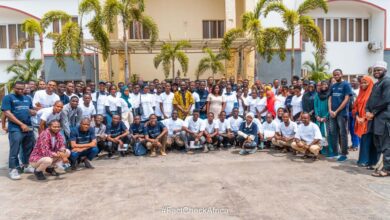
Through the Digital Democracy Lab project, with support from the Nigeria Youth Futures Fund (NYFF), FactCheckAfrica hosted in Ogun State a one-day workshop on the Fundamentals of Artificial Intelligence (AI) to hundreds of citizens, youth civic actors, and journalists.
The event held on Monday, February 9, 2026, at ABIIS Hotels and Suites in Abeokuta, Ogun State, was to empower the media and civic participants with efficient skills to use AI to foster transparency, accountability, and voting rights, as well as to sail through the dangers, particularly when approaching an election term.

The workshop was able to enhance the knowledge of participants regarding the way AI could support civic action and enhance the information ecosystem in Nigeria to resist the widespread menace of misinformation and other web-based harms.
Setting the Tone: Youth, Democracy, and Technology
In his welcome address, Habeeb Adisa, Head of programs at FactCheckAfrica underscored the importance of centring youth in conversations around technology, democracy, and media integrity. He noted that young people are not only the largest users of digital platforms but are also critical actors in shaping Nigeria’s democratic future.

Participants shared their expectations at the start of the workshop, highlighting the need for practical tools, ethical guidance, and locally relevant AI solutions that can help counter misinformation without shrinking civic space.
AI as “Poison or Antidote”
Delivering the keynote address, Professor Dele Odunlami, Dean of the Faculty of Social Sciences at Olabisi Onabanjo University, Ago-Iwoye, challenged participants to rethink artificial intelligence beyond the binary of good or bad.
Titled “Poison as Antidotes: Role of Artificial Intelligence and Fact-Checking in Enhancing Media Accountability and Combating Misinformation,” the keynote explored how the same technologies used to generate deepfakes, manipulated images, and AI-generated audio can also be deployed to detect, verify, and counter false information.

Professor Odunlami traced the evolution of media technology from the analogue era to the rise of large language models, arguing that misinformation has become more organised, professionalised, and technologically sophisticated. He warned that during election periods, AI-driven disinformation poses serious risks to democratic participation, public trust, and social cohesion.
“At this point, AI is the enemy you cannot hate,” he said, noting that rejecting the technology outright would leave fact-checkers and journalists at a disadvantage against well-resourced disinformation networks.
From Theory to Practice: Tools, Demonstrations, and Civic Use Cases
The workshop combined policy discussions with hands-on demonstrations. Ibrahim Mustapha Muhammed showcased MyAIFactchecker, Africa’s first AI-powered verification tool developed and designed by FactCheckAfrica to support journalists and citizens in identifying false or misleading claims.
In a practical session, Lukman Adeoti guided participants through the use of AI tools for journalism and civil society work, demonstrating applications for content verification, research assistance, and monitoring online narratives. Mustapha Lawal presented ongoing initiatives of the organisation, highlighting its work in AI literacy, grassroots media education, and the development of civic-tech tools aimed at strengthening accountability and public trust.

A dedicated session on AI-Assisted Civic Interventions for Inclusive Accountability and Social Change was facilitated by Blessing Oladunjoye, Executive Director of BO Foundation for Inclusive Media and Publisher of BONews Services. The session explored how AI can support advocacy, investigative journalism, and community monitoring, while remaining inclusive, transparent, and accountable. Participants were reminded that “AI is an assistant, not a judge,” and that unchecked automation can amplify harm as easily as it supports truth.
Calls for Collaboration, Ethics, and Inclusion
Throughout the workshop, speakers repeatedly underscored the need for collaboration among fact-checkers, media organisations, technologists, regulators, and civil society. Professor Odunlami called for stronger coordination ahead of future elections, involving institutions such as the Nigeria Fact Checkers Coalition, media platforms, academia, and relevant regulatory bodies.
He also stressed the importance of ethical AI use, including transparency about AI-assisted content, disclosure of verification methods, and safeguards against bias. Special attention was given to inclusivity, particularly the need to design AI tools accessible to underserved communities and persons living with disabilities.
Participant Reflections and Next Steps
Participants described the workshop as timely and practical, noting that the blend of policy discussion, demonstrations, and hands-on learning strengthened their understanding of both the opportunities and risks of AI in media work. Many committed to stepping down the training within their organisations and communities, echoing the workshop’s central message: that combating misinformation requires not only tools, but shared responsibility, ethical judgment, and sustained civic engagement.
As Nigeria’s information ecosystem grows more complex, the organisers reiterated their commitment to equipping journalists and civic actors with the skills needed to uphold accuracy, accountability, and democratic values in the age of artificial intelligence.