FACT-CHECK: Olubunmi Tunji-Ojo Did Not Exclude Southeast Nigerians from Accessing Passport Services


BY: Arinze Chijioke
Claim:
A social media post claiming that Olubunmi Tunji-Ojo, Nigeria’s Minister of Interior, has disqualified the Southeast region from printing international passports has resurfaced online. The post suggests that the minister has taken a decision to prevent the region from producing passports, prompting concerns and reactions among social media users.
Verdict: FALSE.
Full Text:
The Nigeria Immigration Service (NIS) introduced a phased migration of passport production to a centralised facility at its headquarters in Abuja as part of a nationwide modernisation programme.
The reform involves migrating passport offices across Nigeria, as well as Nigerian diplomatic missions abroad, to a centralised production framework. It is not a policy targeting the Southeast or excluding its residents from obtaining international passports.
In August 2026, the NIS further clarified that the centralisation of passport production was an operational reform and would not stop passport processing and issuance at any of its offices across the country.
The service explained that passport booklets would be printed and personalised at its headquarters in Abuja before being dispatched to passport offices nationwide and designated diplomatic missions abroad.
How the Claim Spread
On November 15, 2026, at about 10:37 a.m., an X user identified as @NemeremNjoku reshared a post alleging that Olubunmi Tunji-Ojo, the Minister of Interior, had disqualified the Southeast from printing international passports. The user questioned why the alleged decision was made.
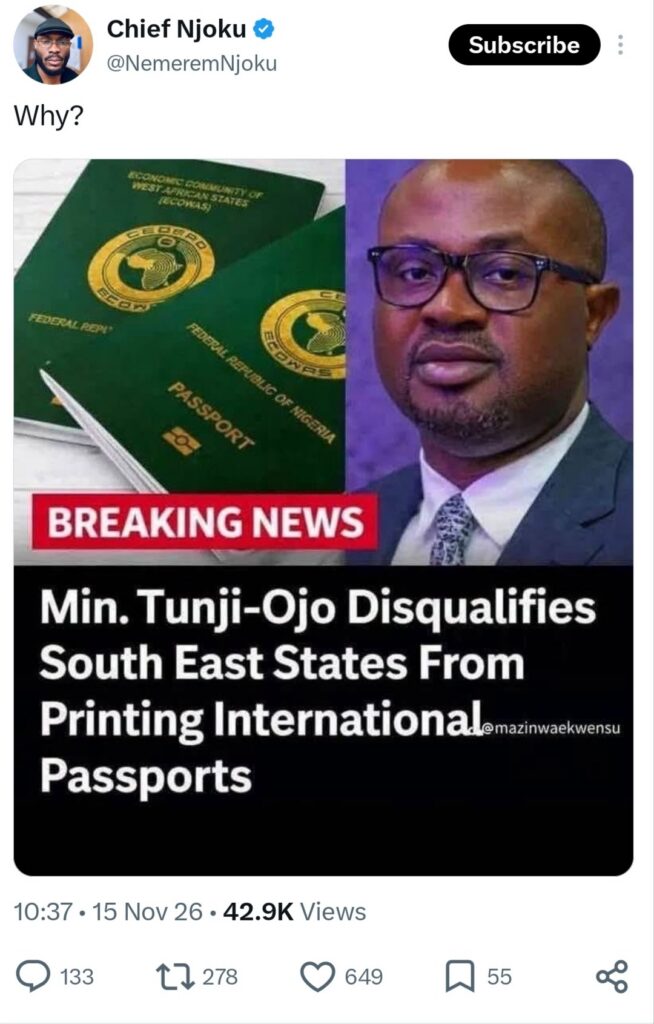
At the time of this report, the post had attracted about 41,000 views, 130 comments and 271 reposts on X.
Some users who came across the post appeared to believe the allegation.
One user, @OpenMediaNG, reacted: “They want us always to have to run to Lagos for everything so they can continue to treat our people like second-class citizens. I really hope a new batch of Igbo leaders will emerge. Not slaves like Umahi & Soludo.”

Another user, @MDonrymo, wrote: “That’s what happens when you keep forcing yourself where you don’t belong. Nigeria is not for you. After crying, your children will continue from where you stopped.”
Another user, @somtolism7 shared the image with the caption “ Ndigbo, Nigeria is not for you,”.
Similarly, @Quintanablfm attributed the alleged decision to claims about fake products originating from the region, writing: “That’s not the reason; you guys will produce fake passports if they allow you. You already gave 30% of eastern Nigeria kidney failure with your fake drinks in all kinds and fake toothpaste.”
The allegation was also shared across several Facebook pages and groups, including Wazobia Gist, Nigeria News, Island Politics, Angel Network News and Welcome to Anambra.
Verification:
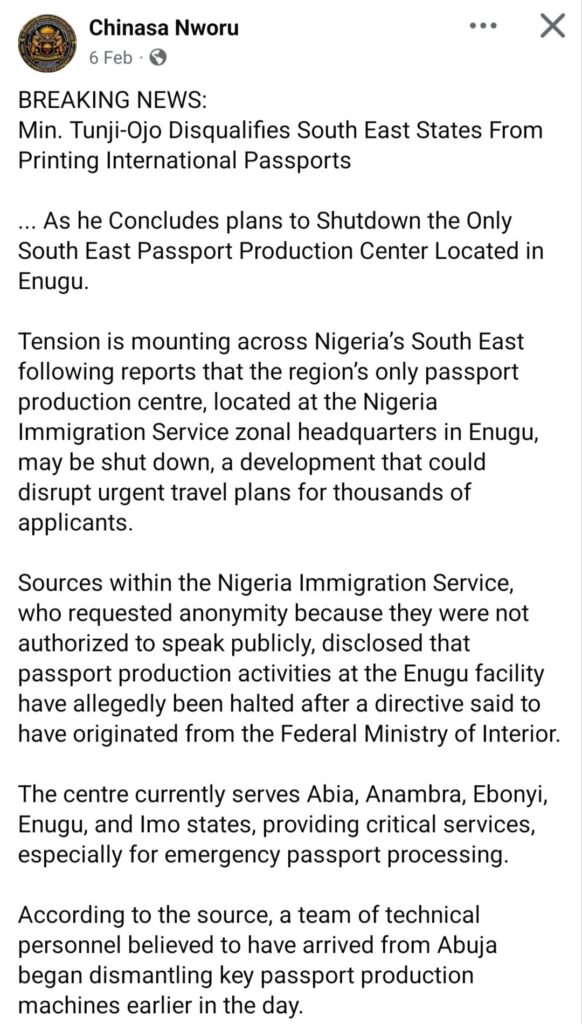
A review of earlier reports and statements from the Nigeria Immigration Service showed that the allegation is not new. It previously circulated on Facebook on February 6, 2026, when a user identified as Chinasa Nworu published a post claiming that the Minister of Interior had disqualified Southeast states from printing international passports.
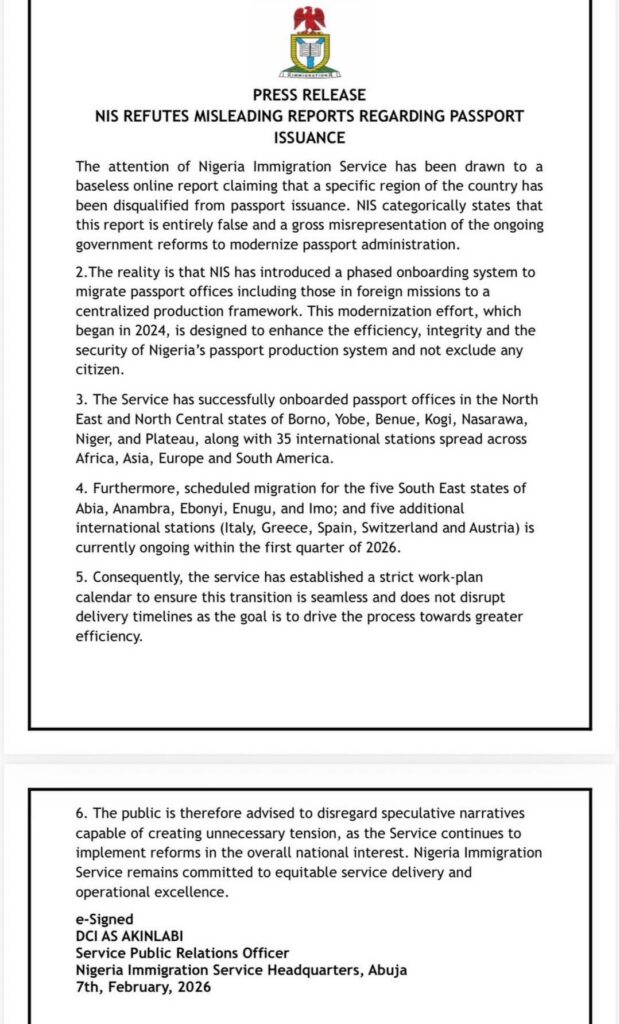
The following day, February 7, 2026, the NIS issued a statement dismissing the allegation as “entirely false and a gross misrepresentation” of its ongoing passport administration reforms.
In the statement, the Service’s spokesperson, Akinsola Akinlabi, explained that the government had introduced a phased onboarding system to migrate passport offices, including those in foreign missions, to a centralised production framework.
He said the modernisation programme, which began in 2024, was intended to improve the efficiency, integrity and security of Nigeria’s passport production system, not to exclude any citizen.
According to the NIS, passport offices in Borno, Yobe, Benue, Kogi, Nasarawa, Niger and Plateau states had already been migrated to the centralised system, alongside 35 international passport stations across Africa, Asia, Europe and South America.
The service also announced that the migration of passport offices in the five Southeast states, Abia, Anambra, Ebonyi, Enugu and Imo was scheduled for the first quarter of 2026, alongside five additional international stations in Italy, Greece, Spain, Switzerland and Austria.
The clarification was reported by Premium Times on February 8, 2026. The Deputy Speaker of the House of Representatives, Benjamin Kalu, also urged residents of the Southeast to disregard the allegation.
In a Facebook post, Kalu described the report about the alleged removal of the international passport printing centre in Enugu as fake news. He said he was present at a Federal Executive Council meeting where the Minister of Interior presented the phased onboarding system to President Bola Tinubu.
More importantly, the NIS issued another clarification on August 5, 2026, addressing concerns about the implementation of its passport centralisation reform. In the statement, reported by TheCable, the service explained that passport production was being transferred from offices across the six geopolitical zones to a central personalisation centre at its headquarters in Abuja.
It stressed that the migration was purely operational and would not stop passport processing and issuance at any passport office in Nigeria or designated Nigerian embassies and consulates abroad.
The service further explained that passport offices would continue to receive applications and issue passports, while the actual printing and security personalisation of passport booklets would take place at the central facility in Abuja.
This distinction is important: although passport production is being centralised, residents of the Southeast are not barred from applying for or obtaining international passports through the region’s passport offices.
Conclusion:
The claim that Olubunmi Tunji-Ojo has disqualified Nigerians from the Southeast from accessing international passport services is FALSE.
The Nigeria Immigration Service has clarified that the relocation of passport production to a centralised facility in Abuja is part of a nationwide reform affecting passport offices across the country, not a decision to exclude the Southeast.