BY: Oluwatoyin Hawal Momolosho
Claim:
A Facebook post by Joseph O Joel, shared in the group that the National Agency for Food and Drug Administration and Control (NAFDAC) has released a list of fake and counterfeit products circulating in Nigeria.
Verdict: FALSE.
Full Text:
The Facebook post reads:
“List of Fake and Counterfeit Products in Nigeria, According to NAFDAC.
Share it with your loved ones so they can also be informed and stay safe.
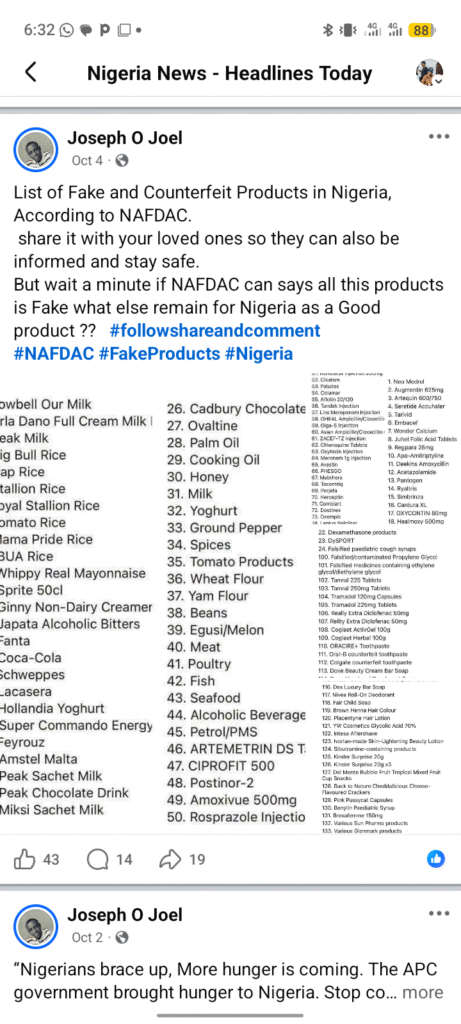
But wait a minute if NAFDAC can say all these products are Fake, what else remains for Nigeria as a Good product??”
The accompanying image contains more than 100 products and product categories, including Cowbell, Peak Milk, Coca-Cola, Cadbury Chocolate, Ovaltine, rice brands, palm oil, honey, medicines, cosmetics and personal care products.
It also lists broad categories such as meat, poultry, fish and seafood as fake or counterfeit.
Verification:
To verify the claim, FactCheckAfrica examined the viral Facebook post, reviewed NAFDAC’s regulatory alerts and consulted media reports concerning the agency’s response to the circulating list.
FactCheckAfrica found that NAFDAC publicly distanced itself from the circulating list on October 8, 2026, clarifying that the publication did not originate from the agency. The agency stated that the list should not be regarded as an official regulatory alert, product recall notice or safety communication. NAFDAC consequently advised Nigerians to disregard the publication and stop circulating it as an official agency document.
Further checks revealed that some products appearing in the viral compilation had previously been mentioned in separate NAFDAC regulatory alerts. However, these alerts were issued at different times and concerned different regulatory issues, including counterfeit products, falsified medicines, unregistered products and product recalls. These categories have different meanings and cannot be combined to suggest that every product appearing in the viral list is fake.
For instance, NAFDAC issued Public Alert No. 026/2025 on August 10, 2025, concerning counterfeit Cowbell “Our Milk” 12g sachets circulating in Nigeria. The alert identified specific counterfeit versions of the product that imitated the original packaging and branding. However, this did not establish that every Cowbell product was counterfeit.
Similarly, NAFDAC issued Public Alert No. 020/2025 on June 3, 2025, concerning unregistered Fair Child Soap found in Nigerian markets. This warning specifically addressed the unregistered product and did not mean that all cosmetic products were fake.
FactCheckAfrica also observed that the viral image includes broad categories such as palm oil, honey, meat, poultry, fish and seafood without identifying specific manufacturers, product batches or other verifiable details. Such generalisations can mislead consumers into believing that entire categories of food products have been declared fake by NAFDAC.
A further review of NAFDAC’s regulatory procedures shows that allegations involving counterfeit, adulterated or unsafe products require proper investigation, including product sampling and, where necessary, scientific and laboratory analysis. Official regulatory alerts are expected to provide identifiable information about affected products and the appropriate actions consumers should take.
Additionally, Africa Check published an investigation on October 23, 2026, titled “No, Nigeria’s food and drug regulator didn’t release ‘long list’ of fake products”, which also confirmed that NAFDAC had disowned the viral publication.
Conclusion:
Findings from this investigation establish that the viral list of fake and counterfeit products circulating on Facebook did not originate from NAFDAC.
Although some products mentioned in the publication have previously appeared in genuine NAFDAC regulatory alerts, those alerts concerned specific products, batches or regulatory issues. They do not authenticate the entire viral compilation.
NAFDAC has explicitly disowned the publication and advised Nigerians to disregard it rather than continue circulating it as an official regulatory document.
Consumers are advised to verify product safety information through NAFDAC’s official website and verified communication channels before sharing such claims on social media.