Mapping Hate: How Digital Narratives Are Fueling Fear, Division, and the Risk of Political Violence Ahead of Nigeria’s 2027 Elections

BY: Habeeb Adisa
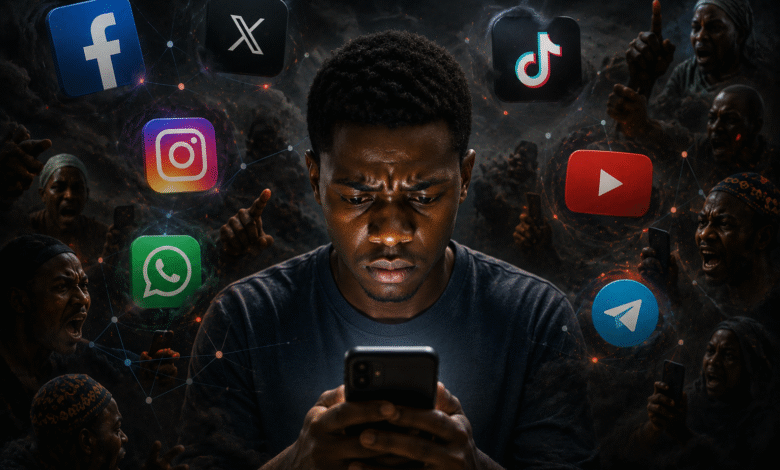
Nigeria is once again approaching a critical political season. Although the 2027 general elections are still months away, the battle for public opinion has already begun. This time, however, the battlefield is not merely the campaign ground, the television studio, or the town hall. It is the digital space—particularly X, Facebook, TikTok, WhatsApp, and other social media platforms—where inflammatory rhetoric, ethnic profiling, disinformation, and hate speech are increasingly shaping political conversations.
Recent analyses by media researchers, fact-checkers, and democratic governance organisations suggest that online narratives capable of inciting ethnic hostility, deepening regional distrust, and undermining democratic cohesion are already emerging. The danger is not merely that people are exchanging harsh words online. The danger is that Nigeria is confronting these digital tensions at a time when insecurity remains widespread across Benue, Plateau, Zamfara, Katsina, the North-East, and parts of the South-East and the South-West.
The National Human Rights Commission recently warned that hate speech poses a direct threat to democracy and national development ahead of the 2027 elections. According to the Commission, inflammatory rhetoric has the capacity to trigger violence, weaken social cohesion, and undermine democratic participation.
What makes the current moment particularly concerning is the convergence of several dangerous trends. First, ethnic political narratives are re-emerging online. Across social media, discussions about elections increasingly revolve around identity rather than policy. Political actors and supporters frequently frame political competition through ethnic and regional lenses, portraying entire communities as enemies rather than fellow citizens. Researchers monitoring online conversations ahead of 2027 have already documented examples of ethnic hostility and dehumanising language targeted at political opponents and ethnic groups.
Second, insecurity is being weaponised for political mobilisation. Every attack in Benue, every kidnapping in the North-West, every communal clash in Plateau, and every security operation in the South-East and South-West now generates waves of online commentary. Rather than encouraging sober analysis, many users exploit these incidents to advance ethnic blame narratives, spread conspiracy theories, or inflame religious tensions. Such narratives transform victims into political tools and deepen existing fractures within society.
Third, monetisation incentives on digital platforms are rewarding outrage. Fact-checking and digital rights organisations have observed that inflammatory content often receives greater engagement than factual reporting. The result is an ecosystem where divisive content is amplified because it attracts clicks, reactions, reposts, and visibility. This should concern every Nigerian regardless of political affiliation.
The United Nations has long maintained that hate speech often precedes violence. Contemporary research on political communication similarly shows that online hate can normalize discrimination, dehumanization, and eventually physical aggression. Studies examining Nigeria’s political environment have repeatedly linked hate speech with election-related tensions and violence. The implications are particularly serious in a country already struggling with terrorism, banditry, communal conflicts, farmer-herder disputes, separatist tensions, and widespread distrust of institutions.
When a citizen repeatedly encounters messages claiming that a particular ethnic group is responsible for national problems, that community becomes easier to fear. When political opponents are consistently described as traitors or enemies, democratic disagreement becomes harder to sustain. When insecurity is framed as evidence of ethnic conspiracy, citizens become more likely to support retaliation rather than dialogue.
In such circumstances, social media ceases to be a platform for communication and becomes a platform for mobilisation—sometimes for dangerous purposes. The responsibility for addressing this challenge does not lie with the government alone. Political parties must discipline supporters who engage in inflammatory rhetoric. Religious leaders must reject messages that demonise other communities. Traditional rulers must use their moral authority to calm tensions rather than inflame them. Civil society organisations must continue exposing harmful narratives before they gain momentum.
Nevertheless, the government has a crucial role to play. The solution is not censorship, as heavy-handed restrictions risk undermining legitimate political expression and democratic freedoms. Rather, authorities should invest in strategic responses that strengthen democratic resilience.
First, Nigeria needs a robust early-warning system for digital conflict indicators. Government agencies, universities, civil society organisations, and technology companies should collaborate to identify dangerous narratives before they escalate into offline violence. Second, digital literacy programmes must become a national priority. Citizens should be equipped to identify manipulated content, inflammatory propaganda, and coordinated disinformation campaigns.
Third, security agencies must improve their capacity to distinguish between lawful political expression and genuine incitement to violence. Enforcement should be transparent, evidence-based, and consistent. Fourth, technology platforms operating in Nigeria must invest more heavily in local-language moderation and context-sensitive content review. Hate speech often spreads in indigenous languages and cultural contexts that global moderation systems struggle to understand.
Finally, political leaders themselves must lead by example. Citizens often mirror the language of their leaders. When politicians embrace civility, public discourse becomes healthier. When leaders resort to inflammatory rhetoric, society follows.
Nigeria cannot afford another election cycle dominated by ethnic hostility, misinformation, and digital incitement. The stakes are too high. Communities are already grappling with insecurity, economic hardship, and declining trust in institutions.
The messages shared today may shape the realities experienced tomorrow. If Nigeria hopes to secure peaceful elections and strengthen national unity, it must confront hate speech not only as a communication problem but as a security challenge, a democratic challenge, and ultimately a nation-building challenge.
EDITOR’S NOTE
This article is a part FactCheckAfrica’s special series on digital hate speech, political disinformation, and online incitement ahead of Nigeria’s 2027 general elections.