PUNCH Journalist, Adetutu Sobowale Wins Reporter Slam, Recounts FactCheckAfrica’s Role in Deleted Post Controversy

BY: Mustapha Lawal
PUNCH journalist Adetutu Sobowale has won the inaugural Reporter Slam Nigeria after recounting her experience reporting the purported lifting of the United Arab Emirates (UAE) visa restrictions on Nigerians and how FactCheckAfrica helped her recover evidence of a deleted social media post central to the story.
Sobowale emerged as the winner of the competition on Wednesday, October 14, 2026, at Alliance Française, Mike Adenuga Centre, Ikoyi, Lagos. She scored a combined 119.90 points from the jury assessment and audience vote, according to PUNCH.
Her 10-minute pitch revisited a difficult episode in her journalism career in March 2024, when a post by Bayo Onanuga, Special Adviser to President Bola Tinubu on Information, announcing the purported resumption of UAE visa services for Nigerians was deleted after several news organisations had reported the development.
The experience left Sobowale needing evidence that the post had existed. She later credited FactCheckAfrica, where she had previously volunteered, with helping her recover a screenshot of the deleted post and providing evidence she needed to update her report.
How FactCheckAfrica helped recover the evidence
On March 5, 2024, Onanuga published a document purporting to announce the resumption of UAE visa services for Nigerians from March 4. The document, presented as a joint announcement by the Nigerian and UAE governments, circulated widely online.
Hours later, Onanuga contradicted the announcement, stating that the UAE had not resumed issuing visas to Nigerians and that the document in circulation was not authorised by either government.
For Sobowale, who had reported the initial announcement for PUNCH, the subsequent deletion created a reporting challenge. She said her editor needed proof that the post had existed, but she had not taken a screenshot before it disappeared.
In a message to FactCheckAfrica’s leadership ahead of the competition, Sobowale recalled that a member of the organisation’s team contacted her that night after seeing her report and asking what had happened.
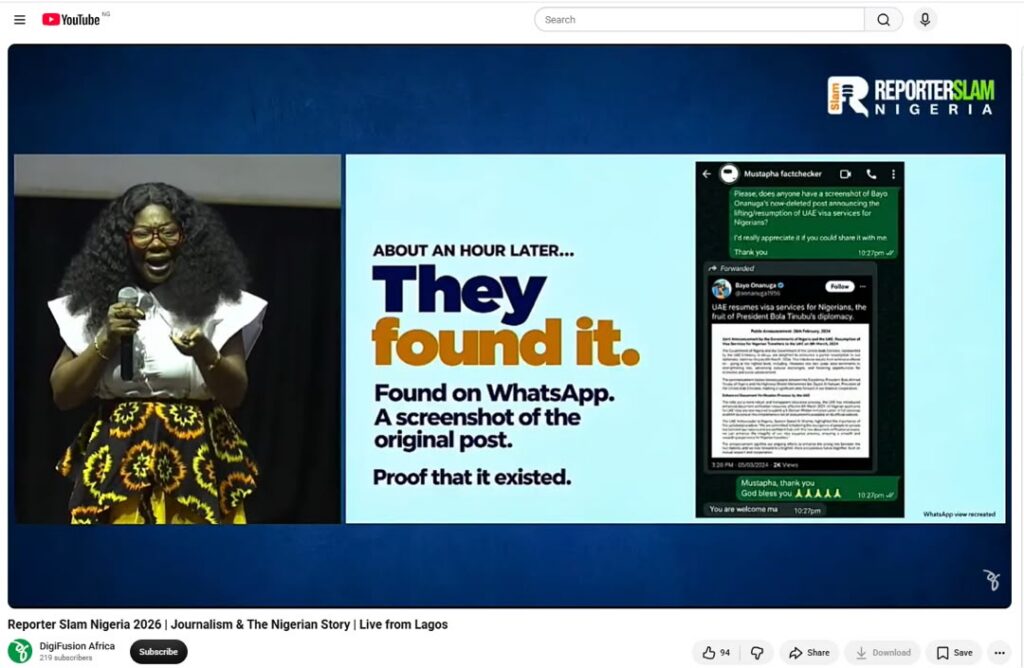
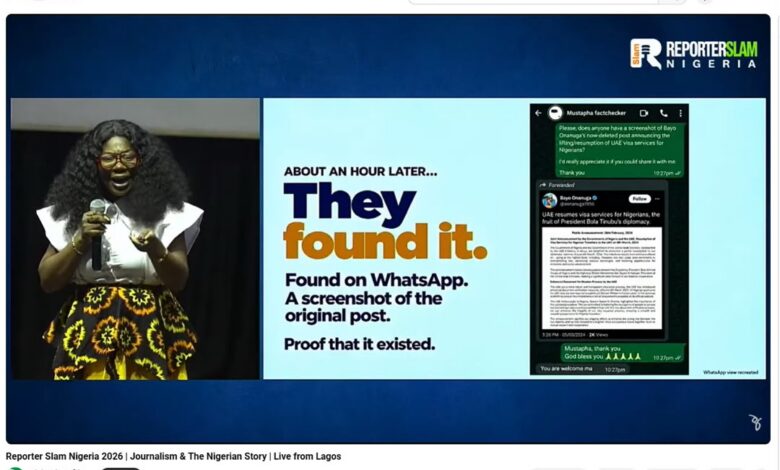
Caption: Screenshot from the ReportSlam Nigeria LiveStream on YouTube showing Adetutu on stage during her pitch
According to her account, the FactCheckAfrica team joined the search for the missing post and eventually recovered a screenshot, which it sent to her via WhatsApp.
The screenshot became the evidence she needed to update her report.
The incident illustrates how journalists can face difficulties documenting information when original social media posts are deleted, particularly when the information has already been published by news organisations and subsequently disputed.
FactCheckAfrica documented the controversy
Beyond helping Sobowale recover the screenshot, FactCheckAfrica published an explainer examining the claim that the UAE had resumed visa services for Nigerians.
The report, titled “Explainer: UAE Has Not Resumed Visa Services for Nigerians,” was authored by Mustapha Lawal and published on March 5, 2024. It documented the viral announcement, the unauthorised document circulated alongside it and Onanuga’s subsequent clarification that visa issuance had not resumed.
The explainer also examined an earlier episode in September 2023, when announcements suggesting that the UAE had lifted its visa restrictions on Nigerians were contradicted by UAE authorities.
By documenting the initial claim and the subsequent denial, the report provided a contemporaneous record of the controversy. Together with the screenshot recovered by the team, it helps preserve the sequence of events surrounding the deleted post.
The episode highlights two related functions of fact-checking in the digital information environment: examining the accuracy of public claims and documenting the evidence needed to understand how those claims emerged and were subsequently corrected or disputed.
Read the full report: UAE Has Not Resumed Visa Services for Nigerians.
The story behind the headline
Speaking about her performance after winning the competition, Sobowale said the experience had left a lasting impression on her, particularly because she had previously worked as a fact-checker, scrutinising claims made by others.
“Actually, that story traumatised me. You know why? I am a fact-checker, I wrote a story, a breaking news and it was a big story, then all of a sudden it was tagged fake,” she said, according to PUNCH.
Her presentation focused on the personal and professional consequences of reporting a development that was subsequently disputed, including the embarrassment and uncertainty she experienced after the original post was deleted.
Sobowale had shared the experience with FactCheckAfrica’s leadership before the competition, explaining that the organisation’s intervention was an important part of the story she intended to tell.
She said she could not recount the episode without acknowledging the team that helped her find the missing evidence.
Following her victory, she also thanked FactCheckAfrica for its support, describing the competition as an opportunity to bring attention to the organisation’s contribution to her professional journey.
She said the experience had reinforced the value of fact-checking, teamwork and professional solidarity, adding that the achievement felt shared with those who had supported her.
Why preserving digital evidence matters
The controversy underscores a challenge in contemporary journalism: information published on social media can be deleted or altered, even after news organisations have relied on it in reporting breaking developments.
When the original material disappears, journalists may need to establish what was published, identify the source and document the sequence of events. Screenshots, archived material and contemporaneous reporting can help preserve a record, although each must be assessed in context and, where possible, corroborated with independent evidence.
In Sobowale’s case, the screenshot recovered by FactCheckAfrica helped her address her editor’s request for proof of the deleted post. The organisation’s published explainer separately documented the claim and the subsequent denial.
The experience demonstrates how collaboration between journalists and fact-checking organisations can support efforts to maintain an accurate public record when online evidence becomes difficult to retrieve.
For Sobowale, an episode that began with a deleted post in March 2024 eventually became the story she told on stage more than two years later. Her victory at Reporter Slam Nigeria brought renewed attention to the challenges journalists face when reporting fast-moving developments, and to the importance of preserving evidence behind the headlines.
Sobowale is expected to represent Nigeria at Reporter Slam Africa, where she will share her story with a wider audience.