BY: Eniola Ahmadu
An Associate Professor at Fountain University, Osogbo, Dr. Rasheed Adebiyi, has warned that false security reports and misleading information about polling-unit locations could suppress voter turnout in the 2026 Osun State governorship election.
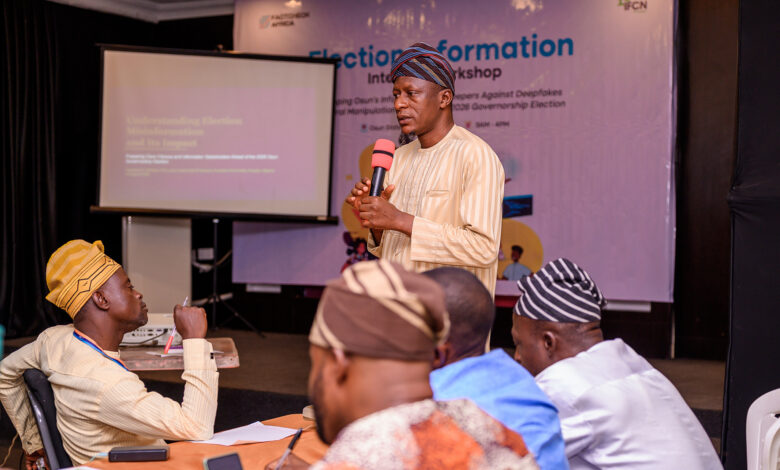
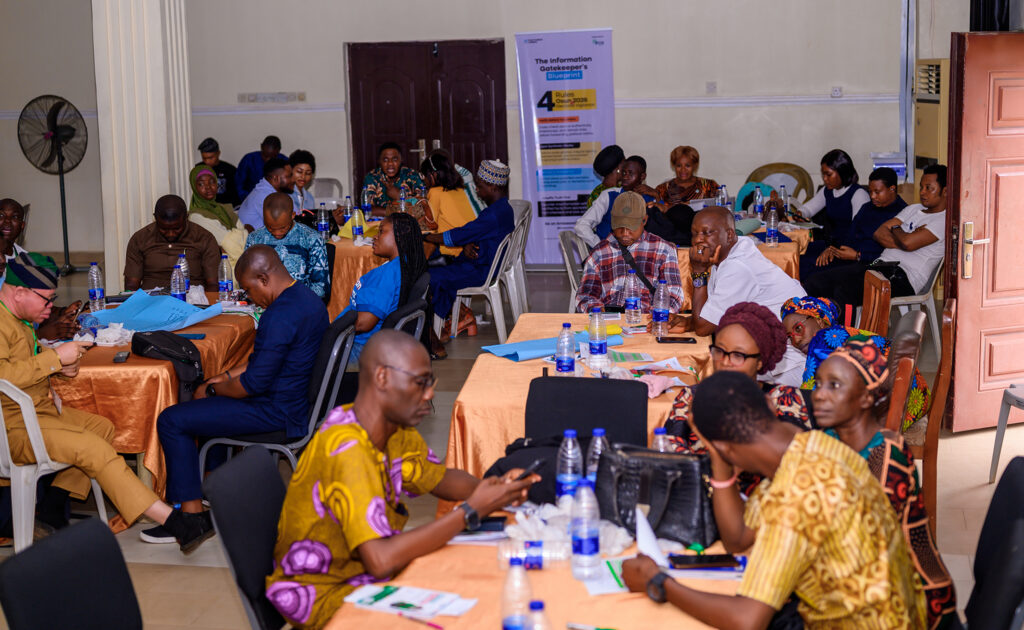
He made this known at a workshop organised by FactCheckAfrica to prepare journalists and information stakeholders ahead of the election.
The workshop, themed “Preparing Osun Citizens and Information Stakeholders Ahead of the 2026 Osun Governorship Election,” was held on August 8, 2026, at Osogbo Holiday Inn Hotel & Suites Ltd, Dada Estate, Osun State.
Adebiyi, while addressing participants on election misinformation and its impact, identified misinformation, disinformation and malinformation as three forms of information disorder capable of threatening election integrity.
He explained that misinformation involves false information shared without the intention to deceive, while disinformation is deliberately created or shared to deceive or manipulate. Malinformation, he added, involves genuine information shared maliciously to cause harm.
According to the academic, election misinformation can have direct consequences for voter participation, particularly when false information is used to create fear or confusion among citizens.
He identified fake security reports and rumours about changes to polling-unit locations as examples of information that could stop voters from going to polling centres.
He also warned that misinformation could confuse voters and disrupt the flow of voting on election day through false reports of violence, fake statements attributed to the Independent National Electoral Commission (INEC), misleading polling-unit information, old video footage presented as current events and premature announcements of election results.
Adebiyi noted that election misinformation could reduce public trust in elections, increase fear and tension, deepen political division, damage the reputations of candidates and undermine confidence in institutions such as INEC, security agencies and election observers.
The Associate Professor further warned that information disorder could continue after voting, with fake election results, false declarations of victory, manipulated result sheets and coordinated false rigging narratives undermining the legitimacy of the electoral outcome.
To counter the spread of harmful information, participants were urged to adopt a “Verify, Validate, Value” approach before publishing or sharing election-related claims.
Participants were urged to ask five questions before amplifying election-related information: whether the claim is true, who the original source is, whether it has been independently verified, who benefits if people believe it, and whether sharing it could increase tension.
Similarly, Israel Olátúnjí Tijani, the founder of ChatVE, identified the rapid production and distribution of manipulated content as a growing challenge to election information integrity, noting that photorealistic images, cloned voices and face-swapped videos could now be created within minutes using free or low-cost tools.
Tijani, a data scientist, also noted that such content spreads rapidly through WhatsApp, Facebook and radio call-in programmes, particularly in local-language spaces, often reaching citizens before fact-checkers or institutions have an opportunity to verify and correct the claims.
To address the challenge, he recommended a coordinated verification and response process involving citizens, journalists, fact-checkers, electoral authorities, security agencies and civil society organisations.
Tijani urged journalists and fact-checkers, on their part, to apply a combination of open-source intelligence and verification techniques, while ensuring that corrections receive sufficient visibility to counter the reach of the original misinformation.
He stressed that relying solely on artificial intelligence detection tools would not be sufficient to establish whether election content was genuine.
In combating information disorder ahead of the election, he recommended a broader verification workflow involving reverse image and video searches, metadata checks, geolocation, chronolocation, contextual verification, supplementary AI detection and cross-checking with fact-checking organisations.
According to him, one unusual feature in an image or video should be treated only as a clue and not as conclusive evidence of manipulation.
Additionally, he emphasised the importance of local knowledge in detecting manipulated content, noting that familiarity with Nigerian and Yoruba sociocultural contexts could help identify inconsistencies that outsider-trained detection systems may overlook.