FACT-CHECK: Viral Post Misrepresents Seun Okinbaloye’s Remarks on 2027 Election Rigging

BY: Oluwatoyin Hawal Momolosho
Claim:
Seun Okinbaloye said President Bola Tinubu and the Independent National Electoral Commission (INEC) had rigged Nigeria’s 2027 general elections.
Verdict: FALSE
Full Text:
Ahead of Nigeria’s 2027 general elections, concerns about the integrity of the electoral process have intensified following reports of suspicious photographs and questionable records in INEC’s preliminary Register of Voters.
The controversy gained further attention on October 30, 2026, after Okinbaloye warned during Channels Television’s Politics Today programme that electoral manipulation could begin long before election day if irregularities in the voter registration process were not addressed.
His remarks subsequently circulated on social media, where they generated debate about the credibility of the forthcoming election and the responsibility of electoral authorities.
On October 31, 2026, an X user, @LM_MessiRebirth, shared a video featuring Okinbaloye alongside a caption attributing a more specific allegation to him.
The caption reads:
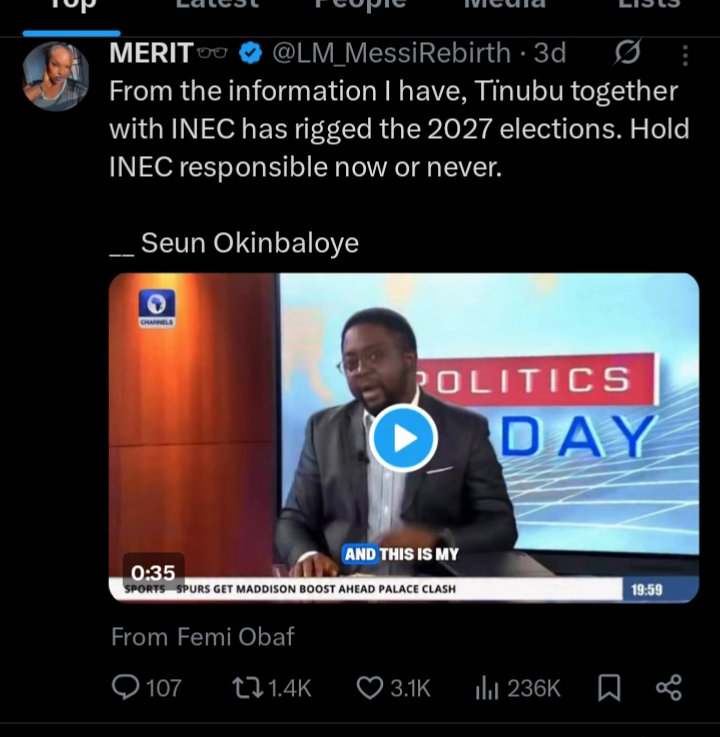
“From the information I have, Tinubu together with INEC has rigged the 2027 elections. Hold INEC responsible now or never.”
The post, which featured footage from Politics Today, presented the statement as a direct quotation from the journalist.
However, the attribution raises a critical question: Did Okinbaloye actually accuse Tinubu and INEC of having rigged the 2027 elections, or did the post misrepresent his warning about electoral vulnerabilities?
Verification:
To verify the claim, FactCheckAfrica reviewed footage of the Politics Today broadcast on Channels Television in which Okinbaloye discussed electoral integrity with Oluwole Osaze Uzzi, a former INEC director.
The discussion took place against the backdrop of concerns about suspicious photographs and other questionable records appearing in the commission’s preliminary voter register.
During the programme’s closing segment, Okinbaloye warned that election manipulation could occur before election day through weaknesses in the electoral process, particularly the voter registration system.
He said:
“But this is my parting words tonight, the election is usually not rigged on election day. Don’t get it wrong, and whatever you may be jumping around all the town halls and the political podiums and platforms, the rigging of the election has in fact begun very few months ago and it’s still much in progress. If you don’t take action and speak up now, forget it, 2027 is already rigged and this is time to clean it up and make sure it doesn’t happen.”
A review of the remarks shows that Okinbaloye warned about the possibility of electoral manipulation through systemic weaknesses. However, he did not mention Tinubu or identify any political party as responsible for the alleged manipulation.
The viral post therefore changes the substance of his remarks by attributing a specific accusation against the president and INEC to him. The distinction is important because a warning that the electoral process may be compromised is not equivalent to a direct allegation that named political actors have jointly rigged an election.
The statement attributed to Okinbaloye in the viral post did not reflect what he said during the broadcast.
Further checks found that Okinbaloye addressed the controversy during Channels Television’s Sunday Politics programme on November 1, 2026.
According to reports published by Nigerian media organisations, the journalist explained that his warning was not directed at a particular political party, candidate or individual.
He maintained that his concern was the possibility of electoral manipulation through questionable voter registration records and the need for INEC to address identified weaknesses before the 2027 general elections.
The clarification reinforces the distinction between warning about vulnerabilities in the electoral system and accusing a named political figure of participating in an established rigging operation.
Meanwhile, the concerns that prompted Okinbaloye’s warning are linked to a separate issue involving questionable entries in INEC’s preliminary voter register.
On October 27, 2026, the commission acknowledged concerns about suspicious photographs and other irregularities identified during the public scrutiny of the register.
INEC said it was investigating the questionable records and explained that the online preliminary register remained subject to verification and correction before the final register was certified.
Subsequently, reports published on October 30 quoted the commission’s Director of Information and Communication Technology, Lawrence Bayode, as saying that some registration officers had introduced questionable records into the database using their official access credentials.
The reports stated that some photographs were AI-generated, while other irregularities resulted from poor registration procedures.
These disclosures provide evidence that the preliminary voter register contained irregularities requiring investigation. They do not, however, establish that Tinubu and INEC had jointly rigged the 2027 election.
Neither the existence of suspicious photographs nor the reported involvement of registration officers is, on its own, sufficient to prove that the forthcoming election has already been manipulated in favour of a particular candidate or political party.
Conclusion:
The claim that Seun Okinbaloye accused President Bola Tinubu and INEC of rigging Nigeria’s 2027 elections is FALSE.
Okinbaloye warned about possible electoral manipulation due to weaknesses in voter registration but did not accuse Tinubu or INEC of rigging the election. He later clarified that his comments targeted no specific party, candidate or individual.
Although INEC has acknowledged irregularities in its preliminary voter register and launched an investigation, these concerns do not support the viral claim.