BY: Oluwatoyin Hawal Momolosho
A viral social media post claiming that a man in Abuja contracted diphtheria after eating sliced watermelon has sparked concerns about the safety of roadside fruits and the spread of the disease.
The post, shared by a social media user identified as Biyi (@Cornecares), featured a photograph purportedly showing a 47-year-old man identified as Simeon Okoh. It claimed that Okoh bought sliced watermelon at Kabusa Junction in Abuja on September 12, 2026, developed sores and difficulty swallowing, and was later diagnosed with diphtheria.
The post further claimed that the infection was traced to the watermelon and urged residents to stop buying sliced fruits from roadside vendors.
However, the Federal Capital Territory Health Services and Environment Secretariat (HSES), after investigating the claim, said it found no evidence to verify the identity of the person in the photograph, the alleged address or the reported diphtheria case.
So, what does the evidence show, how does diphtheria spread, and can eating watermelon cause the infection?
What did the viral post claim?
The post alleged that Simeon Okoh, said to be living in Kabusa Garden Estate in Abuja, bought sliced watermelon from a roadside seller and ate it for dinner.
According to the post, he developed sores on his lips within hours and later experienced difficulty swallowing and a stiff jaw. It claimed that he was subsequently taken to a hospital, where he tested positive for diphtheria.
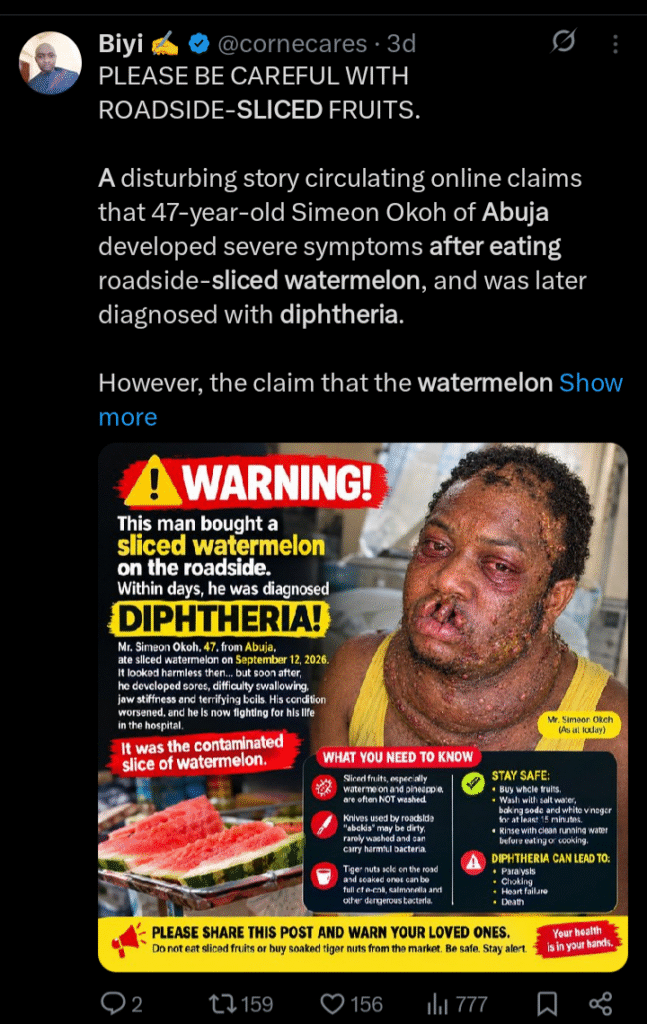
The post then attributed the alleged infection to the watermelon and warned Nigerians against buying sliced fruits from roadside vendors.
It also made several other claims about the hygiene practices of fruit sellers and alleged that contaminated water and knives used by vendors could transmit various bacteria, including the bacterium associated with diphtheria.
However, the post did not provide a medical report, laboratory result, name of a hospital or other independently verifiable evidence confirming the alleged diagnosis.
Did the FCT investigate the claim?
Following concerns generated by the viral post, the FCT Public Health Department, in collaboration with the Abuja Municipal Area Council (AMAC), deployed a multidisciplinary Rapid Response Team to investigate.
The team visited the location mentioned in the post on September 28, 2026.
According to the FCT Health Services and Environment Secretariat, physical inspection and enquiries with estate management showed that the address provided in the social media post did not correspond with the estate’s road designations.
Estate management also could not identify a resident matching the details contained in the post and reported no knowledge of the alleged incident.
The investigation team also checked the FCT diphtheria line list and records at the National Reference Laboratory in Gaduwa but did not find a corresponding record. The alleged patient was also not located.
Did the investigation confirm that the man had diphtheria?
The FCT Health Services and Environment Secretariat said the photograph and information accompanying the social media post could not be verified as genuine or linked to a confirmed diphtheria case in the FCT.
The investigation therefore did not establish evidence supporting the alleged diagnosis or the claim that the illness was caused by watermelon.
This distinction is important because the presence of a photograph does not, by itself, establish the identity of the person shown or confirm a medical diagnosis.
Similarly, a description of symptoms in a social media post cannot replace medical examination and laboratory testing.
How does diphtheria spread?
Diphtheria is a serious bacterial infection usually caused by toxin-producing Corynebacterium diphtheriae.
The FCT Health Services and Environment Secretariat says the disease spreads mainly through respiratory droplets and direct contact with infected respiratory secretions or skin lesions.
This means that the established routes of transmission are different from the route described in the viral post.
The FCT investigation did not establish that the consumption of watermelon caused the alleged illness. Therefore, while poor food hygiene can expose people to other foodborne illnesses, the available evidence does not support the specific claim that eating the watermelon described in the viral post caused diphtheria.
Can contaminated food transmit diphtheria?
The viral post presented contaminated watermelon as the source of the alleged infection. However, the FCT investigation found no evidence establishing that the watermelon was contaminated with Corynebacterium diphtheriae or that it caused a confirmed case of diphtheria.
The public health authority specifically said its investigation did not establish a link between watermelon and the alleged illness. It is therefore important not to move from a general food-safety concern to a specific medical conclusion without evidence.
Cut fruits should, of course, be handled and stored hygienically. But concerns about food hygiene do not, on their own, demonstrate that a particular fruit caused diphtheria.
Is diphtheria a real concern in Abuja?
The FCT’s rejection of this particular social media claim does not mean that diphtheria is absent from the territory. The FCT Health Services and Environment Secretariat said its ongoing diphtheria response remains active and urged residents to remain vigilant and report suspected cases promptly.
The secretariat said most cases recorded during the current FCT outbreak have been among children, particularly those aged five to nine years, many of whom were unvaccinated.
It therefore urged parents and caregivers to ensure that children receive all vaccinations recommended for their age, including the three primary doses of the diphtheria-containing pentavalent vaccine administered through routine childhood immunisation.
What are the symptoms of diphtheria?
Diphtheria can cause symptoms including fever and sore throat and may lead to more serious complications. The FCT health authorities advised residents experiencing symptoms such as fever, sore throat, neck swelling or difficulty swallowing to seek medical assessment promptly.
They also warned that difficulty breathing requires urgent medical attention. These symptoms, however, should not be used to diagnose diphtheria from a social media post. A suspected case needs to be assessed by healthcare professionals and investigated through the appropriate public-health channels.
Why did the watermelon claim spread?
The claim combined several elements that can make health misinformation particularly persuasive: a photograph, a named individual, a detailed account of illness, a specific food alleged to be responsible and a warning directed at the public.
The post also included advice about washing fruits and avoiding sliced foods, which may make the broader story appear credible even when the central claim has not been independently established.
But the FCT investigation found key details in the story, including the alleged address, identity of the person and corresponding diphtheria record but could not be verified.
Should Nigerians stop buying sliced watermelon?
The investigation does not provide evidence that Nigerians should stop eating watermelon because of diphtheria. The FCT specifically said its findings did not establish a link between watermelon and the alleged illness.
This does not remove the importance of food hygiene. Consumers should still be cautious about how fresh fruits are washed, cut, stored and handled. But such precautions should be based on established food-safety guidance rather than an unverified claim that a particular fruit caused diphtheria.
The FCT also urged the public to avoid stigmatising residents, communities or food vendors because of unverified health claims.
What should people do when they encounter health claims online?
Health claims can have consequences beyond social media engagement, particularly when they concern infectious diseases.
Before sharing such a claim, users should ask:
– Has the alleged patient been independently identified?
– Has a health authority confirmed the case?
– Is there evidence of a laboratory diagnosis?
– Has a hospital or qualified medical professional confirmed the information?
– Does the claimed route of transmission agree with established medical evidence?
– Can the information be verified through an official public-health source?
In the Abuja watermelon case, the FCT investigation did not establish the identity of the alleged patient or a corresponding confirmed diphtheria case.
Conclusion
The viral claim linking sliced watermelon to a diphtheria case in Abuja has not been substantiated. The FCT investigation could not verify the alleged patient, address or corresponding diphtheria case, and it found no evidence establishing a link between the alleged illness and watermelon.
Diphtheria, however, remains a genuine public-health concern in the FCT. The disease is vaccine-preventable and spreads mainly through respiratory droplets and direct contact with infected secretions or lesions.
The Abuja watermelon claim therefore highlights the importance of separating a real public-health concern from an unverified explanation of its cause. For now, the available evidence supports the conclusion that the viral story should not be used as evidence that eating sliced watermelon causes diphtheria.