Special Report: The Information Pandemic Paralysing Academic Stability in Nigerian Basic Schools

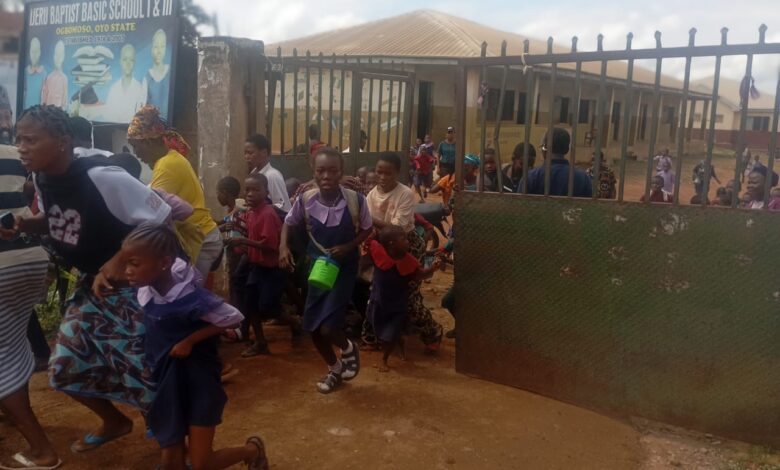
School-children, parents scrambling for safety in Oyo. Credit: Muheeb Mashood
BY: Muheeb Mashood
It was around 9:15a.m., on Thursday, 18th June, 2026. Students were in the middle of a morning lesson. The premises of Government Girls Secondary School, Oke-Oyi, Kwara State, North Central Nigeria, was calm and peaceful. A few minutes later, the atmosphere turned chaotic. An untrue and misleading viral information circulating the presence of bandits has gripped the whole community, and pierced directly into the school. Everything that followed was panic, academic disruption, and the effect of ghost-bandits terrorising people’s minds as a result of unverified information. As the staff scrambled for safety, parents flooded the school to withdraw their children and wards.
The truth later surfaced and the calm was later restored. But it istoo late before the Kwara State Police Command could come with the true story behind the narrative upon completing investigations.
“The Command received reports of panic and commotion around Government Girls Day Secondary School, Oke-Oyi, following claims that suspected bandits had invaded the school premises,” the police’s press release partly carried. “The Divisional Police Officer, Oke-Oyi Division, promptly mobilized personnel to the scene to assess the situation and ensure the safety of students, staff, and residents.”
The police investigations revealed that the false alarm travelled to the school when a woman stormed the school premises with the unverified terror attack. The presence of threats of bandits within the school or anywhere in the community was later debunked. The Command therefore discouraged the public from relying on the basis of unverified information and promised a severe sanction upon apprehension of the perpetrators behind the false narrative.
As the security crisis extended to the North Central upward to the South Western states like Oyo, the Kwara incident is not an isolated issue. The event reflects a growing pandemic pushing residents to fear while crippling academic activities in Nigeria’s basic schools. In this report, Muheeb Mashood speaks with multiple sources to expose the implications of falsehood on the education system in Nigeria amid growing insecurity, while examining the efforts of authorities to curb the information pandemic.
From 2025, Kwara has been turned into an epicenter of insecurity, with the news of attacks from non-state actors dominating the headlines more than any other topic. This has deformed the state’s longtime reputation as the “State of Harmony”. The crisis reached its peak after the Woro Massacre that drew global attention. During the attack, residents were brutally violated when terrorists linked to the Sadiku-Led Boko Haram faction invaded the helpless community and raided for almost several hours without reprisal, killed counts of people, set millions of property ablaze, and matched hundreds of captives into deep forest.
Currently pushed to the forefront of the insecurity is Oyo, a state sitting at the heart of the South Western region of Nigeria. Recall that in May 2026, suspected bandits launched a coordinated attack on Orire Local Government Area of the state. Topical among the casualties is the abduction of school-age pupils, students, and school staff. While one of the teachers was reported to have been brutally killed by the bandits, other victims remained in captivity for 56 days until 44 captives were later freed on 10th July, through rescue efforts as claimed by the government.
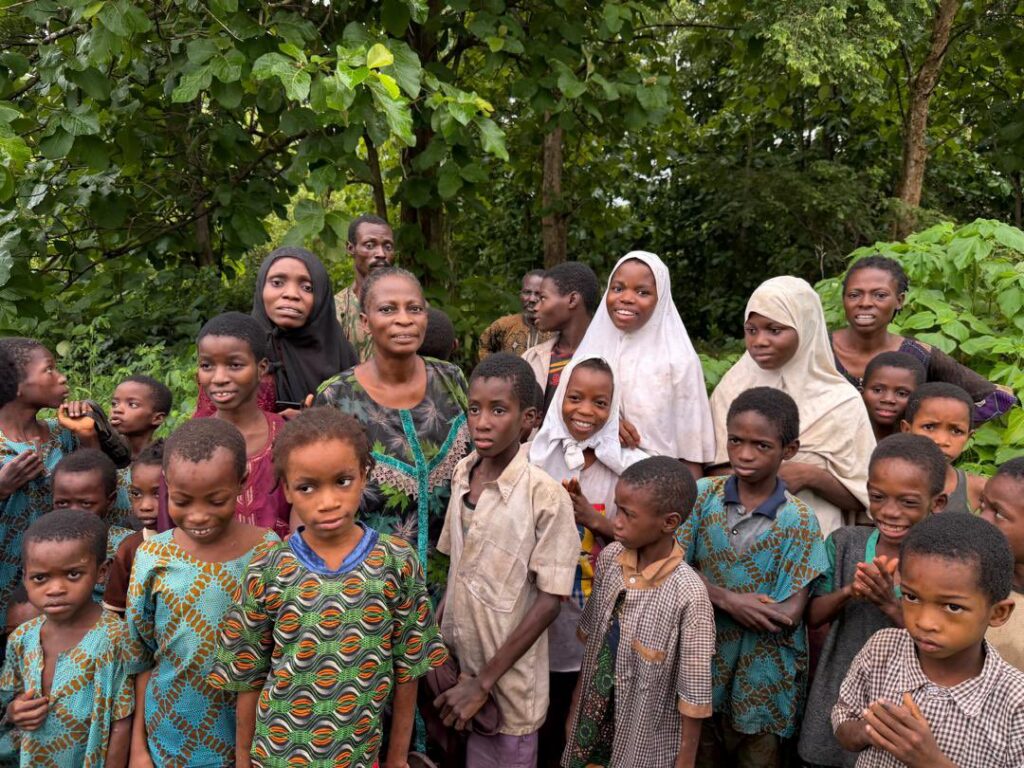
The Oyo school kidnapping victims after regaining freedom. Credit: Bayo Onanuga X page
New Target, Growing Economy
As insecurity intensified across the country, terrorists have shifted focus to schools in a move to boost their booming kidnap-for-ransom economy. The pattern is simple. Attack schools, match captives into forest, put booty into victims’ heads, and start negotiation for release. So far, this new tactic has unlocked another resource for the terrorists. As victims’ families were compelled to arrange ransom, the governments are being lured to make a compromise. Also, crowdfunding is commonly raised through public appeal for the victims.
In November 2025, gunmen raided St. Mary’s Catholic Primary and Secondary Schools in Papiri, Agwara District of Niger State. According to the information released by the Catholic Diocese of Kontagora, the incident saw 230 pupils and staff taken into captivity. This sparked outrage after initial reports of over 300 victims who went missing. The victims later regained freedom after a turn of military exercises portrayed as rescue manhunts by the government. However, the Federal Government of Nigeria reportedly paid a huge ransom of approximately N2 billion to Boko Haram insurgents to secure the freedom of over 200 abducted victims. The investigation would later be refuted by the federal government.
In that same November, during a midnight attack, at least 25 schoolgirls were abducted by terrorists from Maga Comprehensive Girls’ Secondary School in Danko Wasagu Local Government Area of Kebbi State. The terrorists reportedly killed a teacher, Hassan Makuku, and a local guard during the raid.
The above two incidents have extended beyond security breach. They have become a new method to secure ransom payment. Every target exposed a new crisis impacting the educational system in Nigeria. As this crisis is becoming out of hand, a very disturbing trend has emerged. The perpetrators of disinformation now weaponise this sensitive matter to sow deep discord into vulnerable communities. Therefore, the fear of safety continues to fuel information disorder, and interrupt academic activities in Nigeria.
Aisha Balogun, a secondary school student at Al-Awal College, Oko-Olowo, Ilorin, Kwara State, has lived the reality too well. Aisha once received a direction from her mother to go and withdraw her siblings during the school hours on 5th June. Acting on the information, she sprinted to Al-Hamana Nursery and Primary School, a private school in the Oko-Olowo community and withdrew her siblings.
I thought everyone of us was going to die that day,” Aisha examined the degree of fear the residents were thrown into. “That day, the way everybody is running helter-skelter is so terrifying. The parents were putting off their children’s school uniforms right away from the spot.
Aisha disclosed that the incident kept children at home and shut down schools across the locality in the following days. She further decried the spread of the false information. While recounting the life-threatening tolls she was subjected to on that fateful day, she said, “I couldn’t eat despite how starving I am ‘m before receiving the call from my mother.” She shivered throughout that day due to the shock resulting from the falsehood.
The untrue information spread around 11:00a.m., when some of the schools were conducting Continuous Assessment (CA) tests. At Aisha’s school, they are in the middle of academic exercises like debating, spelling bee, and other schedules. But everyone, including the teachers, left their classes and abandoned the activities while scrambling for safety.
Such ghost-presence of bandits has become so recurrent across the state that Aisha came across similar information a few days after. But this time around, she was unperturbed.

Al-Hamana Nursery and Primary School, Oko-Olowo, Ilorin, Kwara State. Credit: Muheeb Mashood
I can’t even believe such kind of information again in my life, because I know it’s all lies. Even if it’s true, they would rather come and kill me because I can’t believe it again.
Education Underfire
It has already stretched over a month since Kwara’s incident occurred. But the traces left behind by the chaos still lingers with the ghost attack. During an interview, Abdulrahman Kabir, the Headmaster of Al-Hamana Nursery and Primary School, corroborated Aisha’s accounts. He quickly shared the impacts of the misleading information on academic activities in the school. Some of the parents are not fully dressed, he said, pointing to the degree of discord sowed in the minds of guardians, prompting them to storm the school premises and withdraw their children from learning.
He stressed that some parents who are not available to pick their wards sent relatives to the school. To ensure the safety of every pupil, the school headmaster gave a directive that whoever showed up to withdraw children on behalf of their parents should write down their information, including their phone numbers, in order to confirm and establish their relationship with the pupils. However, while the majority of the guardians were in too much of a hurry to leave the school, everybody feared that the bandits would ambush them in the scene — hence, the order was disorganised in no time.
The fear later resulted in a physical altercation between the guardians and the teachers. As the school management insisted on the above directive to avoid releasing children to unsafe hands, the guardians quickly cited the Oyo school-children’s kidnapping incidents and opted for violence when the teachers stood their grounds, Mr Abdulrahman said.
“With the security condition of the country, I can’t allow you to pick any child, except the recognised parents,” Mr Abdulrahman was taken aback to the point when the tension became out of control. “You said you are running from bandits, we do not want to run into another problem too.”
Some teachers that tried to control them were physically assaulted. They are just shouting ‘we don’t want the unfortunate incident that happened in Ibadan to befall our children here.
Mr Abdulrahman revealed that the following weeks saw the school recording poor attendance of pupils. It took the intervention of placing several calls to the parents and a clear explanation of the true story behind the rumour before some parents could allow their children to resume study. Although he recognised the concerns of the parents due to the happenings around the country, the headmaster pushed blames on the originators of the widespread information for manipulating such sensitive matter.
In addition, Mr Abdulrahman summarised the implications of the false information on the school children. “We have some of the pupils that collapsed due to the fear and chaotic atmosphere that day. Even if they are too small, they also understand what it means to be attacked by bandits. They also know they will be taken to the bush.”
The tension still grips the community, affecting the punctuality, learning abilities, and performance of the pupils, including the school staff.
Even the teachers in the class are in panic, Mr Abdulrahman stated, adding that the attitude of the teachers became unusual after the incident.
Teachers are also looking around consciously. So what do you expect the pupils to do? We are all human beings, when something disturbed our minds, we can’t blame them for that.
Kunle Adebajo, a Project Manager and Editor of the African Academy for Open Source Investigations (AAOSI) at Code for Africa, who works at the intersections of insecurity and disinformation, highlighted disruption of school activities and prevention of school-children from consistent studies among the end results of the frequently circulated false information.
He was more concerned that the state resources basically ought to tackle direct insecurities are being diverted into other challenges primarily posed by misinformation that mislead people to make life-altering decisions.
Oyo Schools in Limbo
After the abduction of 39 students and seven teachers in Orire Local Government Area, public primary and secondary school teachers in Oyo State commenced an indefinite strike from the first day of June. The Nigerian Union of Teachers (NUT) insisted on the safe return of the captives and enhanced school security before they could resume service.
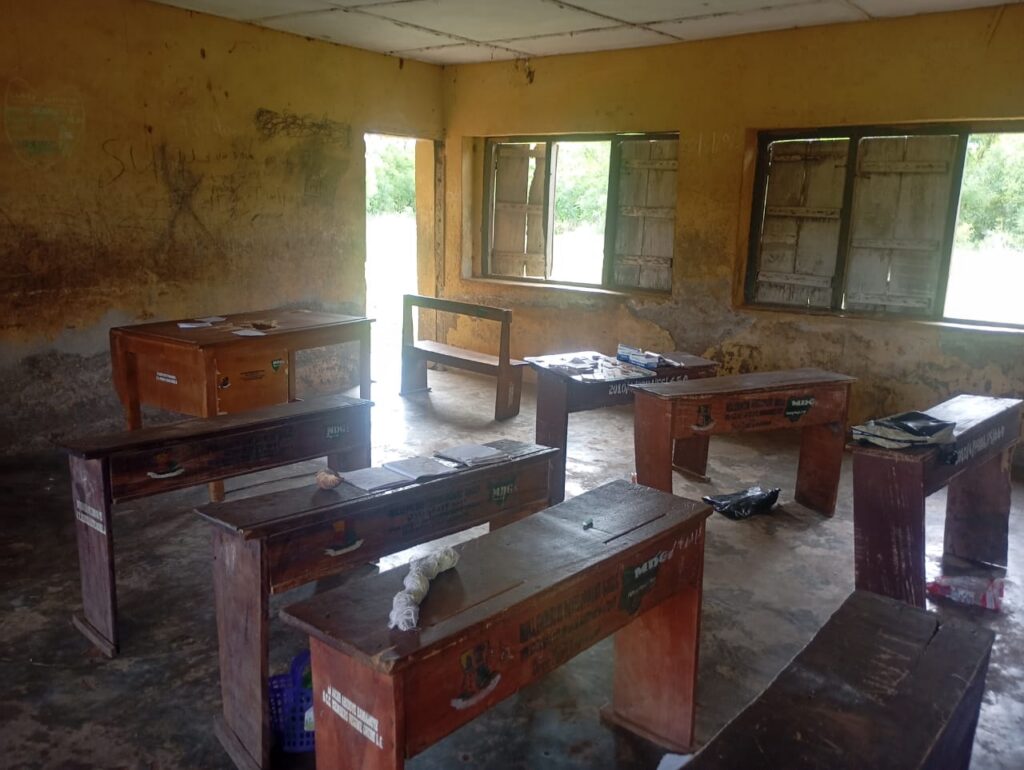
L.A. Primary School, Ahoro-Esiele in Oyo after the May school abduction. Credit: Yisau Babatunde
At the early stage of the industrial action, the National Association of Nigerian Students (NANS) strongly opposed the school shutdown, warning that industrial action and protests could complicate the situation.
Also, Governor Seyi Makinde met with the union in the state, urging them to reopen schools. He also approved N8.7 billion to support learning materials. Since that period, the state government has intensified rescue efforts, imposing curfews across at least 10 local government areas in order to aid security operations. The union only resumed duties on 2nd July, after learners were disconnected from classrooms for a month.
Amid these efforts, the education system in the state is reeling at the receiving end. With the ongoing National Examination Council (NECO) all over the nation, Oyo students are locked in a dilemma. As the strike hit its second month before calling it off, schools were partially opened for the NECO candidates.
Yet, there’s more frustrating concern.
Ridwan Adegoke, a secondary school teacher at Elekuro Community High School, Ona-Ara, Ibadan, was mostly troubled with how false circulation of bandits’ presence around communities that host schools is causing academic disarray in the state.
He recounted an encounter when students were writing a paper for the West Africa Examination Council (WAEC) in March. On that fateful day, the late arrival of the exam materials delayed the assessment till late in the day. Amid the commencement of the examination, misleading information spreading an attack of gunmen dominated the area. This drove parents to the school. When the teachers attempted to calm the parents, the latter started throwing shades and insults into the former.
They all said, we shouldn’t endanger the lives of their wards, the teachers remarked.
Despite the fact that we tried our best to convince the parents that there would be a positive outcome of the security measure, it still proved abortive.
Curbing Falsehood
At the height of the widely circulated falsehood of fictitious abductions of school children across Nigeria, the Nigerian Police has declared war on the originators of false information in an effort to defend public sanctity.
In the statement released by the Kwara authorities, the police strongly frowned at the misleading information. They pointed to the outcome of such information to lead to the breach of public peace. This depicted a typical scenario portrayed by the Kwara’s incident. Upon identification, the police vowed, the person responsible for such information would be invited for questioning and be judged according to the ambit of the law.
This move is not limited to Kwara authorities. Governments from other states have waved towards the same direction of prosecuting the offenders of disinformation. On 18th June, Edo State Police Command debunked a viral information that alleged the kidnap of school children in some parts of Edo State, such as Afuze, Ehor, Otuo, Agbede, and Igueben. This information was disclosed in a circular shared through Police Public Relations Officer, ASP Eno Ikoedem.
The press release added that the police authority apprehended an individual identified as Ernest Ugbomoiko in connection to the false report. While the police assured the public of prompt response to security threats, it warned that individuals who deliberately spread false information that is capable of threatening public peace, undermining security operations, or causing public disorders would be investigated and prosecuted according to the dictates of the law.
As disinformation continues to widen the country’s security crisis, experts called for effective countering efforts. While recognising the fact that controlling what people do with their devices is far from possibility, Kunle, a multiple award-winning journalist, validated the police campaign of penalising the perpetrators of disinformation. He emphasised on tracking down the sources of those information and establishing their malicious intentions before prosecuting them according to law.
Examining the role of the media in tackling information disorder, Kunle further commented on the importance of media literacy. He called for an intensive public awareness on responsible information sharing. He also stressed that stakeholders should prioritise investments in newsrooms and independent fact-checking organisations. This, according to him, would promote effective reporting on disinformation beyond spotting false narratives.
It is really crucial that we educate people about the implications of these actions. It’s crucial that we sensitise people to be better citizens who consider their wellbeing and the wellbeing of others before taking actions.