
BY: Mustapha Lawal
Nigeria’s diversity is one of its greatest strengths. With hundreds of ethnic groups and multiple religious traditions coexisting within a single federation, the country presents a remarkable example of pluralism. Yet this diversity also requires careful stewardship, particularly from institutions that shape public discourse.
Among these institutions, the media occupies a uniquely influential position. The press serves as the bridge between events and public understanding. Through its reporting, citizens interpret political developments, security challenges, and social tensions.
This responsibility becomes even more critical in a country where narratives can easily take on ethnic or religious dimensions. When reporting is accurate and responsible, it strengthens social trust. When it prioritizes sensationalism over verification, it risks deepening existing divisions.
Headlines Become Narratives
Recent reporting surrounding the abduction of pupils and teachers in Oriire Local Government Area of Oyo State illustrates this challenge. Some reports (such as Leadership Newspaper, Punch and several blogs) carried claims that the kidnappers had demanded not only a substantial ransom but also the implementation of Sharia law as a condition for releasing the victims. The claim quickly gained public attention and was amplified across various media platforms despite the absence of clear and independently verified evidence supporting such a demand.
The controversy appears to have originated from interpretations of remarks by Speaker Adebo Ogundoyin, who referred to demands involving money, weapons, and what he described as “concessions of future laws.” Subsequent reports increasingly rendered this phrase as a specific demand for Sharia law despite the absence of any publicly available recording in which the Speaker explicitly used those words.

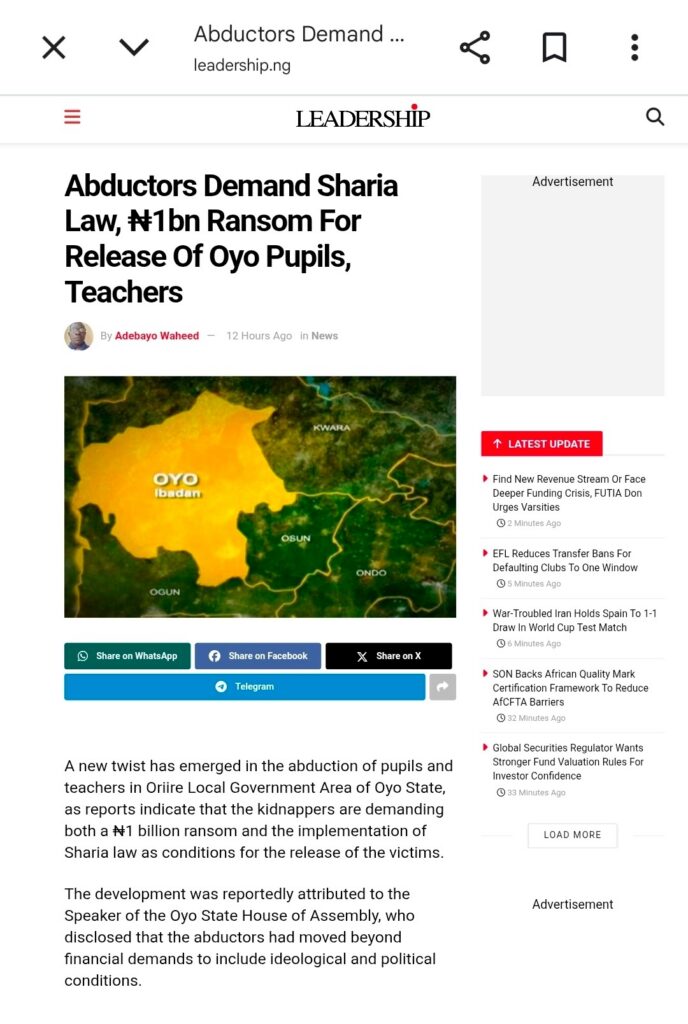
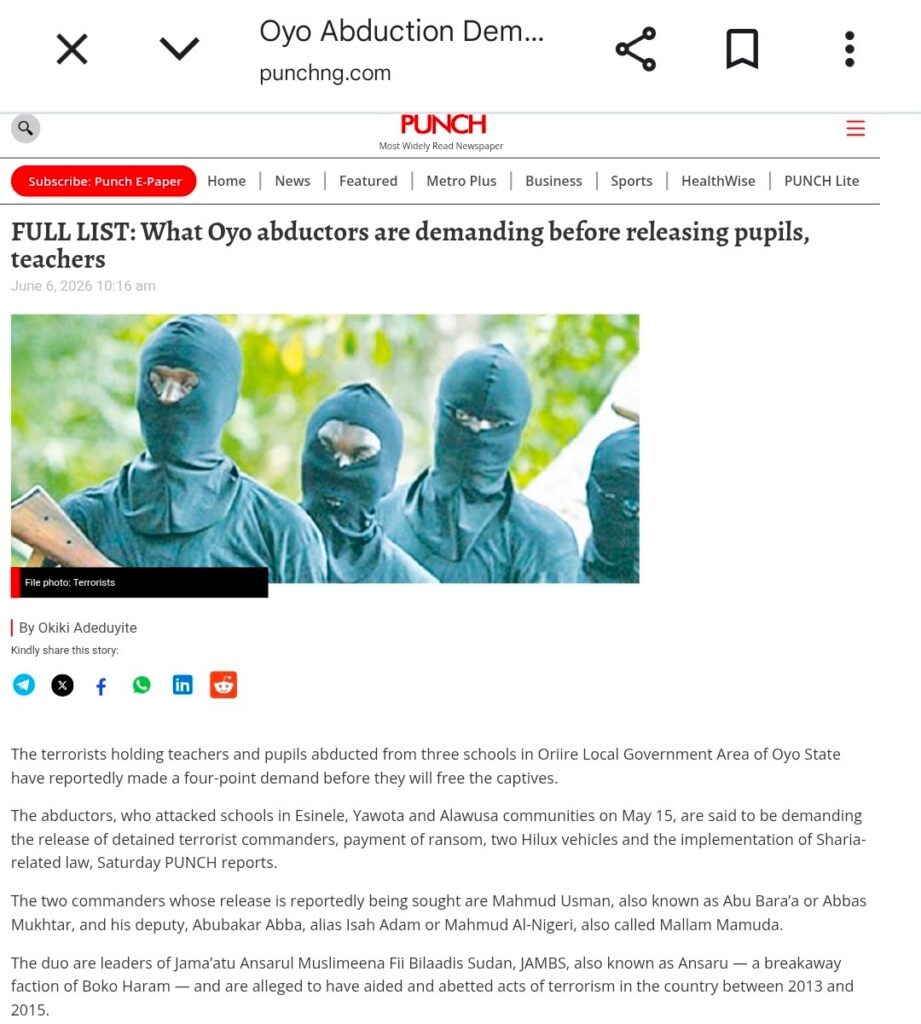
Screenshot of headlines and reports around the incident reinforcing the shariah law mention
The issue was not merely the publication of a controversial claim. It was the speed and scale with which the narrative spread before fact-checking could establish its credibility. In an era of instant news cycles, a single headline can shape public perception long before questions about its accuracy emerge. Once a narrative acquires ethnic or religious significance, correcting the record becomes significantly more difficult.
From Unverified Claim to National Conversation
As the story spread, the distinction between verified information and inferred interpretation became increasingly blurred. The evolution of the narrative illustrates a recurring feature of Nigeria’s contemporary information environment. Information does not always gain prominence because it has been conclusively verified. Sometimes it gains prominence because it has been repeatedly amplified.
The consequences of such reporting extend beyond the digital space. Discussions surrounding the alleged Sharia demand quickly generated reactions within religious and community circles. Public conversations increasingly shifted from the criminal act of kidnapping to debates about religion, identity, and communal interests. Attention moved away from the victims and toward narratives capable of inflaming existing sensitivities.
The Amplification Effect
Once the claim entered mainstream reporting, reactions followed rapidly. The Muslim Community of Oyo State issued a public statement distancing Islam from the kidnappers and rejecting the alleged demand. Religious leaders condemned attempts to associate criminality with Islamic teachings. Community organisations organised prayer sessions and public interventions.
Subsequent reporting by several major media organisations focused extensively on these reactions. Punch reported the Muslim community’s rejection of the alleged demand. The Nation highlighted condemnations by Muslim leaders. Sahara Reporters covered efforts to dissociate Islam from terrorism. Other outlets documented public responses across religious communities. Yet an unintended consequence emerged. Even reports seeking to reject the allegation continued repeating it through headlines mentioning ‘Shariah Law’. The original claim was therefore reinforced through rebuttal.
Communication researchers often describe this phenomenon as amplification through repetition. Once a narrative enters public discourse, repeated references to it, even in the context of criticism or correction can increase its visibility and memorability. As a result, audiences frequently remember the allegation itself long after they have forgotten the caveats surrounding it. In societies already experiencing religious and ethnic tensions, the implications can be significant.
Journalism’s Permanent Record
Another overlooked consequence of such reporting is its permanence in the information ecosystem. Once published, news reports are archived, indexed, and later retrieved as “evidence” in academic work, policy analysis, and investigative research. Future researchers who encounter these materials in digital archives may not experience the original context of uncertainty, correction, or contestation that surrounded them at publication time.
A headline that was speculative or based on unverified inference can, over time, harden into a perceived historical fact simply because it was repeatedly cited and preserved. This is why headlines carry disproportionate weight: they are not just entry points to a story, they are the most durable representation of it. In practice, most audiences never proceed beyond the headline, meaning that interpretive framing often becomes the only consumed version of the news. When that framing is inaccurate or exaggerated, the distortion is not temporary, it becomes structurally embedded in the historical record.
Nigeria’s history contains numerous examples where rumours, assumptions, and unverified allegations have contributed to mistrust between communities. Claims touching on religion, tribe and ethnicity often carry particular weight because they interact with existing fears, political grievances, and historical suspicions.
This makes the evidentiary standard for such claims especially important. A headline suggesting that kidnappers demanded Sharia law is not merely reporting a security development. It is introducing a religious dimension into a highly sensitive national conversation. The consequences can extend beyond the immediate news cycle.
Verification Before Amplification: Reclaiming Media Sanctity
This phenomenon highlights a broader challenge within contemporary Nigerian journalism. Competitive pressures often reward speed, controversy, and audience engagement. Stories framed around ethnic or religious conflict attract attention and generate significant public reaction. However, what attracts attention is not always what serves the public interest. Journalism’s primary obligation is not to maximize outrage but to maximize understanding.
The danger is particularly acute in societies where historical grievances and identity-based tensions already exist. Unverified claims linked to religion or ethnicity can reinforce stereotypes, deepen mistrust, and create unnecessary suspicion among communities. Even when subsequent reports challenge or clarify the original claims, the initial impression often remains embedded in public consciousness.
Responsible journalism requires a higher standard. Claims capable of influencing interfaith or interethnic relations should be subjected to rigorous verification before publication. Where evidence remains uncertain, caution should prevail over speculation. Newsrooms must recognize that reporting on sensitive issues is not merely an editorial exercise; it is a public trust.
This responsibility extends beyond traditional media organizations. Digital platforms have accelerated the spread of information, but they have also increased the importance of professional gatekeeping. Mainstream media outlets should serve as stabilizing institutions that verify claims before amplifying them, not as conduits through which unverified narratives gain legitimacy.
Media sanctity is therefore not an abstract ideal. It is a practical necessity for national cohesion. A society as diverse as Nigeria depends on institutions capable of informing citizens without inflaming divisions. The press can either contribute to this objective or inadvertently undermine it.
Journalism should not be defined by the pursuit of headline
As Nigeria continues to confront security challenges, political competition, and social transformation, the need for responsible journalism has never been greater. The measure of a strong media ecosystem is not how quickly it publishes a story but how reliably it informs the public. In moments of tension, accuracy must take precedence over immediacy, and verification must prevail over sensationalism.
The future of Nigerian journalism should be defined not by the pursuit of the loudest headline but by the preservation of public trust. In a nation where words can either bridge divides or widen them, media sanctity remains essential to both democratic accountability and peaceful coexistence.
The Oyo kidnapping story may eventually fade from public attention. The headlines, however, will remain. Years from now, researchers, policymakers, students, and ordinary citizens searching digital archives may encounter reports stating that kidnappers demanded Sharia law in Oyo State. Whether that claim was ever conclusively established may be forgotten. That is why verification must come before publication, not after controversy. In journalism, errors do not simply disappear; they become part of history.