FACT-CHECK: Viral Results Claim Misrepresents Ero-Arike’s Polling Unit Results in Osun

BY: Mustapha Lawal
Claim:
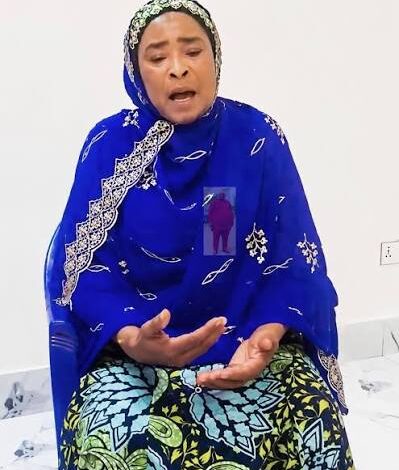
Social media users claimed that Accord Party defeated the All Progressives Congress (APC) at the polling unit associated with Osun businesswoman Alhaja Falilat Yusuf, popularly known as Ero-Arike, posting figures of 241 votes for Accord and 138 for APC, and many other varied figures.
Verdict: FALSE.
Full Text
A viral social media post claiming that the Accord Party defeated the All Progressives Congress (APC) at the polling unit associated with Osun businesswoman Alhaja Falilat Yusuf, popularly known as Ero-Arike, has been found to be inconsistent with the results verified by FactCheckAfrica.
The post, which circulated on X, Facebook, WhatsApp and other platforms, claimed that Accord polled 241 votes, while APC scored 138 votes at what it described as Ero-Arike’s polling unit.
The claim was accompanied by a celebratory message suggesting that voters had rejected political pressure and chosen Accord despite the distribution of food items and other forms of mobilisation allegedly associated with the APC camp.
Different versions of the claim have circulated online, with some accounts publishing varying figures while using the purported result to mock Ero-Arike and suggest that she had been rejected by voters in her community.
Ero-Arike, a prominent political figure in Boripe Local Government Area, had attracted considerable attention during the election campaign. Her political activities and public appearances had previously generated significant discussion online, including videos showing her distributing food items to residents.
FactCheckAfrica examined the claim following the circulation of the purported polling-unit results.
Verification
FactCheckAfrica first sought to establish the precise polling location and ward associated with the claim. Researchers contacted eyewitnesses familiar with the polling locations and cross-referenced the information obtained with available electoral records and the results uploaded to the Independent National Electoral Commission’s (INEC) Result Viewing Portal (IReV).
The polling locations identified in the verification are in the College/Egbada Road Registration Area (RA 03) of Boripe Local Government Area. INEC’s polling-unit directory confirms College/Egbada Road as Registration Area 03 in Boripe, with multiple polling units under the registration area.
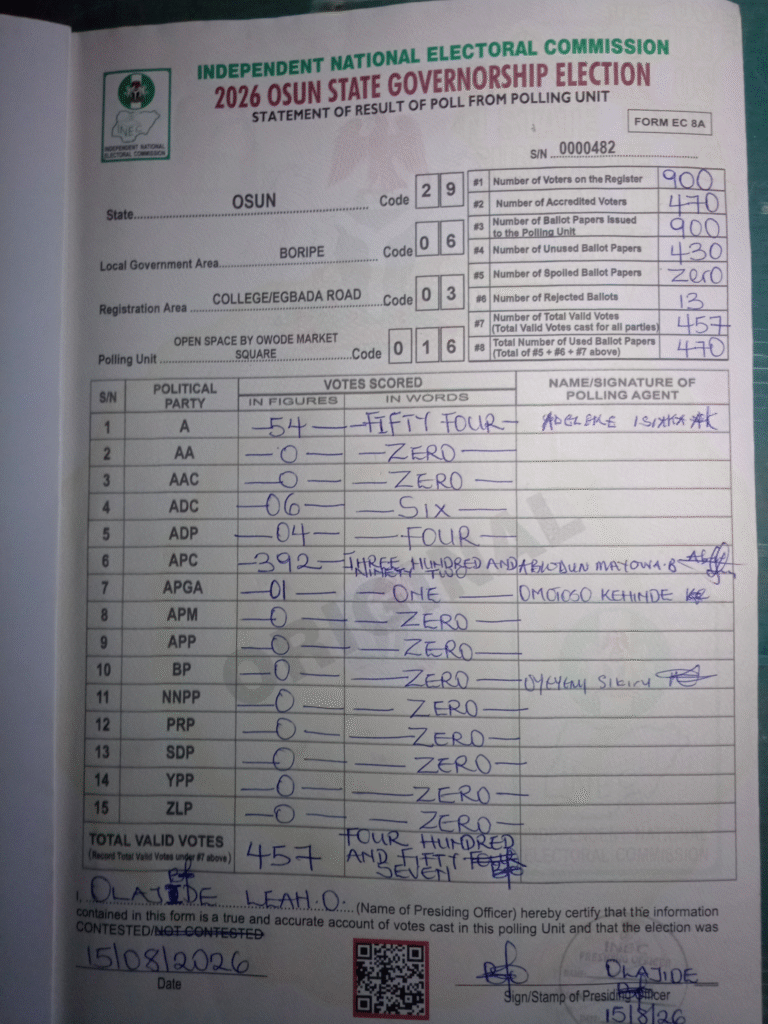
Image of the result uploaded on IREV
FactCheckAfrica subsequently compared the figures circulating online with the results available on the IReV platform for the relevant polling locations.
The result attributed to the location identified as College/Egbada Road, Polling Unit 03, did not show the figures being circulated online. Rather, the result reviewed by FactCheckAfrica recorded 392 votes for the APC and 54 votes for the Accord Party.
A second location identified during the verification, Open Space by Owode Market Square, Polling Unit 016, was also reviewed as part of efforts to establish whether the viral figures corresponded with the polling location being referenced online.
The discrepancy is significant. The viral post claimed that Accord scored 241 votes against APC’s 138, while the result reviewed by FactCheckAfrica for the identified polling location showed APC with 392 votes and Accord with 54 votes.
This means the figures being circulated online do not correspond with the results verified by FactCheckAfrica.
The College/Egbada Road location itself is not an invented electoral designation. INEC’s published polling-unit directory lists College/Egbada Road as Registration Area 03 in Boripe, alongside several polling units under the area.
FactCheckAfrica also found previous public reporting identifying Falilat Yusuf, popularly known as Ero-Arike, as a political figure in Boripe. A 2025 report, for instance, identified her among APC leaders in the local government and reported her support for the party’s candidate, Munirudeen Bola Oyebamiji.
The Claim Has Also Become a Vehicle for Gendered Attacks
Beyond the question of the figures, the circulation of the claim has taken on another dimension. Some social media users have used the purported result to ridicule Ero-Arike personally, with attacks extending beyond her political activities and into her identity as a woman.
This is significant because criticism of a political actor’s campaign activities or electoral performance is legitimate. However, attaching sexist, humiliating or gender-based insults to an election-related claim does not make the information more credible.
Ero-Arike has been a visible political actor in Osun for several years. Earlier reports have documented her involvement in party politics in Boripe and her public interventions on party affairs. More recently, she has publicly backed the APC’s Osun governorship campaign, with reports identifying her as a prominent APC figure in Boripe.
Her political visibility makes claims about her particularly susceptible to partisan amplification. But political disagreement should not become a justification for spreading inaccurate electoral figures or directing gendered abuse at individuals.
The circulation of the purported election result has also taken on a more personal dimension, with several posts using the alleged figures to mock Ero-Arike following her highly visible political activities before the election.
This is important because election-related misinformation does not always focus exclusively on candidates or electoral institutions. Political narratives can increasingly become personalised, particularly when prominent women are involved in partisan mobilisation.
In this case, posts about the alleged result have been accompanied by comments targeting Ero-Arike personally, moving beyond scrutiny of her political activities into attacks on her character and identity as a woman.
FactCheckAfrica notes that criticism of a political actor’s conduct or campaign activities is legitimate. However, presenting an unverified or inaccurate election result as fact can distort public understanding of the election and provide a basis for further personal attacks.
INEC remains the official authority
Although IReV provides an important mechanism for public access to polling-unit results, it is important to distinguish between verification of a result uploaded to the platform and the declaration of an election’s final official outcome.
INEC and its designated returning officers remain responsible for the declaration of official election results in accordance with Nigeria’s electoral framework.
Therefore, the result reviewed by FactCheckAfrica should not be interpreted as an independent declaration of the overall outcome of the election. Rather, it establishes that the specific figures being circulated online, 241 votes for Accord and 138 for APC, do not match the polling-unit result verified by FactCheckAfrica.
Conclusion
The claim that Accord Party scored 241 votes against 138 for APC at Ero-Arike’s identified polling location is inconsistent with the result verified by FactCheckAfrica. The result reviewed from the relevant polling location recorded 392 votes for APC and 54 votes for Accord, not 138 and 241 respectively.
As INEC remains the statutory authority for declaring election results, citizens should rely on official electoral records and verified results rather than viral figures circulating on social media.
FactCheckAfrica advises citizens to verify election results before sharing them, particularly when purported results are being used to promote partisan narratives or target individuals.