Beyond the Written Fact-Check: How FactCheckAfrica Is Using AI and Local Voices to Strengthen Nigeria’s Electoral Integrity

BY: Habeeb Adisa & Mustapha Lawal
As Nigeria approaches the 2027 general elections, FactCheckAfrica is exploring how artificial intelligence, multilingual audio and trusted community networks can make verified civic information accessible to citizens often excluded from conventional digital fact-checking.
In the crowded information environment that precedes an election, the difference between a verified fact and a convincing falsehood can shape public opinion, influence political conversations and undermine trust in democratic institutions. Yet, while fact-checking organisations have become increasingly visible in Nigeria’s struggle against misinformation, an important question remains: how effectively does verified information reach the people who need it most?
For millions of Nigerians, access to reliable political information is not simply a matter of finding a website or reading a fact-checking report. Language barriers, limited literacy, inconsistent internet connectivity and the everyday realities of accessing digital information can determine whether citizens encounter a verified explanation or rely on a forwarded message whose origins they cannot establish.
As Nigeria prepares for the 2027 general elections, these challenges are becoming more consequential. Political communication increasingly takes place through digital platforms, while artificial intelligence is making it easier to generate convincing but misleading audio, images and videos. In communities where WhatsApp voice notes and interpersonal communication are important channels for exchanging information, a fabricated recording can travel far beyond the reach of a conventional fact-check published online.
It is against this background that FactCheckAfrica is advancing Project Sauti, an initiative designed to bring verified civic information closer to communities through AI-assisted multilingual audio and grassroots distribution networks. Rather than treating accessibility as an afterthought, the project places it at the centre of the fact-checking process.
From Fact-Checking to Information Accessibility
Fact-checking has traditionally focused on identifying questionable claims, examining available evidence and publishing findings that establish whether a statement is true, false, misleading or unsupported. This remains indispensable to democratic accountability. However, the existence of a verified report does not automatically mean that the public it is intended to serve can access, understand or use it.
A carefully researched article published in English may be of limited practical value to someone who cannot comfortably read the language. Similarly, a detailed explanation of electoral regulations may fail to reach a rural trader, farmer or transport worker who primarily receives information through spoken communication.
This is not an argument against written fact-checking. It is a recognition that different audiences encounter information in different ways and that effective public-interest journalism must account for those differences.
Project Sauti responds to this gap by exploring how verified civic information can be converted into short, accessible audio explainers in Nigerian languages. The approach combines artificial intelligence with human review and community-led distribution, creating a pathway through which information can move from verification desks into the everyday conversations of citizens.
The project reflects a broader principle: information integrity requires more than producing accurate information. It also requires building the channels, relationships and communication formats through which accuracy becomes useful to the public.
The Ilorin Onboarding: Building the Human Network Behind the Technology
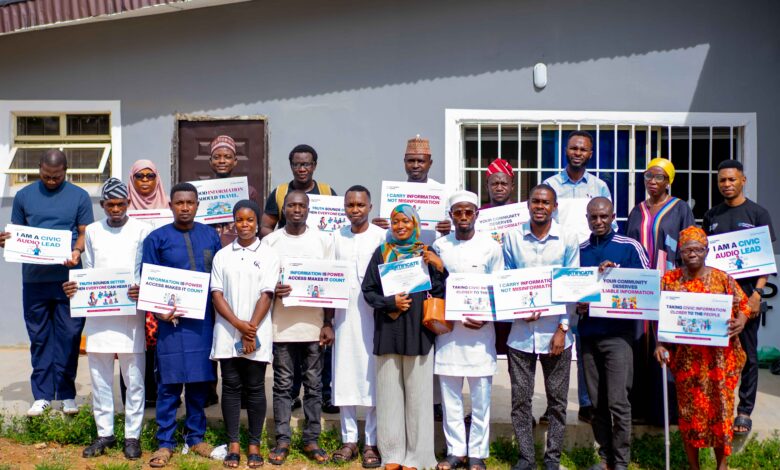
A significant step in this direction took place in Ilorin, Kwara State, where FactCheckAfrica trained 20 young Nigerians during its Project Sauti Civic Audio Leads Onboarding and Capacity Building Workshop.
Through the onboarding, the participants will serve as Civic Audio Leads across Ifelodun, Moro, Patigi and Ilorin West local government areas. Their role is to help distribute approved civic information through community networks while providing feedback on how the information is received and understood.
The workshop went beyond an introduction to the project’s objectives. Participants received training on misinformation, deepfakes, fact-checking, civic communication, local-language adaptation and responsible information distribution. Habeeb Adisa, Editorial Lead at FactCheckAfrica, led discussions on the changing information environment and the challenges posed by misinformation and AI-generated content, introducing practical verification approaches and tools, including MyAIFactChecker.
Mustapha Lawal, the organisation’s Program Lead, introduced participants to Project Sauti’s methodology and facilitated an interactive review of draft civic audio scripts. Participants assessed the scripts against their knowledge of local languages, cultural contexts and community information needs. This process is important because a message can be factually correct and still fail if its language is unnatural, its framing is confusing or its meaning does not translate effectively into local usage.
The onboarding also introduced participants to WhatsApp Tree Networks, a distribution model that uses existing relationships within market groups, youth associations, community organisations and other trusted social networks. Through practical simulations, participants tested audio samples, practised sharing approved content and explored feedback-tracking approaches.
These activities illustrate a central feature of Project Sauti: the technology is only one part of the intervention. Its effectiveness also depends on people who understand their communities, can communicate responsibly and can help identify the information needs that formal media channels may overlook.
Why Audio Matters in the Age of Artificial Intelligence
Artificial intelligence presents a complicated challenge for information integrity. Generative tools can produce synthetic voices and manipulated recordings that imitate public figures or make fabricated statements appear authentic. Such content can exploit existing political tensions, deepen suspicion and spread rapidly before independent verification becomes available.
Audio misinformation deserves particular attention because recordings can carry an impression of intimacy and authenticity. A listener may recognise a familiar voice, hear what sounds like a private conversation or receive a recording from someone they trust. Yet none of these circumstances establishes that the recording is genuine.
The same technology that creates new opportunities for deception, however, can also support more accessible communication. Text-to-speech systems can help transform verified scripts into audio formats, potentially reducing the time and resources required to produce information in multiple languages.
Project Sauti seeks to use this opportunity by combining AI-assisted audio production with human oversight. The proposed process begins with the extraction and verification of relevant civic information, including electoral guidelines, policy documents and governance information. Scripts are then simplified and reviewed by people familiar with the intended languages and audiences before being converted into audio.
The human review stage is very important. AI-generated speech may mispronounce names, mishandle expressions, flatten linguistic differences or produce a fluent recording that conveys a misleading interpretation of the original text. In politically sensitive communication, such errors can have serious consequences.
For this reason, AI should function as an instrument of production rather than an independent authority on truth. Verification must precede publication, and human editors must retain responsibility for the accuracy, neutrality and clarity of the final material.
Project Sauti’s approach recognises this distinction. The ambition is not simply to generate more audio, but to develop an accountable process through which verified information can be translated into accessible formats without sacrificing editorial standards.
WhatsApp, Community Trust and the Last Mile of Information
Producing an accurate audio explainer is only the beginning. It must still reach its intended audience, and that is where Project Sauti’s community distribution model becomes significant.
WhatsApp has become an important communication channel in Nigeria, allowing information to circulate through family groups, professional associations, community organisations and informal networks. These relationships can support the rapid distribution of useful information, but they can also facilitate the spread of rumours, manipulated recordings and unverified political claims.
Project Sauti’s WhatsApp Tree Network seeks to use these same social pathways to distribute approved civic audio content. The 20 Civic Audio Leads trained in Kwara are expected to help connect the project’s materials with communities across their respective local government areas.
The model recognises that people do not assess information solely on its content. They also consider who shared it, whether the source is trusted and whether the message speaks to their circumstances. Community-based distribution can therefore create opportunities for verified information to enter conversations where conventional media content might otherwise be absent.
Nevertheless, trust should not be confused with proof. A message does not become accurate merely because a respected community member forwards it. Civic Audio Leads must communicate the origin of materials, encourage responsible sharing and direct audiences towards evidence where appropriate. They must also avoid presenting the initiative as a political campaign or using community relationships to promote particular candidates.
Beyond WhatsApp, Project Sauti envisages wider distribution through local radio and an open-access Aspirant Audio Vault. Radio could extend the reach of verified information to people with limited internet access, while a public repository could preserve audio explainers and candidate-related information for future reference.
Together, these channels offer a potential bridge between digital production and offline public engagement. Their ultimate value, however, will depend on sustained distribution, accurate content, audience feedback and evidence that the materials are reaching the communities they are designed to serve.
Electoral Literacy Beyond Campaign Promises
The significance of Project Sauti extends beyond countering fabricated recordings. Elections require citizens to make decisions about candidates, policies, public spending and the rules governing the electoral process. Yet these subjects are frequently communicated through technical documents, lengthy statements and political messaging that can be difficult to evaluate.
By translating verified civic information into accessible audio, the initiative could help citizens engage more directly with electoral procedures, policy commitments and questions of public accountability. Short explainers could, for example, clarify what electoral regulations provide, distinguish an announced policy from an implemented programme or examine whether a campaign promise is supported by available evidence.
The proposed Aspirant Audio Vault could also provide a mechanism for preserving candidate-related information in formats accessible to local audiences. If developed with transparent sourcing, consistent editorial standards and clear distinctions between candidates’ claims and independently verified facts, such an archive could support scrutiny beyond election day.
This possibility is particularly relevant in a political environment where campaign messages can disappear from public attention once voting concludes. A structured record of verifiable promises and policy statements could help citizens, journalists and civil society organisations revisit those commitments during the period of governance that follows.
However, an audio archive cannot by itself guarantee accountability. Its usefulness will depend on the quality of the underlying evidence, the completeness of the records, the accessibility of the repository and the willingness of citizens and institutions to use the information.
From a Kwara Pilot to a Wider Democratic Challenge
Project Sauti is being implemented in Kwara State as part of FactCheckAfrica’s participation in the Digital Democracy in Sub-Saharan Africa Grant Programme, the project as an effort to use artificial intelligence and audio technology to strengthen resilience against misinformation and expand access to credible civic information.
The Kwara implementation provides an opportunity to test how the approach works in practice before considering wider adoption. Questions of language accuracy, audio quality, community acceptance, distribution efficiency and audience comprehension will be central to determining whether the model can be replicated elsewhere.
Nigeria’s linguistic diversity makes this an important consideration. A strategy that works in one community cannot simply be transferred to another through automated translation. Language varieties, cultural references, political sensitivities and patterns of information consumption differ across regions. Scaling therefore requires local expertise, editorial supervision and meaningful participation by the communities involved.
The project’s early development should consequently be judged not by the number of audio files produced alone, but by whether people can understand the information, distinguish verified material from rumours and use what they learn to participate more confidently in civic life.
As the 2027 elections approach, such evidence will be essential to understanding Project Sauti’s contribution to information integrity.
A More Inclusive Information Ecosystem
The wider lesson from Project Sauti is that the struggle against misinformation cannot be won through technological innovation alone. Nor can it be resolved simply by publishing more fact-checks. It requires an information ecosystem that recognises the diversity of the people it serves and makes credible information accessible through multiple channels.
Artificial intelligence can help accelerate production and expand language coverage. Human editors can protect accuracy and context. Civic Audio Leads can connect verified content with community networks. Radio and public repositories can extend its reach and preserve it for continued use. Each component addresses a different part of the problem, but the system depends on their effective coordination.
For FactCheckAfrica, the Ilorin onboarding represents an initial step towards putting this approach into practice. The 20 Civic Audio Leads are being prepared to serve as community-level links between verified information and the people who need it, while the project explores how AI-assisted audio can complement established fact-checking methods.
The test ahead is whether this model can move beyond promising technology and deliver measurable public value: improved access to reliable information, stronger civic understanding and greater resistance to misleading political narratives.
Nigeria’s 2027 elections will unfold in an information environment shaped by digital platforms, synthetic media and competing political narratives. Ensuring that citizens can access and evaluate credible information will remain a shared responsibility of journalists, civic organisations, technology developers and the public.
Project Sauti offers one possible response by bringing verification closer to the places where people live, work and exchange information. Its most important contribution may ultimately be the recognition that democratic participation should not depend on a citizen’s ability to read a lengthy report, navigate a website or distinguish an unfamiliar technical format. By combining AI-assisted audio with human judgement and community trust, FactCheckAfrica is testing a model that seeks to make that access more practical ahead of Nigeria’s next general elections.