EXPLAINER: INEC Chairman X Account Controversy – What Can (and Cannot) Be Proven


BY: Mustapha Lawal
Allegations of partisanship against Joash Amupitan, Chairman of the Independent National Electoral Commission (INEC), have generated sustained public debate. At the centre of the controversy is an X (formerly Twitter) account previously operating under the handle @joashamupitan, which posted content during the 2023 election cycle perceived as supportive of the All Progressives Congress (APC) and Bola Ahmed Tinubu.
While the existence of the account and its content is not in dispute, the central question remains unresolved: whether the account can be definitively attributed to Prof. Amupitan. The controversy has since evolved into a broader issue of digital verification, institutional accountability, and public trust in electoral processes.
What Is the Claim?
The allegation is that Prof. Amupitan personally operated or was directly linked to an X account that published partisan content during Nigeria’s 2023 elections.
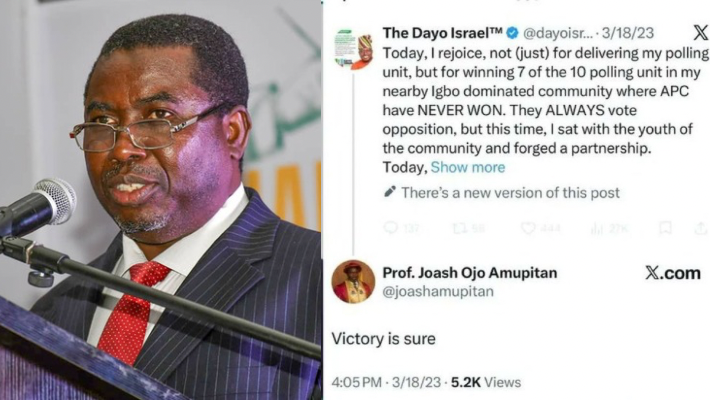
Posts attributed to the account include statements perceived as derogatory toward supporters of Peter Obi, expressions of support for APC electoral prospects, and references aligning with Tinubu’s political identity. These posts, made between March and April 2023, resurfaced in 2026, triggering renewed scrutiny.
The account itself was reportedly created on September 6, 2022, and retained the handle @joashamupitan until April 10, 2026, when it was renamed @Sundayvibe00, locked, and labeled a parody account.
Evidence Supporting the Claim
Investigations by media organisations, including Daily Trust, point to a continuous digital trail tied to a permanent X user ID (1567086242164101120). Because user IDs on the platform do not change even when usernames are altered, this establishes that the account maintained a consistent identity before and after the controversy.
Archived posts recovered from web archives appear to confirm that the account published politically charged content during the 2023 election period. Technical checks on these archives suggest moderate to high confidence that the posts were not fabricated after the fact.
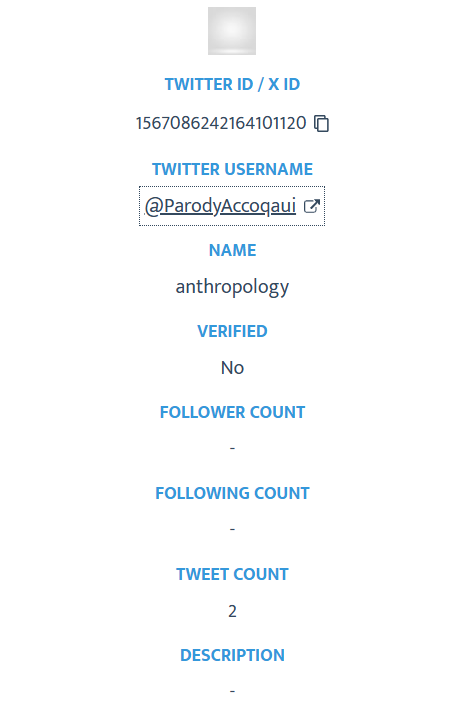
Current details from the user ID showing the account has been locked and classified as parody
The timing of the account’s transformation has also attracted scrutiny. On April 10, 2026, the same day the issue gained public attention, the account was renamed, locked, and reclassified as a parody account. While this does not prove ownership, the sequence has been interpreted by some observers as reactive behaviour. Multiple new accounts with the same or similar handle emerged shortly after, raising further suspicions of a cover-up.
There are also unverified claims that the account may have been linked to personal contact details associated with Prof. Amupitan, including a phone number ending in “99” and a corresponding email address. Some analysts argue that creating and verifying an account with such details would require access to those channels. However, these claims have not been independently confirmed through forensic disclosure.
FactCheckAfrica findings:
Independent review by FactCheckAfrica confirms the existence of the account and the continuity of its user ID across username changes. Archived content aligns with the posts cited in public reports. However, FactCheckAfrica did not obtain platform-level or forensic data linking the account to Prof. Amupitan’s personal credentials, personal email, phone number, or devices. As such, while the digital trail establishes account activity and continuity, it does not conclusively establish ownership.
Evidence Against the Claim
The Independent National Electoral Commission has issued a categorical denial, stating that Prof. Amupitan does not own or operate any X account. The commission described the account as a fabrication created by cybercriminals to impersonate the chairman and undermine the institution’s credibility.
INEC further stated that the matter has been reported to security and cyber-intelligence agencies for investigation, with a commitment to prosecute those responsible under the Cybercrimes Act. The commission also emphasised that multiple fake accounts in the chairman’s name have previously been identified.
Despite these claims, no publicly available forensic report has been released to substantiate the assertion that the account is fake or externally controlled. The absence of such evidence means the denial, while clear, remains unsupported by independently verifiable technical data. This limits the evidentiary weight of the denial to an institutional assertion rather than a technically verifiable rebuttal.
FactCheckAfrica findings:
FactCheckAfrica found no publicly disclosed forensic analysis demonstrating that the account was created or operated by impersonators. No platform-level confirmation has been provided to verify the commission’s claim of cybercriminal activity. This limits the ability to independently validate INEC’s position beyond its official statements.
What the Digital Evidence Proves – and What It Does Not
The available evidence establishes that the account existed, maintained a consistent identity through its user ID, and posted politically charged content during a sensitive electoral period. It also shows that the account underwent significant changes at the onset of public scrutiny.
However, the same evidence does not establish who controlled the account. There is no publicly available data confirming that Prof. Amupitan created, accessed, or managed the account. Likewise, there is no conclusive proof that a third party operated it without his knowledge.
Limits of Open-Source Verification
The case highlights the structural limitations of open-source intelligence (OSINT) in digital investigations. OSINT techniques can reconstruct timelines, verify content authenticity, and trace account evolution. They are effective in establishing that an account existed and behaved in certain ways over time.
However, OSINT cannot independently confirm who operated an account. Attribution requires access to platform-level data such as registration details, login histories, IP addresses, and device identifiers. These are not publicly accessible and typically require either platform disclosure or legal intervention. As a result, OSINT findings in this case remain inherently probabilistic. They can suggest linkage, but they cannot conclusively establish ownership.
The Role of AI Verification and Public Interpretation
An additional dimension to the controversy is the role of AI tools such as Grok, which is integrated into the X platform. Many users have relied on Grok to verify claims about the account. Screenshots circulating online show instances where Grok appeared to affirm the authenticity of the account and its association with Prof. Amupitan. However, INEC has dismissed Grok’s analysis, with officials stating that “Grok can hallucinate like any AI” and that screenshots or AI-generated responses are not valid forensic evidence
This reliance on AI-generated verification highlights a growing challenge in the information ecosystem, where probabilistic outputs are sometimes interpreted as definitive proof. In reality, such tools are limited by the same constraints as public investigators, relying only on accessible data rather than privileged platform-level information.
Why This Matters
The implications of the controversy extend beyond the question of account ownership. Electoral bodies derive legitimacy not only from procedural accuracy but also from perceived neutrality. Even unproven allegations can shape public perception if they remain unresolved. In this case, the persistence of uncertainty risks eroding confidence in the impartiality of the electoral commission. It also establishes a precedent in which digital ambiguity can become a recurring feature of electoral disputes.
Conclusion
The controversy surrounding the alleged X account linked to Joash Amupitan remains unresolved. Available evidence confirms that the account existed, posted partisan content, and maintained a consistent digital identity over time. However, there is no conclusive forensic proof that Prof. Amupitan operated the account.
At the same time, while the Independent National Electoral Commission has denied ownership and attributed the account to impersonation, it has not publicly provided technical evidence to substantiate that claim. FactCheckAfrica has tried to contact X (formerly Twitter) for clarification on the ownership and registration details of the account but to no success till the time of this publication.