The Quietest Crisis of 2027: Why Every Woman in Nigerian Politics Needs a Digital Safety Plan Now

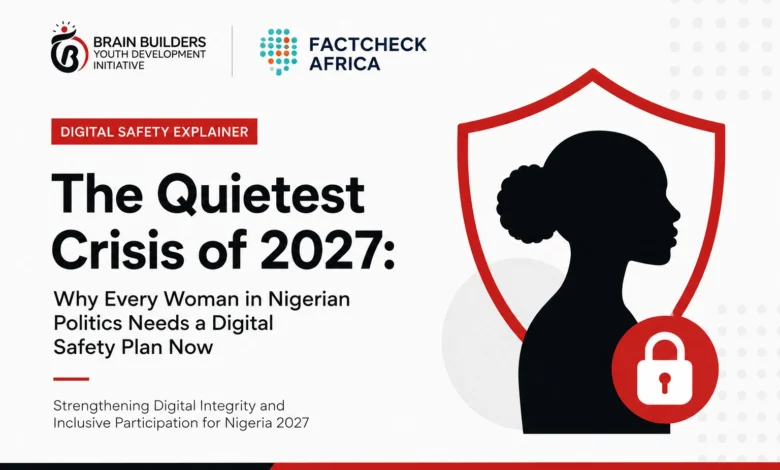
DIGITAL SAFETY EXPLAINER | Issue 01 | May 2026
BY: Olasupo Abideen
First in a monthly series on protecting women’s political voices from online gender-based violence and gendered disinformation
BBYDI × FactCheck Africa | Strengthening Digital Integrity and Inclusive Participation for Nigeria 2027 | May 2026
Nigeria’s 2023 general elections produced a paradox that should disturb anyone who cares about democracy.
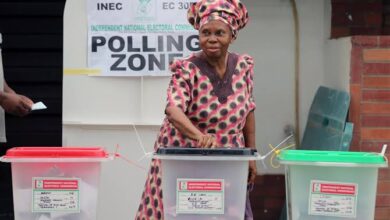
Women made up 47.5% of registered voters. They turned out at parity with men. They campaigned, organised, and stood as candidates across all six geopolitical zones. And then, when the votes were counted, women won fewer than five percent of contested seats. President Tinubu’s first ministerial nominee list included just seven women out of forty-seven names.
There are many reasons women remain locked out of Nigerian political power. But one of those reasons has changed dramatically since the last election cycle — and it will be decisive in 2027. The digital cost of running for office as a woman in Nigeria has risen to a point where many qualified, motivated women now decide it is simply not worth paying.
This is the first article in a monthly series that BBYDI and FactCheck Africa will publish between now and February 2027, as part of the consortium project Strengthening Digital Integrity and Inclusive Participation for Nigeria 2027. Each month we will examine one dimension of the digital threat surface that women in politics face, and what can be done about it. We start, today, with the landscape — so that every reader has a shared picture of what we are dealing with before we dive into the specifics.
What changed between 2023 and 2026
In the 2023 cycle, the dominant pattern of attacks on women in politics looked something like this. A photograph of a woman would surface — sometimes a doctored image, sometimes a misidentified one, sometimes an authentic image stripped of its context. The image would be accompanied by a caption casting the woman as sexually loose, religiously unfit, or culturally inappropriate. Within hours, it would be shared across WhatsApp groups, Facebook pages, and X. By the time fact-checkers caught up, the damage was done.
The clearest 2023 case was the viral photograph of a woman smoking shisha that was misidentified as Abiodun Islamiyat Oyefusi, the running mate to the Labour Party’s gubernatorial candidate in Lagos. Multiple fact-checkers debunked the misidentification within 48 hours. The Labour Party formally refuted it. By then, the post had been shared thousands of times and had become the most-discussed image about her candidacy.
That was 2023. In 2026, three things have changed.
- Generative AI has made the production side of these attacks effectively free. In 2023, the Oyefusi attack required someone to find an image and add a caption. In 2026, the same attacker can generate a photorealistic fabricated image of any woman in seconds, complete with whatever “compromising” context they choose. Fact-checkers have documented Nigerian deepfake content in Hausa, Yoruba, and Pidgin already in 2025, including AI-animated characters mimicking the branding of legitimate institutions.
- Coordination is now industrialised. A 2023 BBC Africa Eye investigation documented Nigerian politicians paying social-media influencers up to ₦20 million ($43,000) to spread coordinated disinformation. The same infrastructure that operates against opposing candidates can be — and increasingly is — turned against women specifically. Coordinated networks targeting a female aspirant can post near-identical content from dozens of accounts within a 60-second window, manufacturing the appearance of organic public consensus that the woman is unfit for office.
- The Liar’s Dividend has arrived in Nigerian politics. Once “AI-generated content” becomes a known category that voters are aware of, every authentic piece of evidence — including, crucially, women’s own testimony about being attacked — can be dismissed as fabricated. Hannah Ajakaiye of FactsMatterNG has documented Nigerian cases of this dynamic in operation, where authentic damaging evidence has been written off by perpetrators as “AI-manipulated.”
Taken together, these three changes mean that in 2026 a determined attacker can produce more convincing fabricated content, push it to a wider audience faster, and erode trust in the woman’s own ability to defend herself. The 2023 playbook has been industrialised. The 2027 playbook will be the result.
Three threats every woman in Nigerian politics should know by name
Public discussion of these issues tends to collapse them into a single category — usually “online abuse” or “trolling.” That language is misleading. The threats women face are distinct, and the defences against them differ. Three categories matter most:
1. Online gender-based violence (OGBV)
OGBV refers to the spectrum of harms enabled by digital technologies that target a person because they are a woman. It includes harassment, stalking, threats of physical and sexual violence, non-consensual intimate image distribution (“revenge pornography”), and impersonation. OGBV is not a new phenomenon — it is the digital extension of pre-existing patterns of misogyny — but the platforms have made it scalable in a way the offline world cannot match.
For women in Nigerian politics, OGBV typically arrives in waves. A single triggering event — a public appearance, a media interview, a critical comment about a male incumbent — produces a coordinated burst of harassment that can last days. The cumulative effect on individual women, and on the broader pool of women considering whether to enter politics, is to make the work feel unaffordable.
2. Gendered disinformation
Gendered disinformation is a specific subset of disinformation in which false information is deployed against a woman, drawing on gender stereotypes to undermine her credibility, fitness for office, or claim to public voice. The Centre for Democracy and Development (CDD-WA) catalogues it as encompassing “sexualised content, sexist and misogynistic content, and the posting of doctored images and videos aimed at ridiculing women based on their gender.”
Unlike OGBV, which targets women as individuals, gendered disinformation operates on the broader narrative environment. It produces stories that take on a life of their own — circulating beyond the original target, shaping the way voters think about female candidates in general, and entering political discourse as if it were ordinary news.
3. Doxxing and coordinated identification
Doxxing — the public release of private information about a person, particularly their home address, family details, or personal contacts — has become a standard tactic in attacks on Nigerian women in politics. The information may be genuine (compiled from public records and social media archaeology) or fabricated (constructed by hostile actors). In either case, the effect is to remove a woman’s sense of physical safety, to expose her family to risk, and to chill her willingness to remain publicly active.
Doxxing is particularly dangerous in Nigeria’s current security environment. A woman whose home address is published alongside accusations of religious or ethnic disloyalty is materially safer if she stops campaigning.
| The asymmetry that defines the threat Production-side AI has caught up with Nigerian indigenous languages. Detection-side AI has not. Generative tools can now produce fluent, persuasive Hausa, Yoruba, and Igbo content at near-zero cost, but the content-moderation systems on the platforms where this content circulates cannot reliably detect harm in those same languages. For a woman in politics whose name circulates in Hausa, Yoruba, or Igbo, this means the attack landscape is essentially unmoderated. |
What this series will do
Between now and February 2027, this series will publish one explainer article each month — accompanied by one high-impact video on the same theme. Each article will take a single specific question and give you a practical, actionable answer. Topics we plan to cover include:
- Account hardening for political aspirants: the five settings every female aspirant should change before the campaign begins;
- Recognising and documenting gendered disinformation, so that what is done to you cannot be quietly erased;
- VPNs, encrypted messaging, and what they actually protect against;
- What to do in the first 24 hours when an attack lands;
- How to use platform reporting mechanisms — and what to do when they fail;
- Working with fact-checkers, civil society organisations, and law enforcement;
- The Liar’s Dividend defence: how to preserve the integrity of your own testimony;
- Building your circle of support before you need it.
The series accompanies the consortium’s Digital Safety Toolkit — a comprehensive, free reference guide we have produced for female political aspirants, activists, and journalists in Nigeria. The toolkit is being distributed without charge across the six project hotspot states and is available on request to any woman in Nigerian politics or civil society who needs it.
One thing to do this month
Every article in this series will end with one concrete action that takes less than fifteen minutes. For May, that action is the simplest and most consequential single step a woman in Nigerian politics can take:
| Audit what is already publicly visible about you Open a private browsing window and search your full name in English. Repeat in any indigenous language you commonly operate in. Note what comes up: which images are at the top of the results; which social-media profiles are surfaced; which old posts, articles, or affiliations appear; whether your home location, family members, or workplace are publicly findable. This is the public dossier any attacker would start from. You cannot defend what you have not yet seen. |
Many women are surprised by what this search reveals — old social media accounts they had forgotten about, archived professional bios with home town information, family photographs uploaded by relatives. Most of it cannot be removed, but knowing it is there changes the threat picture from invisible to manageable. Next month’s article will walk through exactly what to do with what you find.
Where to get help today
If you are a woman in Nigerian politics or civil society and you are currently experiencing online attacks, or anticipate them, the following organisations can help. None of these resources require you to be already “famous” — they exist to serve women who need them, including women at the earliest stages of political work.
- Brain Builders Youth Development Initiative (BBYDI) — brainbuilderedu@gmail.com — for direct project enquiries, including access to the Digital Safety Toolkit and referrals to the consortium’s other resources.
- FactCheck Africa — for verification of attacks against you and support documenting gendered disinformation.
- Centre for Democracy and Development (CDD-West Africa) — for documentation, research support, and advocacy on gendered information disorder.
- FIDA Nigeria (Federation of International Women Lawyers) — for legal advice on harassment, doxxing, and threats of violence.
- NAWOJ (National Association of Women Journalists) — for media-defence support if you are a journalist or politically active communicator.
- Nigeria Police Force Cybercrime Unit — for criminal complaints relating to threats and impersonation; we strongly recommend documenting and consulting with civil-society legal partners before filing.
| Coming in June Next month’s article walks through the five account settings every woman in Nigerian politics should change before the formal campaign window opens — with platform-specific instructions for Facebook, X, Instagram, and WhatsApp. The series builds month by month into a complete defence playbook for 2027. |
This explainer is part of the Strengthening Digital Integrity and Inclusive Participation for Nigeria 2027 project, implemented by Brain Builders Youth Development Initiative (BBYDI) and FactCheck Africa, with the support of the Digital Democracy Initiative (DDI) and CIVICUS. The series is distributed under a Creative Commons Attribution-NonCommercial 4.0 licence — please share, translate, and adapt, with credit.
For questions, contributions, or to receive the series directly by email each month, write to brainbuilderedu@gmail.com with the subject line “Digital Safety Series Subscription.”