FACT-CHECK: Did Imo State Emerge as Nigeria’s 4th Largest Economy Under Governor Hope Uzodimma?

BY: Chukwuemeka Paschal
Claim: A recent press statement issued by the Chief Press Secretary (CPS) and widely circulated across media platforms asserts that Imo State, under Governor Hope Uzodimma, has emerged as the 4th largest economy in Nigeria, citing data from BudgIT. The statement lists Imo’s GDP at N7.68 trillion, behind Lagos (N41.17 trillion), Rivers (N7.96 trillion), and Akwa Ibom (N7.77 trillion), while placing it ahead of Delta and Anambra.
Verdict:
MISLEADING.
Full Text:
A recent press statement issued by Oguwike Nwachuku, Chief Press Secretary (CPS) and Media Adviser to the Governor of Imo State, Senator Hope Uzodimma, asserts that Imo State, under Governor Hope Uzodimma, has emerged as the 4th largest economy in Nigeria.
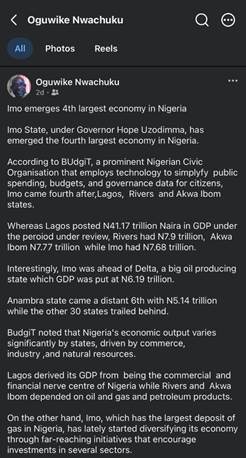
The claim has been widely circulated on social media, especially on Meta platforms like Facebook, following posts by state government representatives and political aides, including social media updates from Ambrose Nwaogwugwu, Senior Special Assistant to the Governor on Electronic and Creative Media (https://www.facebook.com/share/p/1FLGY7CESV/?mibextid=wwXIfr), and Oguwike Nwachuku, who shared the official release across their handles.
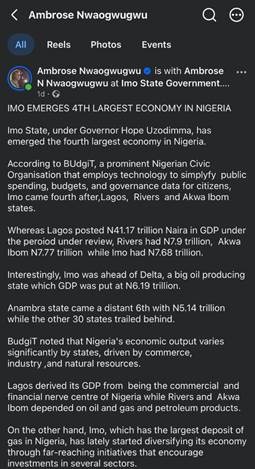
The release directly attributes this ranking to civic tech organization BudgIT and connects the performance to recent economic governance policies under Governor Hope Uzodimma. According to the statement, Imo State recorded a Gross Domestic Product (GDP) of N7.68 trillion, outpacing major oil-producing states like Delta State (N6.19 trillion) and Anambra State (N5.14 trillion). The statement further attributes this growth to recent state-led economic summits and investments attracted to the banking and energy sectors over the last two years.
Given the public interest in subnational economic governance, FactCheckAfrica investigated the origin and accuracy of these figures.
Verification:
FactCheckAfrica findings show that while the numerical figures quoted in the press release are authentic, the context and timeline presented are misleading.
Data Origin and Timeline
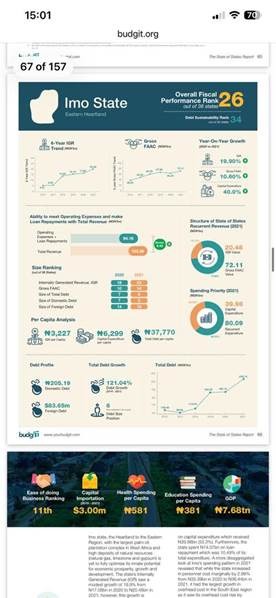
The GDP figures referenced in the statement including Lagos at N41.17 trillion, Rivers at N7.96 trillion, Akwa Ibom at N7.77 trillion, and Imo at N7.68 trillion were published in BudgIT’s 2022 State of States report. That report relied on baseline subnational GDP estimates calculated around 2021.
BudgIT has not issued any new subnational GDP ranking declaring Imo State as the 4th largest economy today. Presenting multi-year-old baseline figures as a recent economic achievement creates a false impression that a new comparative study was recently conducted.
Official Clarification from BudgIT
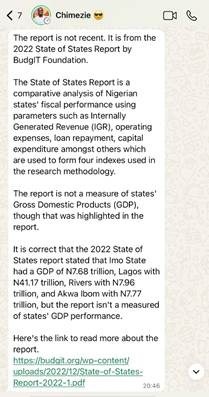
When contacted, Chimezie Ebosie, the Imo State Officer for BudgIT, clarified that the figures circulating are neither current nor designed to rank subnational GDP performance.
“The report is not recent. It is from the 2022 State of States Report by BudgIT Foundation,” Ebosie stated.
He explained that the core focus of the study is not state-by-state economic size. “The State of States Report is a comparative analysis of Nigerian states’ fiscal performance using parameters such as Internally Generated Revenue (IGR), operating expenses, loan repayment, capital expenditure amongst others which are used to form four indexes used in the research methodology. The report is not a measure of states’ Gross Domestic Products (GDP), though that was highlighted in the report.”
Confirming the numbers quoted, Ebosie added, “It is correct that the 2022 State of States report stated that Imo State had a GDP of N7.68 trillion, Lagos with N41.17 trillion, Rivers with N7.96 trillion, and Akwa Ibom with N7.77 trillion, but the report isn’t a measure of states’ GDP performance.”
Cause and Effect Misattribution
Subnational GDP represents the total economic output within a geographic area over a long period. It is largely dictated by structural factors such as natural resources, geography, and historical commerce hubs. Imo State’s position in historical GDP estimates is primarily anchored in its massive natural gas deposits and commercial activity.
Linking a static GDP figure calculated years ago directly to recent policy events, such as recent economic summits or short-term state initiatives, presents a timeline contradiction. Events occurring after data collection cannot retroactively drive historical figures.
GDP vs. Fiscal Performance
BudgIT’s primary annual index, the State of States report, focuses on fiscal sustainability, measuring indicators such as Internally Generated Revenue (IGR) growth, debt burdens, and dependence on Federal Allocations (FAAC).
In BudgIT’s annual fiscal sustainability rankings, Imo State routinely ranks significantly lower than 4th position due to its reliance on federal transfers and ongoing challenges with local revenue generation relative to its expenditure needs. Readers interested in examining the methodology and full data metrics directly can access the complete https://budgit.org/wp-content/uploads/2022/12/State-of-States-Report-2022-1.pdf.
Conclusion:
The claim that Imo State recently emerged as Nigeria’s 4th largest economy under Governor Hope Uzodimma based on new BudgIT data is MISLEADING.
Although the N7.68 trillion GDP figure was indeed published by BudgIT in 2022, it reflects older baseline structural data rather than a new comparative ranking. Presenting these historical figures alongside recent policy events misrepresents both the timeline and the underlying economic cause.
While Imo State possesses massive natural potential particularly through its natural gas deposits, attributing past baseline structural estimates to recent policy wins blurs the line between economic facts and strategic public relations.