FACT-CHECK: Graphic Misleads on Buhari and Tinubu’s Petrol Prices, Debt Figures and Time in Office

BY: Abayomi Abdulwaliyy Jolayemi
Claim:
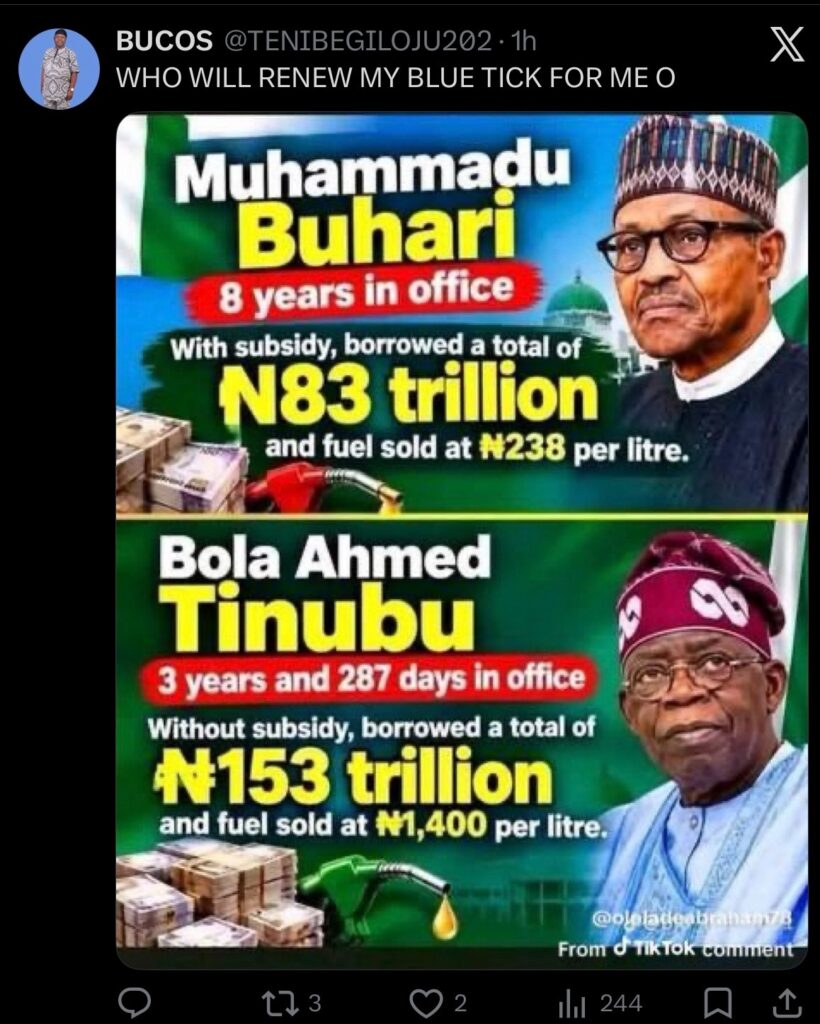
A graphic shared on X by @tenibegiloju202 compares the administrations of former President Muhammadu Buhari and President Bola Tinubu, claiming that petrol sold for ₦238 per litre and Nigeria’s debt stood at ₦83 trillion under Buhari, compared with ₦1,400 per litre and ₦153 trillion under Tinubu. It also claims Tinubu had spent three years and 287 days in office.
Verdict: Misleading:
Full Text:
A graphic shared on X by @tenibegiloju202 compares the administrations of former President Muhammadu Buhari and President Bola Tinubu using petrol prices, Nigeria’s public debt and the length of their respective tenures.
The graphic lists petrol at ₦238 per litre and public debt at ₦83 trillion under Buhari. For Tinubu, it gives petrol at ₦1,400 per litre and public debt at ₦153 trillion, alongside a claim that he had spent three years and 287 days in office.
FactCheckAfrica examined the figures against official debt statistics, available petrol-price reports and the dates of the presidents’ tenures.
The findings show that although petrol prices have increased substantially under Tinubu and Nigeria’s public debt has risen, the graphic does not provide consistent reference dates or sufficient context for its comparisons. It also gives an incorrect calculation of Tinubu’s time in office.
Verification:
FactCheckAfrica examined the figures against official debt statistics, available petrol-price reports and the dates of the presidents’ tenures.
Claim 1: Petrol sold for ₦238 per litre under Buhari and ₦1,400 under Tinubu
Finding: The comparison lacks sufficient context.
Petrol prices in Nigeria have changed considerably over time, influenced by government pricing policies, the removal of the petrol subsidy, supply conditions and market developments.
Tinubu announced the removal of the petrol subsidy during his inauguration on May 29, 2023. Petrol prices subsequently rose, and prices have continued to vary across locations and filling stations.
Reports published in 2026 have documented petrol prices around ₦1,400 per litre in some parts of Nigeria. However, the graphic does not identify the date or location associated with either the ₦238 or ₦1,400 figure. It also does not establish whether the figures represent official pump prices, prices during scarcity or prices charged by particular retailers.
Without this information, the two figures cannot be treated as a standardised comparison of petrol prices under the two presidents.
The graphic therefore reflects the broader reality of increased petrol prices but does not provide enough evidence to verify the comparison as presented.
Claim 2: Nigeria’s debt was ₦83 trillion under Buhari and ₦153 trillion under Tinubu
Finding: The figures are insufficiently contextualised, and the Tinubu figure is below the latest official debt stock.
According to the Debt Management Office (DMO), Nigeria’s total public debt stood at approximately ₦87.38 trillion as of June 30, 2023, near the end of Buhari’s administration.
The DMO’s latest available figures at the time of this fact-check put Nigeria’s total public debt at ₦166.79 trillion as of June 30, 2026. This comprised approximately ₦91.59 trillion in domestic debt and ₦75.20 trillion in external debt.
The ₦153 trillion figure in the graphic is below this latest published total debt stock. Because the graphic does not specify the date or source of its figure, it is not possible to determine precisely which reporting period it represents.
More importantly, total public debt is not the same as the amount newly borrowed by a president during his administration. Debt stock reflects accumulated obligations, new borrowing, repayments and other changes in the value of outstanding debt. Exchange-rate movements can also increase the naira value of foreign-currency-denominated debt.
The Federal Government has previously disputed claims that the entire increase in public debt represents new borrowing, explaining that exchange-rate depreciation and accounting adjustments contributed to the increase in the reported naira value of debt.
This does not mean that the current administration has undertaken no new borrowing. Rather, it means that the change in total debt stock cannot automatically be equated with the amount borrowed under one president without examining the underlying figures.
The graphic does not explain these distinctions and presents the debt figures without the reporting dates needed for a meaningful comparison.
Claim 3: Tinubu had spent three years and 287 days in office
Finding: Incorrect.
Tinubu was inaugurated as president on May 29, 2023. As of October 15, 2026, he had been in office for three years and 139 days, not three years and 287 days.
The graphic therefore overstates the elapsed time since his inauguration by 148 days.
For comparison, Buhari served two presidential terms from May 29, 2015, to May 29, 2023, completing eight years in office.
Conclusion:
The viral graphic combines a petrol-price comparison without consistent dates or locations, public-debt figures without sufficient context, and an inaccurate calculation of Tinubu’s time in office.
Official figures confirm that Nigeria’s total public debt stood at approximately ₦87.38 trillion in June 2023 and ₦166.79 trillion in June 2026. Petrol prices have also risen substantially since the removal of the subsidy in May 2023. However, these facts do not establish that every figure in the graphic is accurate or that the difference in debt stocks represents only new borrowing undertaken by Tinubu’s administration.
As of October 15, 2026, Tinubu had spent three years and 139 days in office, contrary to the graphic’s claim of three years and 287 days.