By: Oluwaseye Ogunsanya
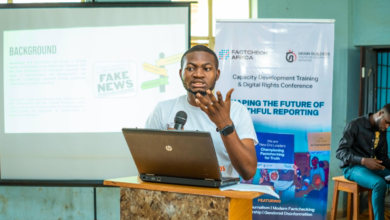
Dr. Rasheed Adebiyi, a senior lecturer at the Department of Mass Communication, Fountain University, Osogbo has emphasized the vital role of AI in combating misinformation while reminding journalists and civic actors that ethical judgment remains indispensable in verification work.
Adebiyi disclosed this at a one-day AI Fundamentals Workshop, which is a part of FactCheckAfrica’s Digital Democracy Lab initiative under the Nigeria Youth Futures Fund (NYFF) Catalyst Grant.
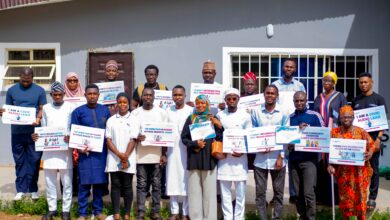
The workshop which held at Osogbo on Thursday brought together and trained hundreds of citizens, youth civic actors, and journalists in Osun State on the fundamentals of Artificial Intelligence (AI) and its use in promoting transparency, accountability, and civic participation.
In his keynote address the academician said the rise of AI has “demystified the Yoruba adage that says ‘Ireje kò sì nínú foto bí ó bá ṣe joko lo ṣe má bá ara rẹ’,” meaning that appearances can deceive, reinforcing the need for verification in today’s fast-paced digital environment.
According to him, fact-checking has never been more important, as the world faces an unprecedented wave of information pollution. “After good health, the next most important thing in life is information,” he said. “It is in the state of anxiety that mischief makers strike. Any attempt to pollute the information ecosystem leads to crisis.”
Tracing the evolution of misinformation, Dr. Adebiyi explained that rumours and propaganda are not new but have become more dangerous due to their speed, scale, and sophistication.
“Social media algorithms reward virality, not accuracy,” he warned. “What we hear at the beginning is rarely what we hear at the end.”
He noted the growing threat of deepfakes, which can convincingly replicate voices and faces in seconds, adding that the same technology used to spread misinformation can also be harnessed to counter it. “We need to be careful, AI is powerful, but it must be handled responsibly.” He said.
Defining AI fact-checking, Dr. Adebiyi described it as the use of machine learning, natural language processing (NLP), and data analysis to identify, flag, and verify questionable information. These tools, according to him, helps detect false claims faster, cross-check textual and visual data, and ultimately “scale truth” in an era of information overload.
However, he emphasized that technology alone is insufficient. “We cannot overlook human ethics and editorial judgment, they remain central to the practice of fact-checking,” he stated.
He outlined several AI use cases in modern verification work, including:
- Reverse image or video verification, to identify outdated or out-of-context visuals spread during crises.
- Social media monitoring, to track the recurrence of old or modified claims.
- Claim detection and text analysis, supported by AI-driven pattern recognition.
- AI text and deepfake analysis, to identify both machine-generated (upstream) and human-generated (downstream) misinformation.
While highlighting AI-powered verification tools, Dr. Adebiyi reminded participants that human discernment remains the first line of defense. “Verification begins with you,” he urged. “Question every viral post. Don’t follow the crowd. Take a second look before you share.”
He concluded by warning that during natural disasters and elections, when people are desperate for information, the urge to pollute the ecosystem often peaks. “AI gives us a fighting chance, but integrity, patience, and verification must guide our every click.” he said.