ANALYSIS: #OsunDecides2026: Where Electoral Pressure is Concentrated Ahead of Saturday’s Vote

BY: Hafiz Rabiu
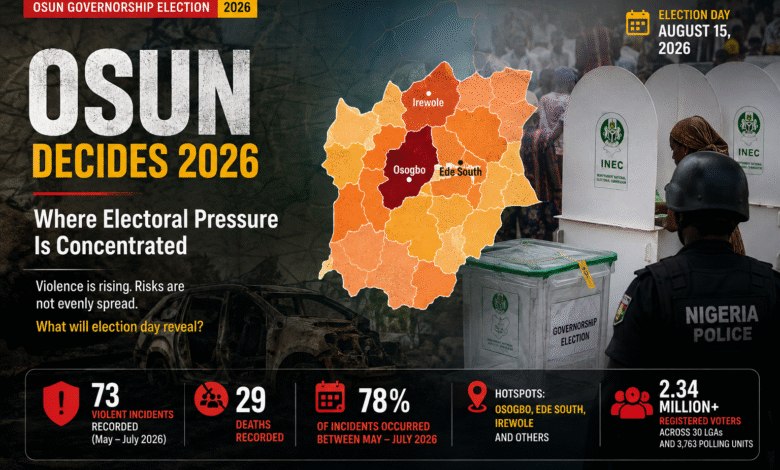
Osun voters decides on Saturday, August 15, 2026, in an election involving over 2.3 million registered voters across 30 local government areas and 3,763 polling units according to the Independent National Electoral Commission INEC.But the security picture ahead of the vote is not evenly distributed across the state.
Available security assessments point instead to a concentration of electoral pressure in particular locations, raising a more specific question ahead of election day. Incidents concentrated around politically significant locations can disrupt voting, intimidate voters and agents, or create tensions around the credibility of results.
The Kimpact Development Initiative (KDI), which has monitored election-related violence in Osun, initially documented 44 election-related violent incidents and 13 deaths between October 2025 and June 2026. Of those incidents, 26 occurred in May and June alone, representing 59.1 per cent of the incidents recorded during that period. The findings were part of KDI’s wider election-security monitoring work.
In its 2026 Osun Election Integrity and Security Assessment: Electoral Pressures, Risk Scenarios and Strategic Mitigation Priorities, KDI reported 73 election-related violent incidents resulting in 29 deaths in the build-up to the August 15 election. The findings were reported by The Guardian’s report on the KDI assessment and subsequently examined in detail by Premium Times’ August 13 analysis.
The latest assessment found that 54 of the 73 incidents, or 78 per cent, occurred between May and July 2026, coinciding with the intensification of political activities and campaigns. KDI described the principal threat not as widespread violence across Osun, but as the convergence of political, criminal, operational, social, coercive and information pressures in a limited number of locations.
Osogbo stands out
Among the locations repeatedly appearing in the available assessments, Osogbo stands out most clearly.
The latest assessment recorded 22 incidents and 15 fatalities in Osogbo, making the state capital the location with the highest concentration of both incidents and deaths in the assessment.
KDI’s assessment described Osogbo’s prominence partly in terms of its political importance and the convergence of several drivers of electoral insecurity there.
This is consistent with an earlier assessment, which also identified Osogbo as the most affected location in its monitoring data. The repeated appearance of the state capital across separate assessments makes it an important location for close election-day monitoring, although it does not establish that violence will occur there on August 15.
The risk extends beyond the state capital
The latest KDI assessment identified Ede South and Osogbo as critical electoral-pressure areas, while placing Ede North, Egbedore, Iwo, Irewole, Ayedaade, Obokun, Oriade, Ilesa East, Ilesa West, Ife North and Olorunda among areas experiencing significant electoral pressure.
A separate assessment by the National Peace Committee, through the Kukah Centre, also identified 15 local government areas across critical, high and moderate-risk categories.
In its Political and Security Context Analysis, presented to stakeholders in July, the Kukah Centre identified Osogbo and Irewole as critical-risk areas, while Iwo, Boripe, Ife Central and Ife East were among the other high-risk LGAs. Punch’s report on the Kukah Centre/National Peace Committee assessment.
KDI’s latest assessment describes the pattern as a form of “political geography” of electoral violence, with incidents concentrated around particular local governments and politically significant locations rather than spread uniformly throughout Osun.
A violent confrontation around a polling location could delay voting. Intimidation could affect whether voters or party agents appear. An attack could disrupt movement around a community. And repeated incidents in a particular area could affect perceptions of whether it is safe to participate.
The participation question
Osun has 2,339,233 registered voters, meaning that the eventual turnout will provide a clear measure of how voters responded to the electoral environment.
The important comparison after Saturday will not simply be the statewide turnout figure. It will be whether areas repeatedly identified as high-pressure locations record markedly different participation patterns from areas where fewer security concerns were documented.
A lower turnout in a high-risk LGA would not automatically prove that violence caused the decline. Logistics, voter mobilisation, weather, political interest, access to polling units and other local factors could also influence turnout.
The security agencies have responded to the concerns with an expanded election operation.
The Nigeria Police Force has announced a major deployment for the election, while authorities have repeatedly emphasised the need to prevent violence and maintain order. The response has also attracted scrutiny from human-rights organisations.
On August 11, 2026, Amnesty International called on Nigerian authorities and security agencies to remain neutral and protect Osun residents’ right to vote freely and fairly, citing concerns about violence, intimidation and alleged interference. Premium Times’ report on Amnesty International’s warning.
Amnesty said its own assessment indicated escalating violence and potential for further clashes in Osogbo, Ede, Ife, Oriade, Ijebu-Ijesha, Ilobu and Ikire.
The overlap between these locations and those identified by KDI and the Kukah Centre is notable, although the organisations use different methodologies and should not be treated as producing a single common risk ranking.
What observers should watch on August 15
The evidence available before the election suggests that monitoring should go beyond simply counting the number of violent incidents recorded. On election day, the more important question will be how these incidents, if they occur, affect the ability of voters to participate and polling officials to conduct the process.
Observers will need to pay close attention to whether voters can reach polling units safely, particularly in locations repeatedly identified in pre-election risk assessments. Any intimidation or threats involving voters and party agents, clashes around polling units, or attempts to disrupt voting and collation will be important indicators of how the security environment is translating into the electoral process. The movement of political thugs or armed groups, the nature and timing of security intervention, and whether security personnel respond impartially will also require close scrutiny.
The same attention should be given to the areas repeatedly identified as electoral pressure points, particularly where incidents have already been documented. Comparing what happens in these locations with voter turnout and the conduct of voting elsewhere in the state could provide useful evidence after the election.
A confrontation at one polling unit should not automatically be described as evidence that an entire LGA is unsafe. Equally, a security claim circulating online should not be entered into an incident count until it has been independently verified.
The latest KDI assessment’s 73 incidents and 29 deaths, including 54 incidents recorded between May and July, the repeated identification of Osogbo and other LGAs in separate risk assessments, and the heightened attention from security and human-rights actors all point to an election requiring close, location-specific monitoring.
Election day
Once voting begins, the question will no longer be simply where risks were predicted to exist. It will be where incidents actually occurred, who was affected, how security agencies responded, and whether voters were able to participate despite the risks.
Those observations, combined with turnout and polling-unit results, will provide the stronger evidence needed to determine whether the security concerns documented before the election actually shaped how Osun voted.