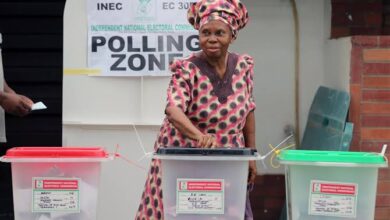
Analysis: Inside Osun’s Information Landscape Ahead of the 2026 Governorship Election

BY: Mustapha Lawal
As Osun State prepares for its off-cycle governorship election on August 15, 2026, the contest is unfolding not only on campaign grounds, radio programmes and political rallies, but also across an increasingly contested information environment.
The election comes at a particularly sensitive moment. Political tensions have risen in the state, security agencies have raised concerns about violence, political actors have traded accusations of rigging and intimidation, and citizens are consuming increasing amounts of election-related information through social media and private messaging platforms.
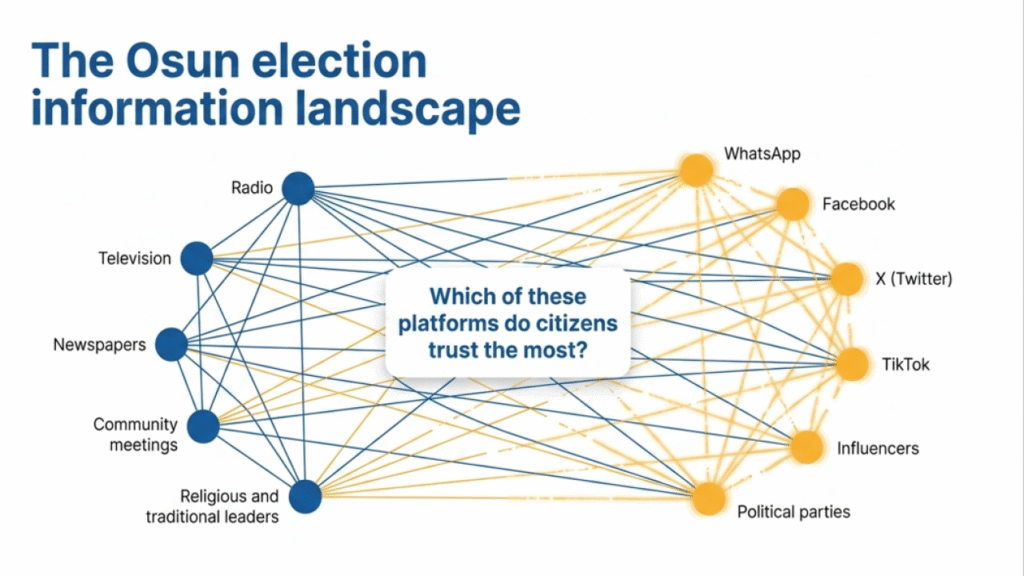
Source: Dr. Rasheed Adebiyi’s presentation at FactCheckAfrica Election Information Integrity in Osun.
This means that the battle for Osun’s votes is also becoming a battle over information: what citizens believe happened, what they believe will happen and, perhaps most importantly, what they believe can happen on election day. As Dr Rasheed Adebiyi, Associate Professor of Mass communication succinctly puts it during the FactCheckAfrica Osun election information integrity stakeholder training in Osogbo last week, the integrity of elections depends not only on ballots but also on the quality of information citizens receive before they vote.
A recent analysis by the Nigerian Democratic Report described information manipulation and interference as a growing threat to the Osun election, noting that political actors and supporters have used online spaces to spread misleading content, weaken opponents, discourage participation and undermine trust in electoral institutions. The challenge, therefore, is not simply to identify obviously fabricated stories. It is to understand how seemingly ordinary political claims, edited videos, recycled photographs, exaggerated security reports and premature allegations can collectively shape the electoral environment.
The information battle has already started
One of the clearest characteristics of the current information environment is that misinformation does not necessarily appear as an obviously false story. It can take the form of an authentic photograph attached to a false claim, an old video presented as a recent incident, a genuine statement stripped of its context, a fabricated press release designed to look official, or a political allegation presented as an established fact.
This distinction matters because election misinformation increasingly operates through context manipulation rather than outright fabrication. For example, in December 2025, the African Democratic Congress was forced to publicly deny claims circulating across WhatsApp, Facebook and X that the party had already selected a particular candidate for the Osun governorship election. The party said the circulating videos and posts were false and insisted that its candidate-selection process had not reached the stage claimed in the viral material.
The incident provides an early indication of how the information environment can become contaminated even before the formal election campaign reaches its peak. The same pattern has continued into 2026, with political actors and government institutions repeatedly responding to competing allegations of “fake news”, rigging threats and misleading claims.
In February, for instance, the Osun State Government described allegations concerning an alleged ₦13 billion payroll fraud as “fake news” while disputing the claims and calling for scrutiny of the underlying audit controversy. In March, the government again accused opposition actors of making statements that it considered threats to rig the election, while the APC disputed the characterization.
These exchanges illustrate an important feature of election misinformation: the information war does not always consist of one side inventing a story and another side correcting it. Sometimes competing political actors produce competing versions of reality, each presenting its own interpretation as fact. For citizens, this makes verification more difficult.
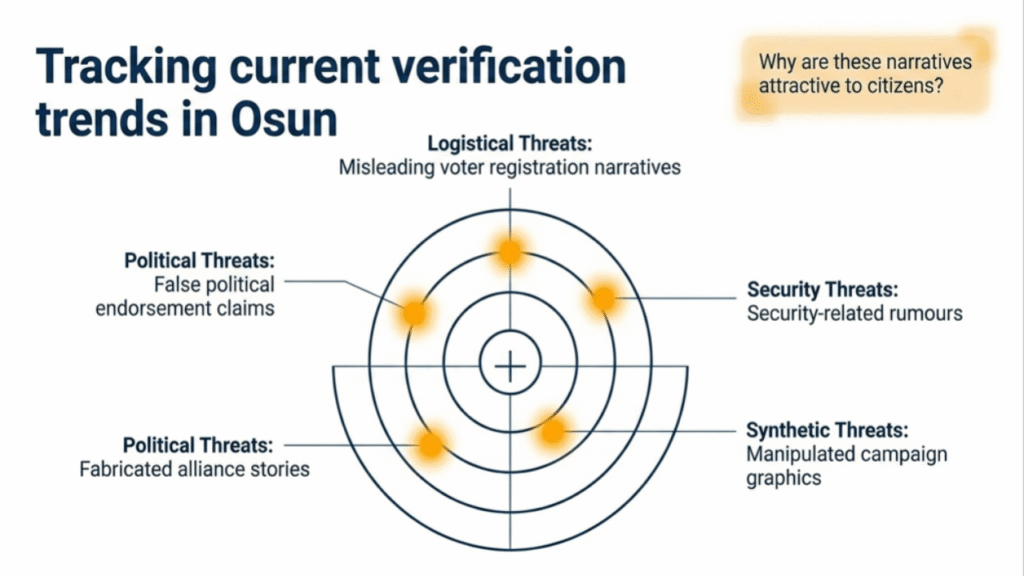
Source: Dr. Rasheed Adebiyi’s presentation at FactCheckAfrica Election Information Integrity in Osun.
The fear of rigging can become a self-fulfilling narrative
Another major vulnerability is the growing circulation of claims about electoral manipulation. Governor Ademola Adeleke has repeatedly urged residents to disregard what he described as rumours, rigging narratives and scaremongering ahead of the election.
But the existence of competing claims about rigging presents a deeper problem. When citizens repeatedly encounter messages saying that the election has already been compromised, some may begin to believe that voting is pointless. Others may interpret ordinary administrative problems as evidence of deliberate manipulation.
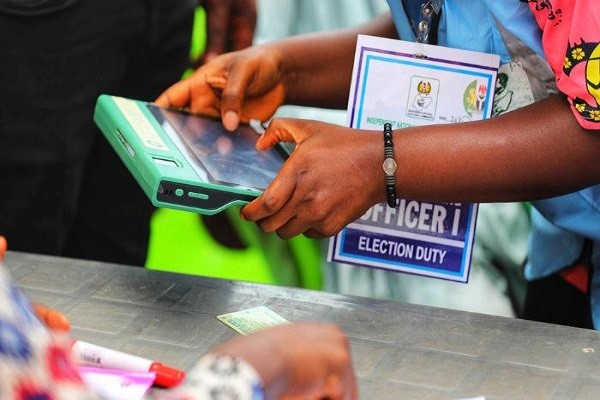
A malfunctioning device, a delayed arrival of electoral materials, a disagreement at a polling unit or a temporary network problem can quickly be presented online as proof that “INEC has rigged the election”. The reverse is equally possible. A genuine irregularity may be dismissed as “fake news” simply because it is politically inconvenient. This is why the information environment around election technology deserves particular attention.
The Bimodal Voter Accreditation System (BVAS) and the INEC Result Viewing Portal (IReV) have become important symbols in Nigeria’s electoral discourse. Their performance can affect public confidence, but so can misinformation about their performance.
A citizen who sees an unverified post claiming that BVAS has “failed everywhere” may make decisions based on an event that never occurred. The appropriate response is not to automatically believe or disbelieve such claims. It is to verify them.
Political violence has also become an information problem
The information environment cannot be separated from the security environment. Reports of politically motivated attacks and killings have generated significant anxiety in Osun ahead of the election. Civil society groups have called attention to rising political violence, while the Inspector-General of Police, Tunji Disu, has publicly warned political actors and residents against violence and stressed that the election should not be treated as a war.
In July, the IGP’s engagement with the Osun government focused specifically on political violence, with the police leadership promising to clamp down on political criminals and their sponsors.
This creates a particularly sensitive environment for information. An unverified claim that “thugs have taken over” a particular community, that an opposition stronghold has been attacked, that security personnel have withdrawn from a polling area, or that violence is imminent can have consequences even when the claim is later disproved.
It can cause voters to stay home; influence the deployment of political party agents; trigger retaliatory mobilisation; create the impression that an area is unsafe when it is not and it can provide justification for political actors to challenge the legitimacy of the election before voting has even taken place. This is why false information about security should be treated as an electoral integrity issue, not merely as a social media problem.
AI has changed the nature of political deception
The 2026 election also arrives at a time when generative artificial intelligence has significantly reduced the technical barriers to creating convincing synthetic content.
A fabricated video no longer necessarily looks like a crude Photoshop job. A politician can be made to appear to say something he or she never said. A fake photograph can place a candidate at an event they never attended. An artificial voice can reproduce a public figure’s speech patterns. A fabricated campaign announcement can be designed to look almost indistinguishable from an authentic political communication.
This creates a particularly dangerous situation during elections because people tend to make decisions based on familiar voices, faces and emotions.
A deepfake claiming that a candidate has withdrawn from the election, endorsed an opponent, insulted a community or admitted electoral wrongdoing could spread rapidly before the affected candidate has an opportunity to respond. And by the time the denial arrives, the damage may already have been done.
The threat is not hypothetical. The Osun information environment has already experienced doctored videos and fabricated political materials. The ADC’s earlier experience with fake videos claiming that the party had selected a governorship candidate demonstrates how easily political branding can be replicated and redistributed online.
The growing use of AI therefore means that citizens can no longer rely solely on visual appearance as evidence of authenticity. Seeing is no longer necessarily believing.
Liar’s Dividend: Context, Interpretations and Evidence
There is, however, another emerging dimension to this problem: the AI liar’s dividend. As synthetic audio, video and images become increasingly difficult to distinguish from authentic material, the existence of deepfakes can create a new form of uncertainty. Political actors may not need to manufacture synthetic evidence themselves; they may simply dismiss genuine recordings as fabricated, manipulated or generated by AI when the material becomes politically inconvenient. The result is a more difficult information environment in which citizens are left questioning not only what is false, but also what can still be trusted as evidence.
The recent controversy involving Senator Francis Fadahunsi illustrates a related credibility problem ahead of the Osun election. On August 10, a video circulated showing the Osun East senator addressing supporters in Ilesa in Yoruba. Premium Times and The ICIR reported that the remarks appeared to amount to a call for supporters to “kill” members of the Accord Party if they encountered them before the election. The remarks prompted political condemnation, including calls for his arrest and investigation, and the police subsequently invited the senator for questioning.
Fadahunsi later disputed that interpretation. Following his appearance before the police, he said he was not calling for violence and that his use of the word “kill” was metaphorical, meaning that APC supporters would defeat the Accord Party with their votes. The Nation reported his explanation, while Punch quoted his media office describing the statement as “purely political and metaphorical”.
The controversy demonstrates how quickly a political statement can acquire competing versions of meaning: the original recording, its translation and interpretation, media reports, political reactions, police intervention and the speaker’s subsequent clarification.
It is important to stress that the Fadahunsi case is not evidence of an AI-generated video. Rather, it demonstrates a credibility problem that becomes increasingly important in an age of synthetic media: even when authentic evidence exists, disagreements over context, language and interpretation can make it difficult for citizens to determine what actually happened.
This is where the broader concern about the liar’s dividend becomes relevant. As Nigerians become increasingly aware that voices and images can be fabricated, political actors may find it easier to cast doubt on genuine recordings when those recordings become damaging. Conversely, citizens may also dismiss legitimate clarifications as attempts at political damage control. In both situations, the information environment becomes more uncertain.
The existence of a viral video, therefore, is not the end of verification; it is the beginning. Journalists and fact-checkers must examine the complete recording, establish when and where it was made, verify the language and context, compare translations where necessary, document the speaker’s response and assess competing claims against available evidence. In an election already marked by concerns about political violence, the inability to establish what a candidate or political actor actually said can itself become a source of tension.
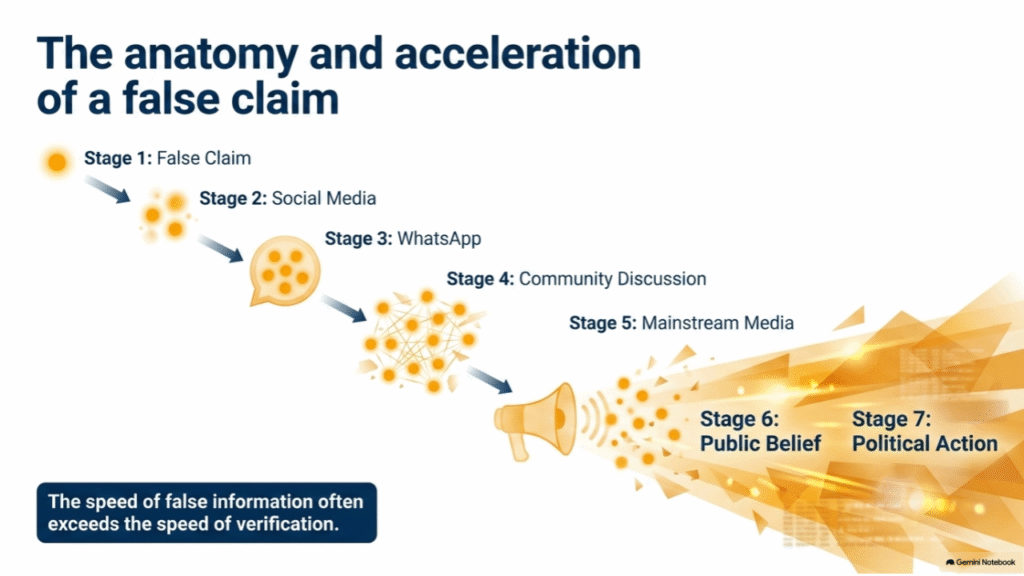
Source: Dr. Rasheed Adebiyi’s presentation at FactCheckAfrica Election Information Integrity in Osun.
WhatsApp remains particularly difficult to monitor
Much of the public conversation about election misinformation focuses on X, TikTok, Facebook and Instagram because these platforms are visible and searchable. But some of the most consequential misinformation may circulate in places researchers and journalists cannot easily observe.
WhatsApp groups provide a powerful distribution network because information travels through existing relationships: family groups, religious associations, neighbourhood groups, alumni networks, political groups and professional communities. A message received from a friend, relative, religious leader or community member may be trusted more readily than an unfamiliar post from a public account. This creates what can be described as a trust advantage for misinformation.
Research on political misinformation in messaging environments has shown that WhatsApp can facilitate the rapid circulation of manipulated images and misleading stories, while the closed nature of many groups makes systematic monitoring and intervention more difficult. For Osun, this means that the most important misinformation story may not necessarily be the one trending on X. It may be the voice note circulating in a ward-level WhatsApp group.
Gendered disinformation deserves attention
The information environment also has a gender dimension. Women participating in politics often face a different category of attacks from their male counterparts. Instead of challenging their policies, competence or records, online narratives can target their appearance, morality, family life, marital status, sexuality or perceived “character”.
Such attacks can be particularly effective because they exploit social expectations about women in public leadership. The danger is that gendered disinformation can make political participation more costly for women even when the underlying claim has no evidentiary basis.
It can also shift public conversation away from policy. Rather than asking what a candidate proposes for Osun’s education sector, health system, economy, security or local government administration, citizens may find themselves debating a fabricated personal scandal. That is not merely a distraction. It can influence who feels safe enough to participate in politics.
The media has a role beyond reporting the misinformation
The response to this environment cannot rest entirely on fact-checking organisations. Newsrooms have an equally important responsibility. A media organisation can unintentionally amplify misinformation simply by reporting that a false claim is trending without adequately explaining its origin, evidence and status. Headlines are particularly important because many people consume news without reading the full article. A misleading headline can therefore give a false narrative a second life, even when the body of the article eventually provides clarification.
This is especially important for election-related allegations involving violence, rigging, ethnic identity, religion and security. Journalists must ask basic but essential questions: Who made the claim? What evidence supports it? Can the claim be independently verified? What does the opposing evidence show? Is the material recent? Has the image or video appeared previously? Is the source identifiable and credible? These were among the issues discussed during the election information integrity training FactCheckAfrica hosted for 70 journalists, newsroom editors and online publishers.
The International Press Centre organised fact-checking and digital-literacy training for INEC officials in Osun, focusing on digital literacy, fact-checking, crisis communication and proactive public information management. The Osun Police Command has also warned that misinformation and disinformation pose threats to the election and highlighted the importance of responsible information management. These interventions are important because information integrity cannot be achieved through censorship. It requires better information, faster verification and greater public resilience.
What citizens should watch for
As August 15 approaches, citizens should be particularly cautious about several categories of information. Claims announcing that a candidate has withdrawn, been disqualified or endorsed another candidate should be checked against official party and INEC communication.
Claims of violence should be verified before being forwarded, particularly where they contain no location, date, identifiable source or evidence. Videos should be checked for their original date and context rather than assumed to be recent simply because they appear alongside current election commentary.
Screenshots of supposed INEC notices, police statements and government directives should be treated cautiously. A logo or official-looking letterhead does not establish authenticity. Audio messages allegedly featuring candidates or public officials deserve particular scrutiny because AI voice cloning makes imitation increasingly accessible.
Most importantly, citizens should distinguish between what someone says happened, what can be independently established to have happened, and what someone predicts will happen. These are three different things.
FactCheckAfrica has established the TruthGuard Election Integrity and Misinformation Situation Room to strengthen monitoring of misinformation, disinformation and other forms of information disorder around the Osun 2026 governorship election. The initiative brings together fact-checking, monitoring and research efforts to identify emerging narratives, verify suspicious claims and provide citizens with reliable information.
Citizens are encouraged to play an active role in protecting the information environment by sharing suspicious claims, messages, images, videos or election-related information they are unsure about with the TruthGuard Situation Room for verification via its WhatsApp hotline: +2348128575778. Rather than forwarding uncertain information, citizens can submit it for verification and help prevent false or misleading claims from spreading during the election period.
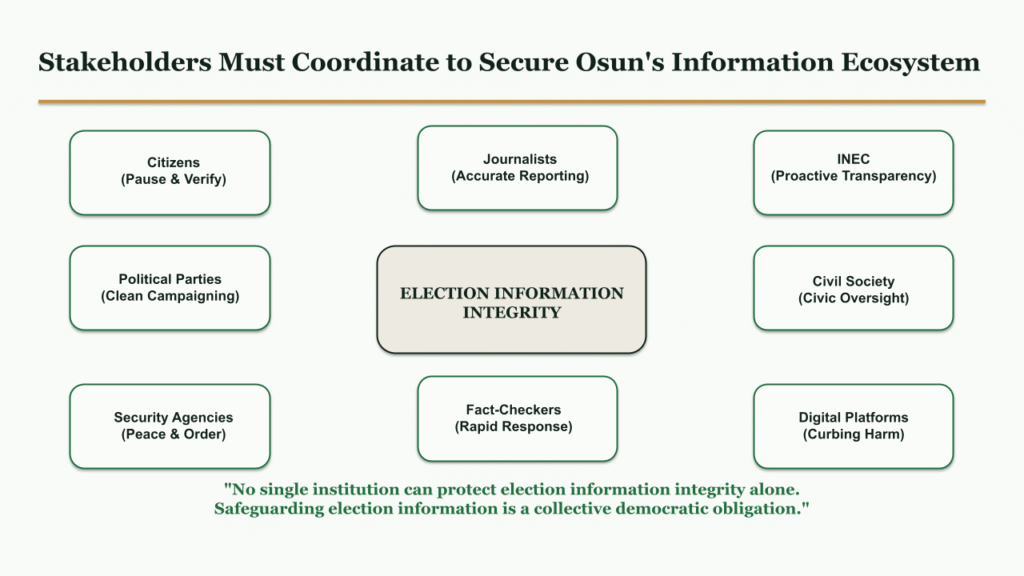
Source: Dr. Rasheed Adebiyi’s presentation at FactCheckAfrica Election Information Integrity in Osun.
The election will also be a test of information resilience
Osun’s August 15 election is more than a contest between political parties and candidates. It is also a test of whether citizens, journalists, institutions and civil society organisations can maintain a shared commitment to evidence in an increasingly polarised information environment.
The state has already seen political violence, competing allegations, fabricated political materials and warnings from authorities about misinformation. At the same time, journalists, civil society organisations, election observers and security agencies are developing mechanisms to respond.
The critical question is whether these mechanisms can move faster than the misinformation they are designed to counter. The most dangerous information environment is not necessarily one where everyone believes false information. It is one where citizens become so uncertain about what is true that they stop believing anything at all.
Dr Rasheed noted this during his session at the FactCheckAfrica training that False information does not need to change every vote. It only needs to create enough doubt. And that is the real stakes of information integrity in Osun. The responsibility therefore extends beyond fact-checkers. Political parties must discipline their supporters. Journalists must verify before amplifying. Institutions must communicate quickly and transparently. Technology platforms must respond to coordinated manipulation. And citizens must resist the pressure to forward information simply because it confirms what they already believe.
As Osun approaches August 15, the most important civic habit may be a simple one: pause before you share. Verify before you believe. And when the evidence is not available, say so.
For an election whose outcome will ultimately be determined by votes, the information citizens rely on to make decisions remains just as important as the ballot itself.